As the Spring Festival, or Chinese New Year, approaches on February 17, festive decor lights up cities and regions across China along with cultural shows and consumer events.
Chang'an Avenue, the main thoroughfare of Beijing, capital of China, is beautifully embellished with eco-friendly lanterns boasting an impressive 90 percent reuse rate, highlighting a commitment to sustainability.
In Baoqing County, in northeast China's Heilongjiang Province, a charming ski town is welcoming Russian tourists from across the border to a vibrant New Year fair, offering them a unique opportunity to immerse themselves in Chinese culture.
Business districts in Guangzhou City, in southern China's Guangdong Province, have adorned their streets with 5,000 lanterns themed with the Year of the Horse. They are showcasing captivating Hanfu performances, celebrating traditional Chinese culture and adding a festive flair to the atmosphere.
Xuan'en City, located in Central China's Hubei province, has established traditional Tujia light displays.
Meanwhile, other places in China including Jiangsu Province and Chongqing Municipality have enhanced the holiday spirit with vibrant folk and flower markets.

Cultural events, shopping fairs, festive decor seen across China as Spring Festival approaches

Cultural events, shopping fairs, festive decor seen across China as Spring Festival approaches
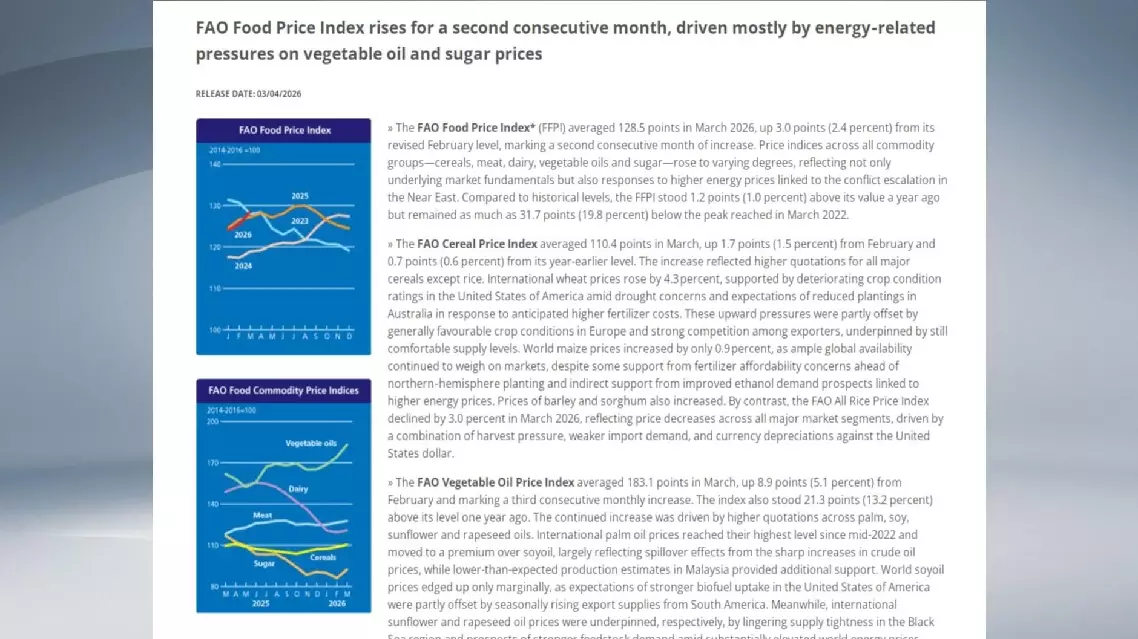
Global food commodity prices climbed for a second consecutive month in March, driven mainly by higher energy costs linked to escalating conflict in the Middle East, the Food and Agriculture Organization of the United Nations (FAO) said in report released on Friday.
The FAO Food Price Index, which tracks monthly changes in the international prices of a basket of globally traded food commodities, averaged 128.5 points in March, up 2.4 percent from February and 1.0 percent above its level a year ago.
According to the report, the FAO Vegetable Oil Index and Sugar Price Index showed the largest increases, up 5.1 percent and 7.2 percent, respectively.
The FAO Cereal Price Index increased by 1.5 percent from the previous month, driven primarily by higher world wheat prices, which rose 4.3 percent.
The FAO Meat Price Index rose by 1.0 percent from the previous month, and the FAO All-Rice Price Index declined by 3.0 percent in March, according to the report.
FAO stated that rising energy and fertilizer prices have been driving up agricultural input costs.
If the conflict stretches beyond 40 days, farmers will have to choose to farm the same with fewer inputs, plant less, or switch to less intensive fertilizer crops, according to FAO Chief Economist Maximo Torero.
These choices will hit future yields and shape food supply and commodity prices for the rest of this year and beyond, Torero said.
Global food prices rise for 2nd consecutive month in March amid Middle East conflict: FAO