Peruvian agricultural products are enjoying increasing popularity thanks to the trade agreement between China and Peru, especially Peruvian blueberries that have sprung up on Chinese people's dining tables with the arrival of November, the harvesting season of the fruit.
Official data from Peru show that over the 14 years since the free trade agreement came into effect in 2010, Peru's agricultural product exports to China increased 18 times.
After some 50 days of shipping, a batch of 7,800 boxes of Peruvian blueberries have recently arrived in Shanghai.
After boxing at local factories, these fruits will be distributed across China.
At a local supermarket in Shanghai, consumers and sellers have expressed their unabashed love for these fruits.
"We buy it about once every two or three days. The kids and the elderly at home all like to eat it," said a customer at the market.
"My wife and I each eat at least one box of blueberries every day," said another shopper.
"We sell different types of blueberries in different times. November is a very good season for Peruvian blueberries, and our sales are pretty good. We can sell over 20,000 boxes every day," said Zhang Lingli, fruit purchasing director of RT-Mart.
Luis Miguel Baanante Cerdena, a Peruvian fruit exporter, was dispatched from his company Camposol, the largest importer and exporter of fruits and vegetables in Peru, to Shanghai in 2017 to expand its presence in the Chinese market. Now his company exports thousands of tons of fruits every year to China.
"Blueberry is one category. It's the biggest category, but there are also important fruits like avocados and grapes, and we also do mangoes from Peru," said Luis Miguel Baanante Cerdena, general manager of Camposol.
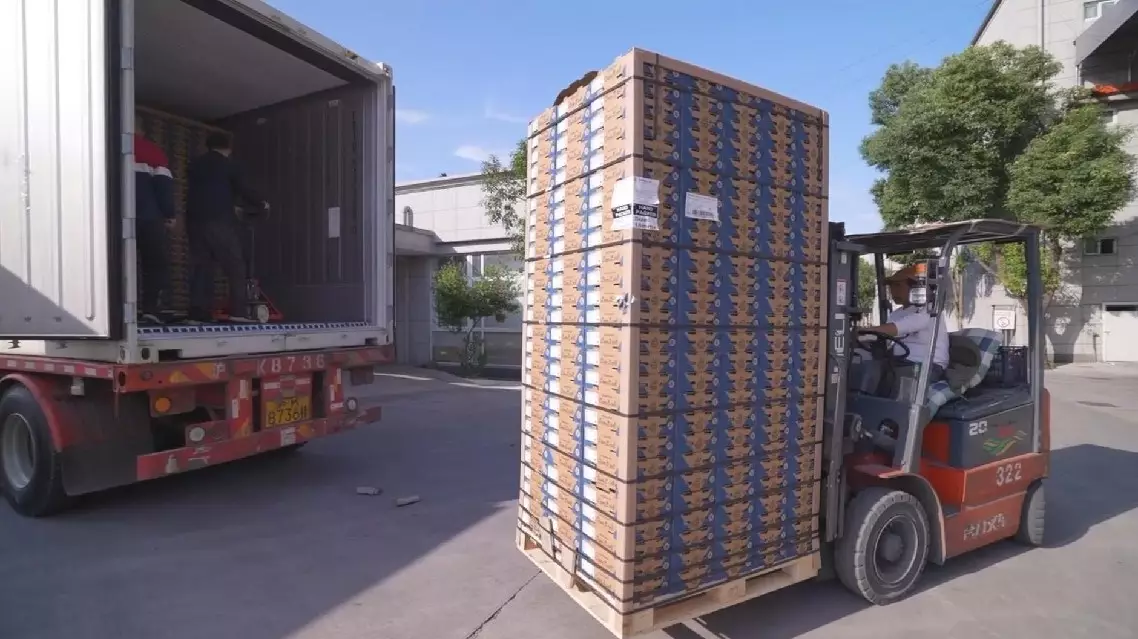
Peruvian blueberries enjoy surging popularity on Chinese dining tables

Chinese Premier Li Qiang on Friday presided over a State Council executive meeting which studied further arrangements on energy conservation and carbon reduction, and heard a report on a special campaign on business-related administrative law enforcement.
The meeting also reviewed and approved a draft regulation on administrative law enforcement oversight, discussed a draft law on firefighters, and arranged work for a crackdown on tobacco-related illegal activities.
The meeting emphasized the need to ensure higher-standard and better-quality work in the fields of energy conservation and carbon reduction -- work which must be advanced with greater overall planning efforts and in light of local conditions.
To that end, the meeting called for efforts to maximize the impact of policies, continuously improve market mechanisms, and accelerate the transition to green production and green lifestyles.
A special campaign on regulating business-related administrative law enforcement this year has achieved positive results, the meeting noted, underlining further efforts to enhance the standardization of administrative law enforcement.
By drafting and implementing the regulation on administrative law enforcement oversight, the boundaries and responsibilities of law enforcement authorities will be clarified further, and administrative power will be upheld consistently within a legal framework, it said.
It discussed and approved in principle a draft law on firefighters, which will be submitted to the Standing Committee of the National People's Congress for deliberation.
It is imperative that the institutional arrangements for the country's firefighting force are improved, making it more standardized and professional, the meeting said, stressing the need to consolidate fire safety management, and to resolutely prevent and curb serious or major fire accidents.
Work will also be done to crack down strictly on tobacco-related illegal activities, strengthen supervision and law enforcement across all links, and improve the tobacco market environment, according to the meeting.
Chinese premier chairs meeting on carbon reduction, administrative law enforcement