The widespread adoption of new technologies and devices such as drones, driverless vehicles, and automated sorting systems is transforming logistics in China, improving service efficiency and quality.
China's e-commerce logistics index, which measures logistics operations within the e-commerce sector, rose to 115 points in October, an increase of 0.6 points from September, according to the data released Monday by the China Federation of Logistics and Purchasing (CFLP).
The sub-index tracking efficiency and fulfillment rates registered an increase of 0.1 and 0.4 points respectively from last month, marking three consecutive months of gains.
Much of this progress can be traced to the growing use of unmanned sorting and delivery technologies.
For instance, a total of 20 driverless delivery vehicles are actively in service at a logistics hub of a newly operational smart logistics park in Changzhou City of east China's Jiangsu Province.
Small yet technologically advanced, these vehicles cover a radius of five kilometers around the hub, reaching nearby parcel stations.
"These vehicles are equipped with two LiDAR sensors, 12 cameras, and have a detection range of 120 meters, making them highly smart and safe," said Feng Yu, head of the Longcheng logistics hub at the SF Express Fengtai Industrial Park in the city.
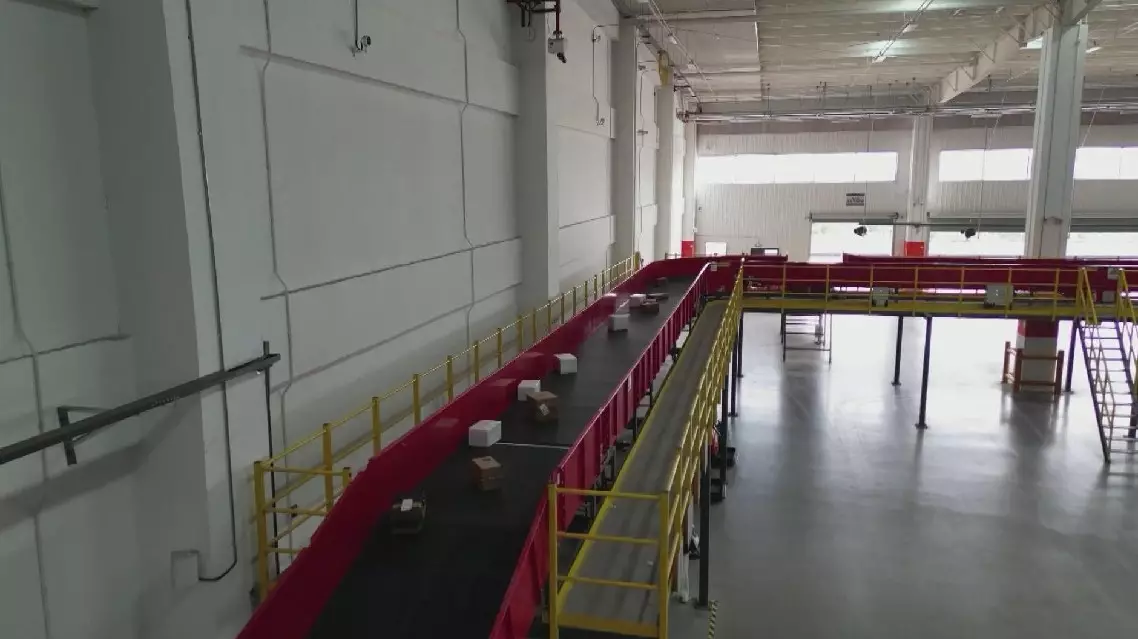
Beyond driverless vehicles, high-speed sorting systems are revolutionizing the distribution process. Crisscrossing conveyor belts can automatically direct packages by scanning delivery orders, enhancing accuracy and speed.
"We've boosted our parcel processing capacity from 3,600 items per hour on manual sorting lines to 6,300 items," said Zhang Jian, senior automation engineer at the Longcheng logistics hub. Technological advancements are also enhancing last-mile delivery. Drones, for instance, are now used to improve parcel delivery efficiency in remote regions.
In Longquan City of east China's Zhejiang Province, a new program combining drones with traditional delivery networks has been launched, significantly cutting delivery time for rural residents.
"Our existing delivery network remains in place, and with the addition of drones, delivery frequency has increased to five times per week, significantly improving the speed of rural deliveries," said Zhou Yumiao, director of Longquan's transportation development center.
Unmanned sorting, delivery boost efficiency in China's logistics sector
International guests who have dedicated their lives to historical truth joined China's 12th national memorial event honoring the hundreds of thousands of victims killed by Japanese troops in the Nanjing Massacre during World War II.
The memorial was held on Saturday at the public square of the Memorial Hall of the Victims in Nanjing Massacre by Japanese Invaders in Nanjing, capital of east China's Jiangsu Province. China's national flag was flown at half-mast in the presence the crowd that included survivors of the massacre, local students, and international guests.
In one of the most barbaric episodes during WWII, the Nanjing Massacre took place when Japanese troops captured the then-Chinese capital Nanjing on Dec 13, 1937. Over the course of six weeks, they proceeded to kill approximately 300,000 Chinese civilians and unarmed soldiers.
Joining the crowd was Christoph Reinhardt, the great-grandson of John Rabe (1882-1950) who was then a representative of German conglomerate Siemens in the war-ravaged Nanjing. During the Nanjing Massacre, Rabe set up an international safety zone with other foreigners, and they together saved the lives of around 250,000 Chinese people between 1937 and 1938 from the Japanese invaders.
Throughout the massacre, Rabe continued to keep a diary. To this day, all his pages remain one of the most comprehensive historical records of the atrocities committed by the Japanese aggressors.
Sayoko Yamauchi, who was also in the crowd of mourners, arrived in Nanjing on Friday from Japan's Osaka to attend Saturday's ceremony, just as she has done almost every year since China designated Dec 13 as the National Memorial Day for the Victims of the Nanjing Massacre in 2014.
Yamauchi's grandfather was one of the Japanese soldiers who invaded Nanjing in January 1938. However, since first setting foot in Nanjing in 1987, she has dedicated herself to uncovering and spreading the truth about Japan's history of aggression and enlightening the Japanese public about their country's wartime atrocities.
In 2014, ahead of China's first National Memorial Day for the Victims of the Nanjing Massacre, Yamauchi, along with 10 other individuals, received an award for her special contribution to the Memorial Hall of the Victims in the Nanjing Massacre by Japanese Invaders.
By attending the grand memorial event, Reinhardt and Yamauchi both said they hope to convey a message of remembering history and cherishing peace.
"This is my fifth visit to China, and Nanjing, and the third times I visited the ceremony. I have a wish that these survivors survive again and again and again. But my other wish is that the families of the survivors, that they transport the information, the right intention like their ancestors, because anyone must hold a hand (during) this remembering," Reinhardt told China Central Television (CCTV) in an interview before the event began on Saturday.
"Our delegation is on its 20th visit to China, coming to Nanjing to express our heartfelt condolences to those who perished 88 years ago, to remember this history, and to reflect on what we can do for a new future. That's why we are here," Yamauchi told CCTV on board the bus that took her to a local hotel in Nanjing on Friday evening.
Int'l guests call for remembering history at China's national event honoring Nanjing Massacre victims