A formation of three carrier-based J-15 fighter jets of the Chinese People's Liberation Army Navy (PLA Navy) delivered a debut performance as the latest models of the jet series made their inaugural appearance at the 15th China International Aviation and Aerospace Exhibition in south China on Tuesday.
Also known as Airshow China, the country's premier aviation event is running from Tuesday to Sunday in Zhuhai, a coastal city in Guangdong Province, with this also marking the first time the PLA Navy's has appeared at the airshow with its naval-based aircraft.
The formation, consisting of one J-15D and two J-15T fighter jets, flew over the Zhuhai Jinwan Airport, displaying the advanced capabilities of the aircraft with a refueling and landing demonstration.
Though similar in appearance, the three J-15 aircraft serve different functions, and all are fully domestically developed.
The navy also arranged displays of air assault operations by the Z-20J shipborne helicopter and the Z-8C transport helicopter, carrying naval marine units and related equipment.
Additionally, the navy also exhibited the Z-9F shipborne anti-submarine helicopter and Y-8 anti-submarine patrol aircraft, as well as several shipborne weapons systems and maritime rescue and survival equipment, most of which are being publicly unveiled for the first time.
The J-15, also known as "Flying Shark," is an updated version of the fourth-generation carrier-based fighter jet independently developed by China for its navy, which completed its maiden flight back from the Liaoning aircraft carrier back in 2012.
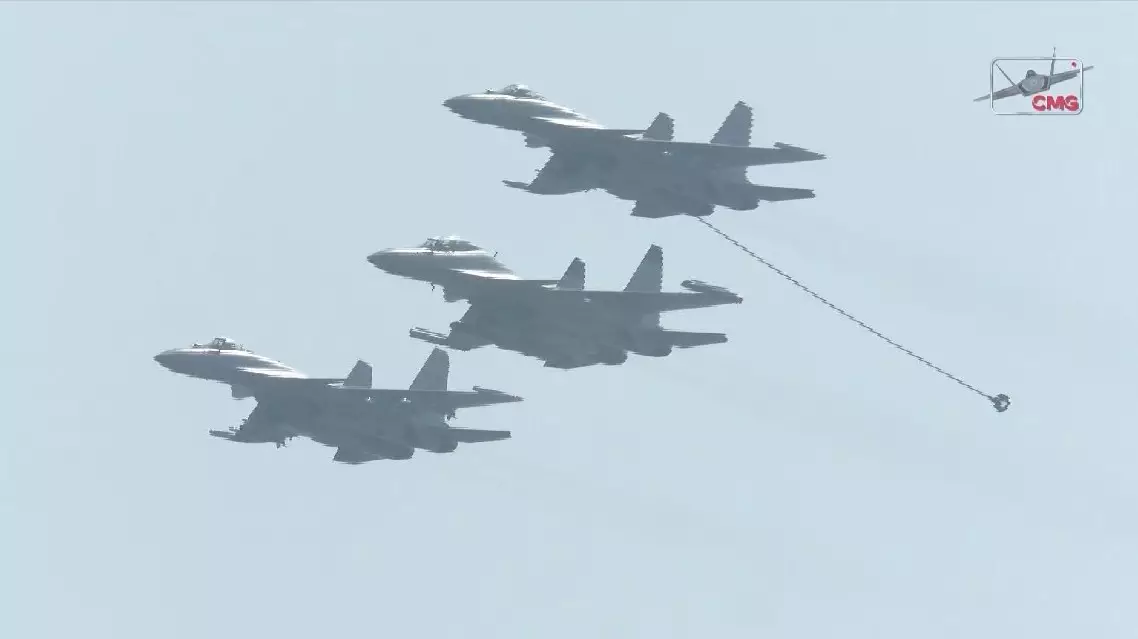
New J-15 fighter jet models perform aerobatic display in debut at Zhuhai airshow
The Iranian Ministry of Foreign Affairs on Friday strongly condemned U.S. attacks on Iranian oil tankers and several locations along the coast of the Strait of Hormuz.
In a statement, the ministry emphasized that Iranian forces are determined to defend the country's territorial integrity, independence, and national sovereignty against any aggression.
It also said the ministry had called on the United Nations Security Council and the UN Secretary-General to uphold international peace and security in accordance with the UN Charter.
Meanwhile, Iranian Foreign Minister Seyed Abbas Araghchi on Friday slammed the U.S. for once again choosing what he called a "reckless military adventure" when "a diplomatic solution is on the table" again.
Writing on social media platform X, Araghchi said Iranians "never bow to pressure" and "diplomacy is always the victim."
He also dismissed the U.S. intelligence assessment, saying Iran's missile inventory and launch capacity were not at 75 percent of their February 28 levels, but had reached 120 percent. Iran's readiness to defend its people, he added, stood at "1,000 percent."
U.S. forces on Friday struck and disabled two more Iranian-flagged empty oil tankers before they entered an Iranian port on the Gulf of Oman amid rising tensions in the Strait of Hormuz, U.S. Central Command (CENTCOM) said.
In a post on X, CENTCOM said it had "enforced blockade measures against two Iranian-flagged empty oil tankers attempting to pull into an Iranian port on the Gulf of Oman."
A U.S. Navy F/A-18 Super Hornet from the USS George H.W. Bush disabled both tankers by firing precision munitions into their smokestacks, the command said.
On Wednesday, U.S. forces disabled another unladen Iranian-flagged oil tanker, the Hasna, as it attempted to sail to an Iranian port on the Gulf of Oman. An F/A-18 Super Hornet from the USS Abraham Lincoln fired several rounds from a 20mm cannon to disable the ship's rudder.
"All three vessels are no longer transiting to Iran," the command said.
CENTCOM commander Brad Cooper said U.S. forces would continue to fully enforce blockade measures against vessels entering and leaving Iran.
There are currently more than 70 oil tankers that U.S. forces are preventing from entering or leaving Iranian ports, CENTCOM said in another post, noting these commercial ships have the capacity to transport over 166 million barrels of Iranian oil worth an estimated 13 billion-plus U.S. dollars.
U.S. and Iranian forces traded fire on Thursday when three U.S. Navy destroyers were transiting out of the Strait of Hormuz.
CENTCOM said it was a "self-defense" action while Tehran accused Washington of violating a ceasefire which took effect on April 8.
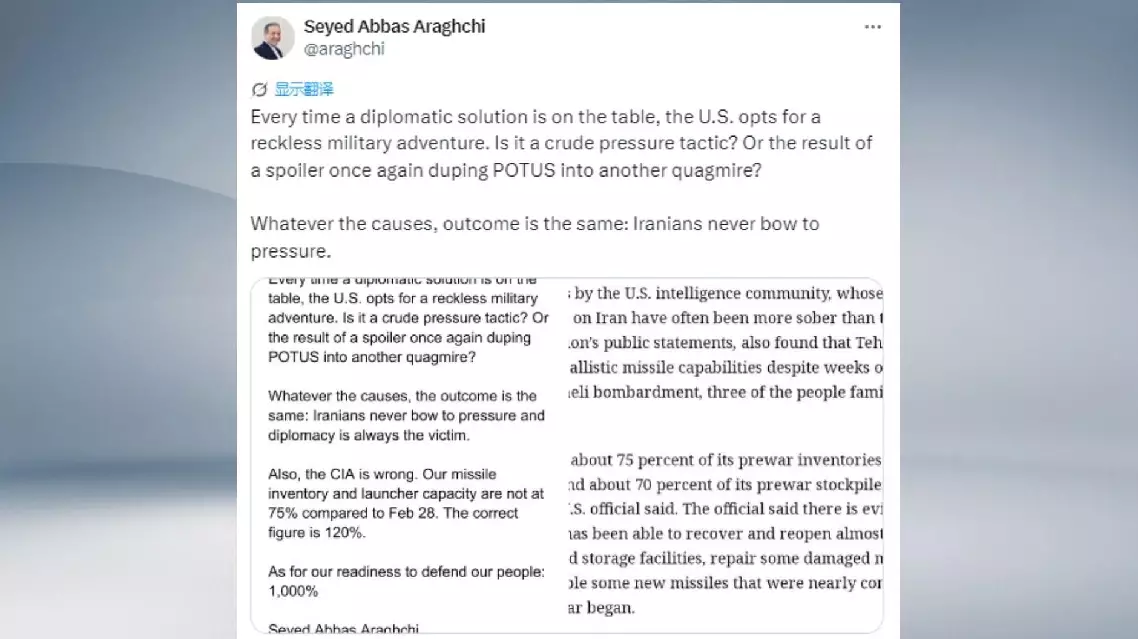
Iran condemns U.S. attacks on tankers