Skip to Content Facebook Feature Image

China's first MW-level offshore PV farm successfully connected to grid

China

China

China

China's first MW-level offshore PV farm successfully connected to grid

2024-11-13 15:13 Last Updated At:17:27

China’s first million-kilowatt level offshore photovoltaic project was successfully connected to the national power grid, according to China Energy on Wednesday.

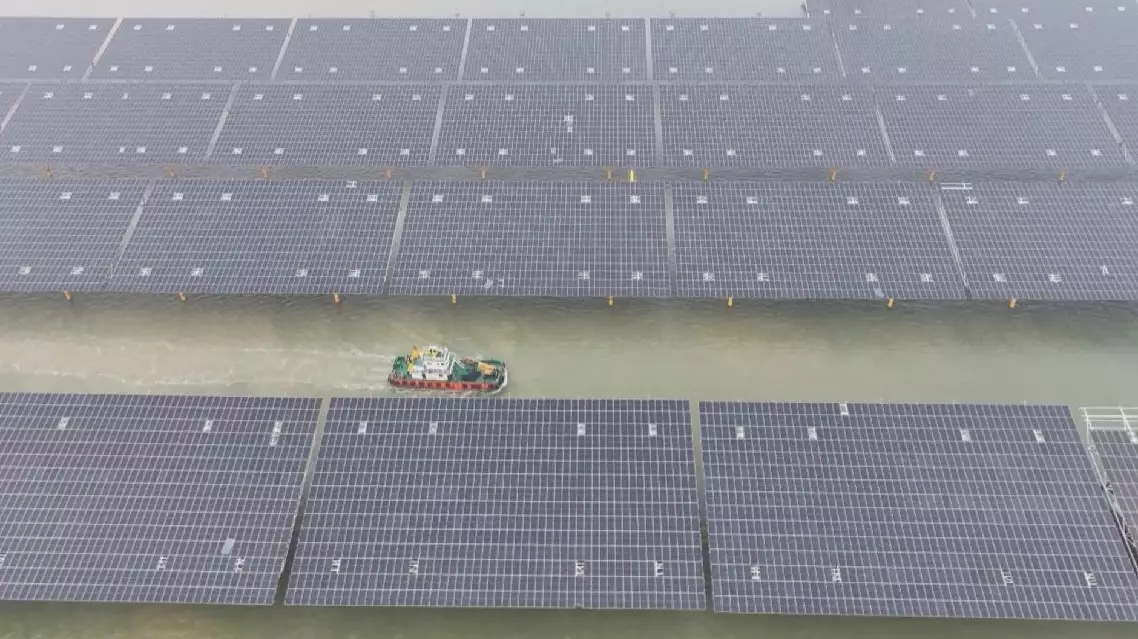
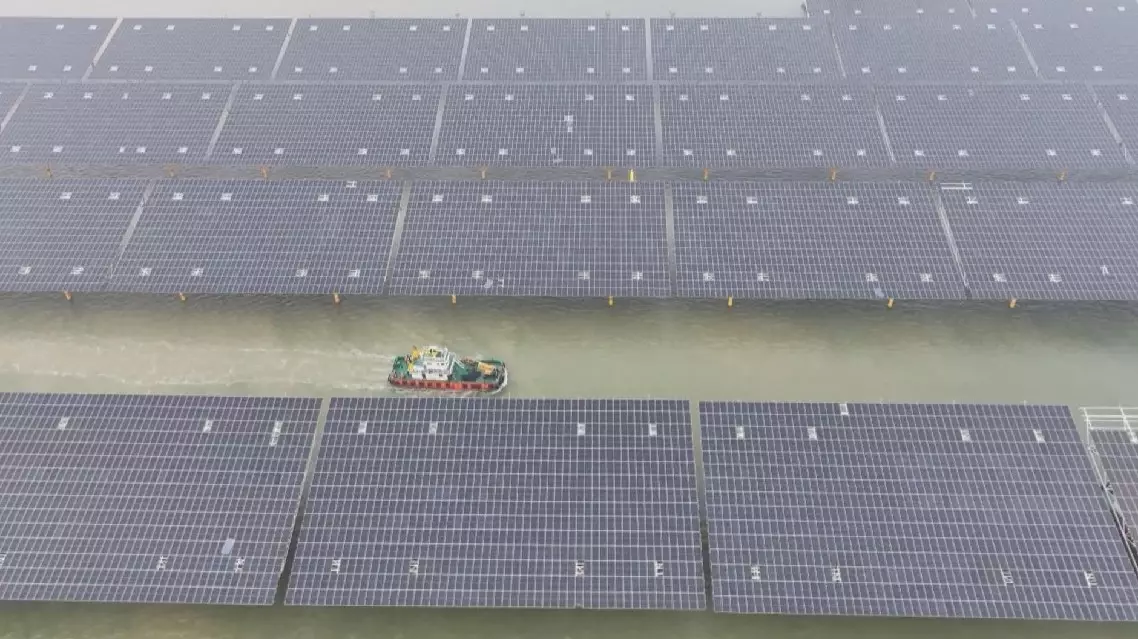
Located in the offshore area eight kilometers from Dongying City of Shandong Province, the one-million-kilowatt offshore photovoltaic project has seen the completion of the first 300 photovoltaic platforms, arranged in five rows extending towards the deep sea. Each platform measures 60 meters in length and 35 meters in width, equivalent to the size of five standard basketball courts. The entire project will require the installation of 2,934 such photovoltaic platforms.

This project is currently the largest open-sea offshore photovoltaic project in China, covering an area of approximately 1,223 hectares. It is the first project to apply 66-kilovolt undersea cables and long-distance land cables to offer greater transmission capacity at lower costs.

"Once fully connected to the grid, the annual power generation is estimated to reach 1.78 billion kilowatt-hours, roughly meeting the annual electricity consumption of 2.67 million urban residents in China, saving approximately 503,800 tons of standard coal and reducing carbon dioxide emissions by 1.347 million tons," said Wang Lin, project manager of Shandong Kenli Project.

In contrast to traditional land-based photovoltaic farms where solar panels are typically assembled on-site, offshore photovoltaic farms require a unique approach. The initial assembly phase for offshore installations begins on land. Here, workers meticulously assemble both the solar panels and their supporting structures before transporting the entire unit to the site using tugboats. Once on location, the solar panels are then carefully lifted and mounted onto four pre-installed steel piles, ensuring the stability and functionality of the offshore photovoltaic array.

While only two meters of the steel piles are above the water surface, approximately 23 meters are submerged below, with 17 meters anchored into the seabed. The piles are coated with a special anti-corrosion primer, ensuring a lifespan of over 30 years. Moreover, the platform can withstand strong winds and sea ice as thick as 25 centimeters.

All the photovoltaic panels in this project face south, with a precisely calibrated tilt angle of 15 degrees. This angle maximizes the panels' exposure to sunlight. These double-sided panels not only capture direct sunlight from above but also utilize light reflected from the sea surface. This design enhances the power generation of each panel by around three percent.
China's first MW-level offshore PV farm successfully connected to grid
China's first MW-level offshore PV farm successfully connected to grid

China's first MW-level offshore PV farm successfully connected to grid

China's first MW-level offshore PV farm successfully connected to grid

The 14th Olympic Summit announced Thursday to support the recommendation of the International Olympic Committee's (IOC) Executive Board (EB) that youth athletes with a Russian or Belarusian passport should no longer be restricted in entering international youth competitions, in both individual and team sports.

The IOC EB meetings, held from Tuesday to Wednesday in Lausanne, Switzerland, recommended to lift restrictions on youth athletes from the two countries in international youth events.

"The Summit supported the IOC EB's recommendation that youth athletes with a Russian or Belarusian passport should no longer be restricted in their access to international youth competitions, in both individual and team sports," announced the IOC in a statement.

The IOC explained the definition of youth competitions and the application of these recommendations for this purpose depends on the regulations of each International Federation (IF).

According to the statement, the standard protocols of the International Federation (IF) or the International Sports Event Organizer regarding flags, anthems, uniforms and other elements should apply.

The above principles should also apply to the Dakar 2026 Youth Olympic Games, and are recommended for adoption by all IFs and international sports event organizers for their own youth events.

The 14th Olympic Summit at Olympic House is a high-level annual meeting of the Olympic Movement, where representatives exchange views on major current issues and provide recommendations to the IOC for its decision-making.

This year's summit agenda included topics such as the Milano Cortina 2026 Olympic Winter Games, the Dakar 2026 Youth Olympic Games, the 2028 Los Angeles Olympic Games, and anti-doping efforts.

The meeting was chaired by IOC President Kirsty Coventry. Gao Zhidan, president of the Chinese Olympic Committee, and Gene Sykes, chair of the U.S. Olympic and Paralympic Committee, were present as representatives of their respective National Olympic Committees.

Additionally, presidents of IFs, including Sebastian Coe, president of World Athletics, and FIFA President Gianni Infantino, were invited to participate in the summit.

IOC recommends unrestricted access for Russian, Belarusian athletes to int'l youth competitions

IOC recommends unrestricted access for Russian, Belarusian athletes to int'l youth competitions

Recommended Articles