The comprehensive display of China's active military hardware at the 15th China International Aviation and Aerospace Exhibition, or the Zhuhai Airshow, has indicated Chinese army's confidence, inclusiveness and openness, according to a military expert.
The airshow takes place in the southern coastal city of Zhuhai from Tuesday to Sunday. Multiple types of Chinese advanced military aircraft, such as the multi-role fighter jet J-10C, the Y-20 large transport aircraft, and the stealth fighter jets J-20 and J-35A, staged stunning flight performances, wowing visitors at the airshow.
These equipment, among others, are also on static display, enabling visitors to observe their exquisite designs and details up close.
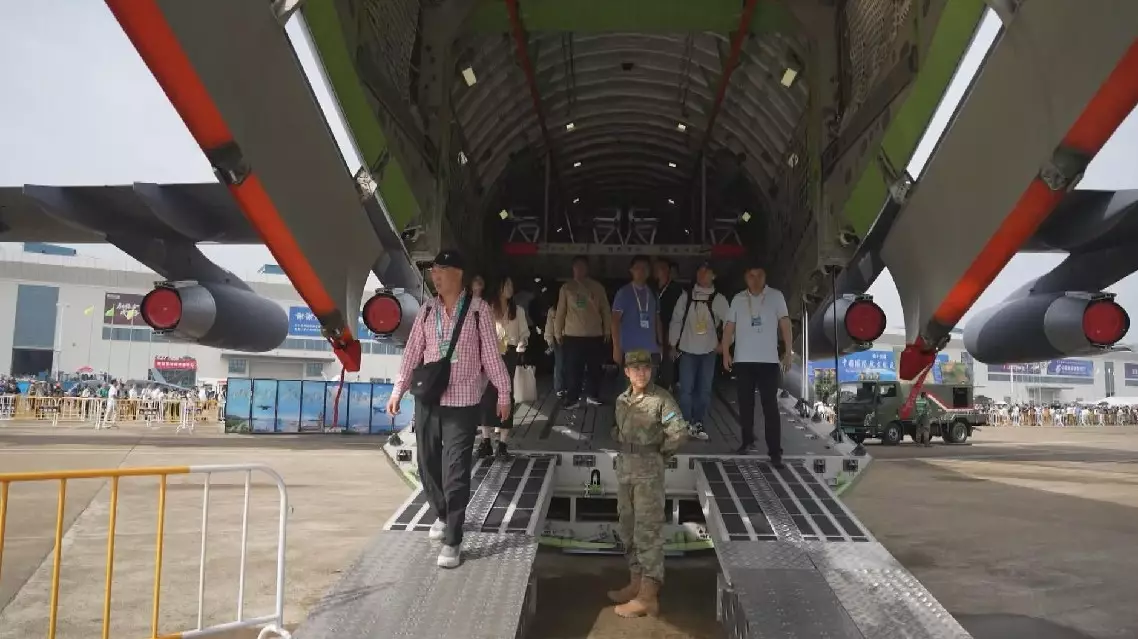
The Y-20 even opened its cargo belly for visitors to have a multi-dimensional view and direct understanding of its projection capabilities.
"[The Chinese People's Liberation Army (PLA) Air Force's] August 1st aerobatics team already replaced its jets with the J-10C aircraft last year, the latest model of the J-10. Many people captured the splendid aerial displays presented by the J-10C, and they feel very proud. The latest progress of the Chinese army in the development of advanced weapons and equipment have left a deep impression on them," said Li Li, a famous military expert in China.
"Meanwhile, the cargo belly of the Y20 is open to visit reservations by ordinary people, so that they can directly feel the strategic projection capabilities of the aircraft. They can know how the airport projects tanks and troops [to combat zones] and how the chairs are arranged inside the cabin. This will help enhance people's understanding the Chinese air force and even mobilize more people to become pilots," she also said.
Covering more than 800,000 square meters, the airshow this year has attracted 1,022 companies from 47 countries and regions to participate.
Comprehensive display of active military hardware indicates China's openness: expert
A video featuring a former member of Unit 731, a notorious Japanese germ-warfare unit during World War II (WWII), was released on Thursday in northeast China's Harbin, revealing details of how the unit used meteorological data to conduct horrific bacterial experiments on human beings.
The video was released by the Exhibition Hall of Evidence of Crimes Committed by Unit 731 of the Japanese Imperial Army, in which former Unit 731 member Tsuruo Nishijima detailed how the unit used meteorological data to carry out a bacterial dispersal experiment.
The video was recorded in 1997 by Japanese scholar Fuyuko Nishisato and donated to the exhibition hall in 2019, according to the hall, which was built on the former site of the headquarters of Unit 731 in Harbin, the capital city of Heilongjiang Province.
Jin Shicheng, director of the Department of Publicity, Education and Exhibition of the exhibition hall, said that Nishijima joined Unit 731 in October 1938 and served in the unit's meteorological squad. The squad was not a simple observation section but rather an auxiliary force supporting the unit's field human experiments by measuring wind direction, wind speed, and other conditions to ensure optimal experimental results, according to Jin.
Nishijima confirmed in the footage that "the meteorological squad had to be present at every field experiment." He testified to the "rainfall experiments" conducted by Unit 731, which involved aircraft releasing bacterial agents at extremely low altitudes.
At a field-testing site in Anda City, Heilongjiang, Unit 731 aircraft descended to about 50 meters above the ground. They sprayed bacterial culture liquids onto "maruta" -- human test subjects -- who were tied to wooden stakes. Each experiment involved about 30 people, spaced roughly 5 meters apart. After the experiments, the victims were loaded into sealed trucks and transported back to the unit, where their symptoms and disease progression were recorded over a period of several days.
"Unit 731's bacterial weapons were dropped by aircraft from a height of 50 meters in the open air. Therefore, the meteorological squad needed to observe wind direction and speed, which directly affected the precision and accuracy of the bacterial weapons deployment," said Jin.
Nishijima recounted the harrowing experience of the human test subjects.
"They were fully aware that inhaling the substances would certainly lead to death, so they closed their eyes and held their breath to avoid breathing them in. Their resistance prevented the experiment from proceeding. To compel them to comply, they were forced at gunpoint to open their mouths and lift their heads," said Nishijima.
These experiments, disguised as "scientific research," were in fact systematic tests of biological warfare weapons conducted by the Japanese military. The data generated from these inhumane activities became "research findings" shared among the Japanese army medical school, the medical community, and the military at large.
"At that time, the entire Japanese medical community tacitly approved, encouraged, and even participated in the criminal acts of Unit 731. The unit comprised members from Japan's medical and academic sectors who served the Japanese war of aggression against China. Thus, Unit 731 was not just a military unit but represented an organized and systematic criminal enterprise operating from the top down," said Jin.
Unit 731 was a top-secret biological and chemical warfare research base established in Harbin as the nerve center for Japanese biological warfare in China and Southeast Asia during WWII.
At least 3,000 people were used for human experiments by Unit 731, and Japan's biological weapons killed more than 300,000 people in China.

Video offers details of Japan's germ-warfare crimes in northeast China