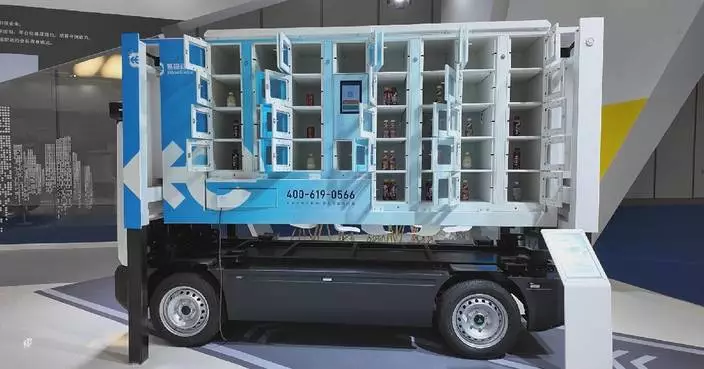
The 26th China Hi-Tech Fair, which ran from Thursday to Saturday in south China's tech hub of Shenzhen, featured the debuts of over 4,300 new products and technologies.
One of the most eye-catching exhibits is an intelligent drone camera that doesn't require a remote control. It can take high-resolution pictures hovering at a certain distance above its owner after a facial recognition process.
"A great merit of the drone is it's portable, safe and convenient. The fully enclosed structure can effectively avoid visual obstacles for its 8K video camera. It is easy for customers to learn how to use the drone. It can fly at a speed up to 42 kilometers per hour. So it can be used during traveling and outdoor activities," said Song Yulong, an exhibitor.
Another highlight at the fair is a coffee robot capable of making latte art based on images uploaded to its system.
Besides daily products, the fair also presented many innovative solutions to production facilitation, such as a large language model that can quickly come up with dozens of design proposals based on a few pictures.
"For example, I upload the pictures of this pair of shoes and an armor, and then it can make a design based on just these two pictures. It can generate a specific and practical product design according to style references and modeling inputs," said Li Jiaxiang, another exhibitor.
The annual China Hi-Tech Fair, inaugurated in 1999, is the largest and the most influential science and technology fair in China.
This year's event attracted nearly 5,000 companies and organizations from over 100 countries and regions. More than 1,000 purchasing delegations around the world visited the fair, and more than 400,000 professional visitors negotiated deals at the fair.
It witnessed the signing of 869 contracts with their intended transaction volume surpassing 120 billion yuan (about 16.8 billion U.S. dollars).
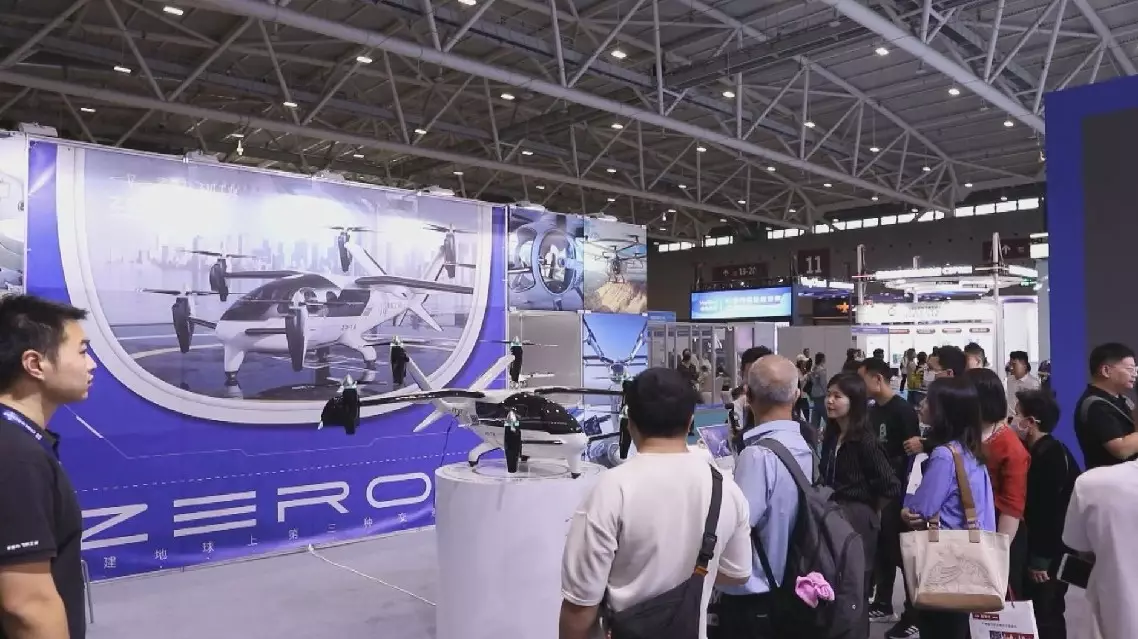
New technologies, products shine at China Hi-Tech Fair
Amidst overlapping global challenges, international experts at the 2026 Global Governance Forum in north China's Hebei Province emphasized that rebuilding confidence and cooperation in global governance requires enhanced dialogue, the establishment of common rules in emerging fields, and a fairer, more inclusive international system that amplifies the voice of the Global South.
Held from October 23 to 25 in Xiong'an, China's "city of the future" built on the North China Plain, the forum brought together nearly 400 representatives from over 90 countries. Spanning five major sectors and 22 thematic seminars, the event provided a platform for diverse stakeholders in politics, economy, technology, culture, and think tanks to jointly address governance challenges and promote inclusive, multi-stakeholder global governance reform.
"In this conference, I met some American representatives, a remarkable businessman. I asked him, 'what are you doing here?' And he said, 'I wanted to discuss Global Governance Initiative.' I said, 'Listen, I don't believe because whatever China proposes, the U.S. will object. And he said no. And he mentioned specific subject -- AI. He said, 'I want to make my humble contribution into establishing (of) global governance in AI.' So among Americans, this idea is also receiving some understanding. More dialogue is required and I would underline the weight of this forum," said Djoomart Otorbaev, former prime minister of Kyrgyzstan.
In today's world, where deficits in peace, development, security, and governance are intertwined, rebuilding confidence and cooperation is the most scarce international public good. In response, China has proactively set the agenda to address pressing concerns, such as advancing the reform of the UN-centered governance system, cooperating on new frontiers like cyberspace, outer space, and AI, and bridging civilizational divides amidst geopolitical rivalry.
"And there were some specific initiatives which we also have discussed, which is to set the global governance for the outer space, for the deep seas, for some areas of the planet like the Antarctica, where there is various needs for more common rules. One area the world is looking for is artificial intelligence and we need to regulate globally and efficient intelligence to avoid the worst. So if we work together, we can get the benefits and make sure that we make it much more difficult to do the harm," said Erik Solheim, chairman of the EU-Asia Centre and former UN under-secretary-general and former executive director of the UN Environment Programme.
"The world has become a global village, but this global village is now fighting. There's a problem going on in the Middle East, there's a problem going on in Africa, but China is trying to promote a conclusive thing so that the world can be peaceful. Because of this Global Governance Initiative, China has been able to tell the world (that) how to work together," said Khalid Taimur Akram, executive director of the Pakistan Research Center for a Community with a Shared Future.
Since its proposal over a year ago, the Global Governance Initiative has garnered support and responses from over 160 countries and international organizations.
During the forum, China announced pragmatic measures to further implement the initiative, reaffirming its firm support for multilateralism and the core status of the United Nations, while emphasizing the need to enhance the representation and voice of the Global South in international affairs to translate the initiative from a Chinese proposal into broader international practice.
"It's that combination of defense of the games that arise from the existence of the international system, but improving it, updating it, performing it, making it fairer, particularly to the great mass of developing countries, which is why the Chinese proposals meet a lot of support, particularly from the Global South, but also from fair minded people in other countries," said Keith Bennett, vice chairman of UK 48 Group Club.
Participants of Global Governance Forum hail China's contribution to fairer international order