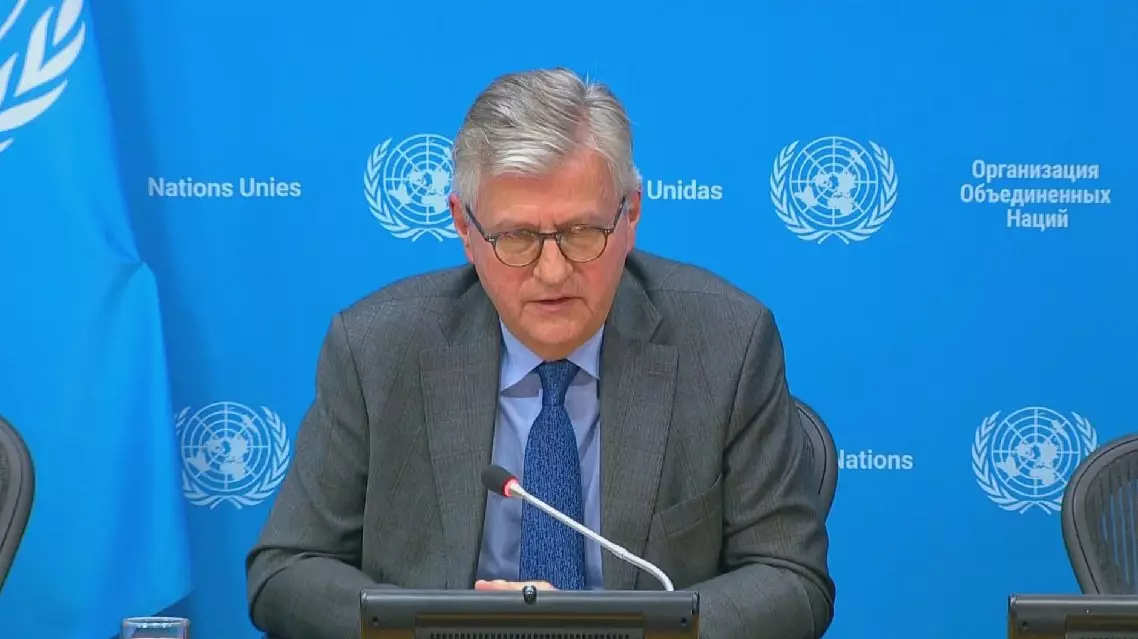
The Israeli army used white phosphorus munitions in southern Lebanon, said United Nations Under-Secretary-General for Peace Operations Jean-Pierre Lacroix on Tuesday.
Lacroix made the statements at the UN headquarters in New York, noting that the United Nations Interim Force in Lebanon (UNIFIL) has launched an investigation into the matter.
"I believe there has been use of white phosphorus [munitions]. Then again, our position is that it should not be used in conditions where the civilian population is potentially affected by that. Now, in terms of the specifics, the conditions in which those cases occur, the UNFIL has conducted investigations. I don't have the elements of these investigations which are ongoing," he said.
White phosphorus munitions are offensive incendiary weapons that produce high temperatures and toxic smoke when burning. As a weapon, they are strictly regulated by international law.
In 1980, the United Nations adopted the Convention on Prohibitions or Restrictions on the Use of Certain Conventional Weapons which may be deemed to be Excessively Injurious or to have Indiscriminate Effects, and the protocol on prohibitions or restrictions on the use of incendiary weapons annexed to the convention prohibits the use of incendiary weapons against civilians and civilian gatherings.
The Israeli army argued that it only used white phosphorus munitions as flares or to provide cover using the smoke they produced, and was therefore not subject to this restriction. Lacroix also said that UNIFIL is discussing with all parties on expanding the force's capacity building after the end of this round of conflict, with a focus on enhancing its ability to remove remaining explosive devices.
"I believe that the post hostilities environment in southern Lebanon would be characterized by a very significant presence of improvised explosive devices, remnants of war mines, and we are already working with some contributing countries to expand UNIFIL's capacity in that area," Lacroix said.
UN peacekeeping chief confirms Israel's use of phosphorus munitions in Lebanon

Amid ongoing diplomatic efforts to end nearly four years of war in Ukraine, many Ukrainians remain defiant, demanding not just promises, but a peace grounded in justice.
Streets in Kiev bustle as usual, phones buzz with air raid alerts -- many checked, most shrugged off -- as Ukrainians adjust to a reality where war is both background noise and ever-present threat.
Peace discussions, including a scheduled meeting between Ukrainian President Volodymyr Zelensky and U.S. President Donald Trump in Florida on Sunday, are giving hope to some. But for many Ukrainians, the talk must translate into more than documents.
"The main key of the message to Trump is we're ready to discuss even controversial plans from you because we need peace, but this peace should be just peace, we don't need peace without justice. That's why we're ready to talk. We're ready to discuss. But we are not ready to capitulate," said Ivan Us, a senior consultant.
That delicate balance between hope for peace and the demand for justice echoes across the country, even as communities grapple with worsening humanitarian conditions.
"The situation is critical. No evacuees are coming from Pokrovsk. Security doesn't allow teams in, and people aren't leaving those settlements," said Evgenya Pinchuk, an NGO supervisor.
Others closer to combat zones describe an unrelenting emotional toll under near-constant threat.
"Drones fly over people every day. You go to bed wondering if your window will be hit. It's intense from morning to evening, and we're being shelled too," said one resident requesting anonymity.
The precarious state of Ukraine's energy infrastructure remains a target, with cold weather magnifying the impact of each strike.
"Russia targets energy because it hits daily life directly. When power and heat are unstable, services get disrupted and uncertainty grows, especially in winter," said Hennadi Ryabtsev, an energy analyst.
In places like Zaporizhzhia, home to a key nuclear power plant under dispute in ongoing peace talks, the anxiety is nearly constant.
"When strikes happen, you wonder: Will the lights go out? Will heating stop? Nights are restless - you're always preparing," said Olena Musher, a local resident.
Zelensky confirmed his planned face-to-face with Trump will focus on security guarantees and the status of Ukrainian territory. Among the key topics are regaining full control of the Zaporizhzhia nuclear facility, and finalizing Ukraine's 20-point peace proposal, which he states is 90 percent complete.
Ukrainians defiant as peace talks doubts persist