An arid county in northwest China's Xinjiang Uygur Autonomous Region has planted cash crops like corn on sandy soil as part of its efforts to combat desertification, while helping locals increase income.
In Cele County, the most severely affected area in Xinjiang's Hotan Prefecture by wind and sand, there's a corn field covering an area of 300 mu (about 200 hectares). Starting last year, local farmers have planted corns in the arid region of Cele.
The cornfield has become a symbol of both ecological restoration and economic development. The corn variety not only thrives in the harsh desert conditions, but also serves a crucial role in preventing wind and sand erosion. According to surveys, the yield of this corn variety per mu can reach as much as over 800 kilograms.
Previously, the land was nothing more than loose sand, easily swept away by the wind. After the introduction of corn, the land has transformed, with a layer of biological crust covering the surface.
The crust, which is usually a surface cover formed by binding of small organisms and soil particles, has greatly enhanced the soil's ability to retain moisture and prevents it from being blown away by the wind.
Planting corn in this arid area not only helps control desertification, but also protects interplant crops.
Underneath the towering corn stalks, locals have planted a crop of leafy grass, which is rich in protein and will eventually be processed into various products or used as animal feed, further diversifying the region's agricultural output.
Watering the crops in such an arid environment is a big challenge as the sandy soil can hardly store water, so the desertification control workers have introduced a drip irrigation system.
With this system, snowmelt is stored in nearby facilities and the water is distributed through flood channels to the drip irrigation belt. When needed, farmers just need to open valves to irrigate the field. This method not only conserves water, but also ensures that crops receive necessary moisture in an efficient manner.
The improvement of ecological environment in Cele is not only reflected in crop planting, but also in wildlife. Grey cranes have become frequenters to the region, which have been frequently spotted soaring through the sky or foraging in the fields.
Their presence is a powerful indicator of the improving ecological environment in Cele, demonstrating that the land is not only becoming more fertile, but also more hospitable to wildlife.
In recent years, local people have taken the initiative to join the team of sand control, and have planted 21.4828 million trees and 164,500 mu (about 109,721.5 hectares) of cash crops such as walnuts and red dates in the desert.
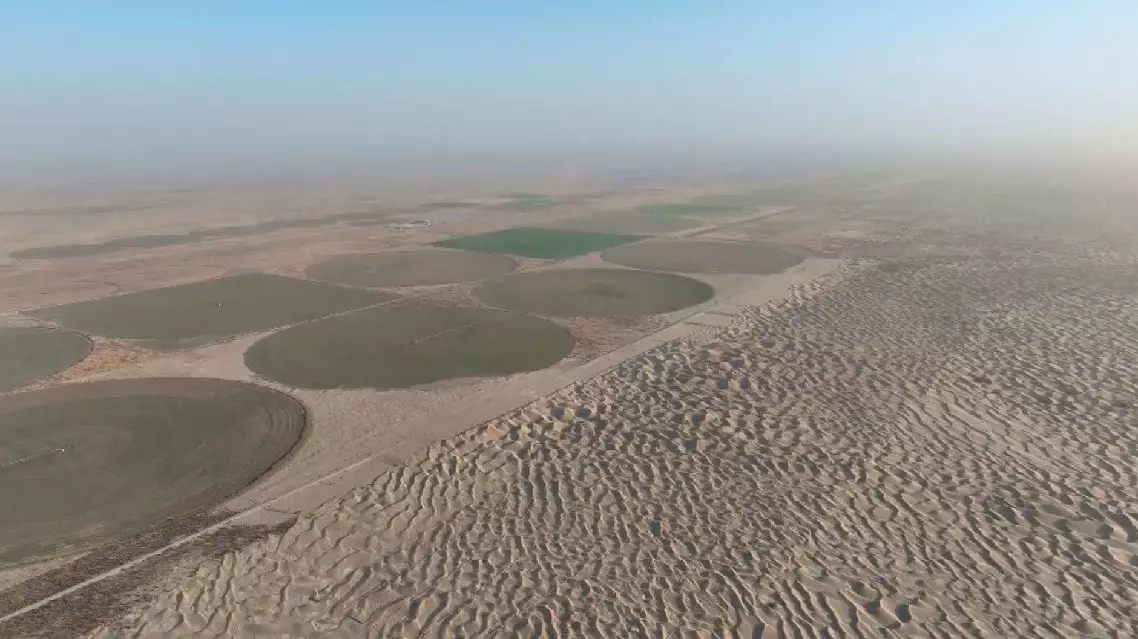
Xinjiang's arid county develops corn planting on sandy soil to combat desertification