Skip to Content Facebook Feature Image

Chinese traditional board-shoe racing highlights collaborative spirit

China

China

China

Chinese traditional board-shoe racing highlights collaborative spirit

2024-11-26 17:17 Last Updated At:17:37

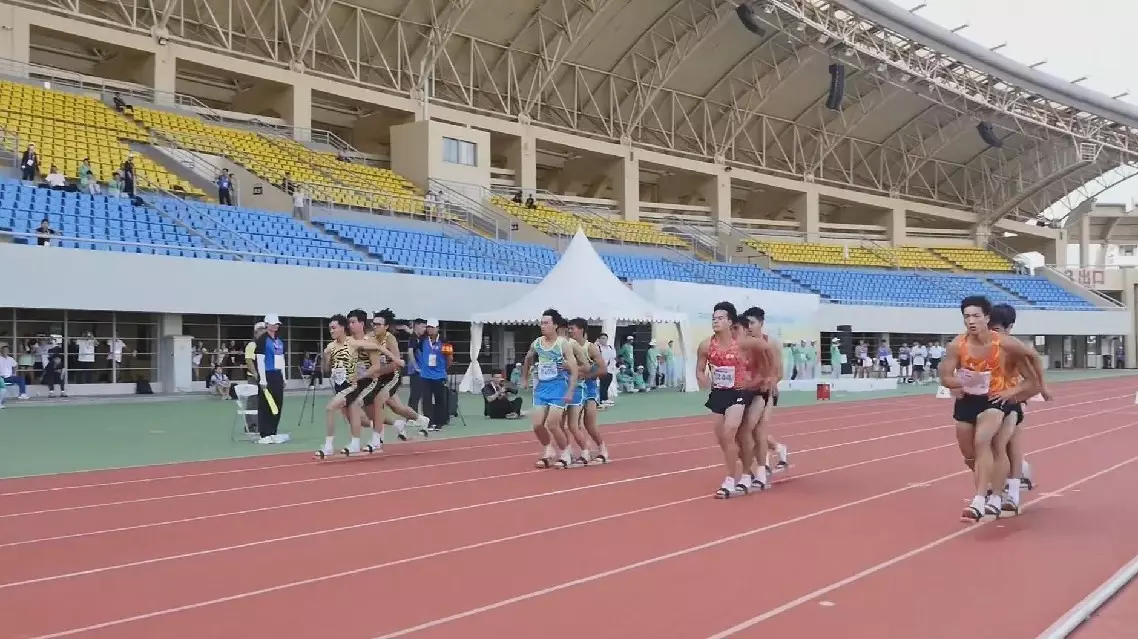
The unique sport of board-shoe racing is demonstrating the collaborative spirit and athletic prowess of China's ethnic minorities at the 12th National Traditional Games in Sanya, a coastal city of Hainan Province.

Board-shoe racing is a traditional folk sports event of the Zhuang ethnic group in south China's Guangxi Zhuang Autonomous Region. It pits teams of three athletes wearing a single pair of wooden board shoes against each other.

The interesting sport can be traced back to the Ming Dynasty, when legend has it that a famous heroine used it as a way to train soldiers. It has been passed on from generation to generation since then, and has grown in popularity, attracting participants from northern provinces as well.

The sport was introduced as an official competition event in the 8th National Ethnic Games in 2007 for the first time. The event includes men's and women's three-member 60 meters, 100 meters, 200 meters racing, and 2×100 meters relay, as well as 4×100 meters mixed relay.

This year, a total of 30 board-shoe racing teams of 348 athletes from different ethnic minority groups will compete in the 12th National Ethnic Games. Athletes say the sport requires perfect coordination of the trio and concentration of each member.

"We're like a train. The member at the front is relatively more capable than the two members at the back because the locomotive drives the train faster, which is what our coach tells us. As for the two of us in the back, the person in the middle is responsible for coordination between the front and back, and the one at the end controls the forward movement of the board and the up and down movement of our legs. Each of us has our own function," said Liu Yilin, a member of Chongqing board-shoe racing team.

This seemingly simple sport actually has many challenges. The athletes need to ensure tacit cooperation while running at full speed to prevent slipping out of the shoes or even toppling over each other.

Liu and his teammates made a mistake in the middle of the heat, which resulted in Liu's ankle injury. But these athletes got back on their board shoes to finish the race.

"At that time, we were still trying to finish the game. I guess one of my nerves might have been injured, so half of my foot was numb. But I still insisted on putting my feet into the board shoes. We were determined to finish the race. I told my teammates that we should persist in the competition and respect the event and the process," said Liu.

Opened on Friday night, the grand event, which will take place through Nov 30, has gathered nearly 7,000 athletes, representing 35 delegations across China to compete in 18 sports and three demonstration sports, most of which were once unique to specific ethnic groups or regions.

Unlike modern sporting events, the ethnic games feature competitions rooted in traditional customs and the daily life of people of different ethnic groups in China.
Chinese traditional board-shoe racing highlights collaborative spirit
Chinese traditional board-shoe racing highlights collaborative spirit
Cuba has strongly condemned the United States' seizure of a Venezuelan oil tanker, with a former Cuban diplomat calling the action illegal and warning it threatens regional energy security as the U.S. escalates pressure on Venezuela.

Carlos Alzugaray, the former Cuban diplomat, said the seizure of the tanker and its cargo violates international law.

"They have seized the ship, the tanker, but they have also seized the oil, they have taken the oil. All the sanctions that the United States has imposed on Venezuela are illegal because they are not based on any decision of an international institution like the Security Council of the United Nations," he said.

U.S. forces last week seized a Venezuelan oil tanker, the Skipper, in the Caribbean, alleging it was part of an "illicit oil shipping network supporting foreign terrorist organizations." The U.S. has since intensified its campaign against Venezuela's oil trade.

U.S. President Donald Trump said Tuesday that he has ordered a total blockade of all sanctioned oil tankers traveling to and from Venezuela, escalating a months-long pressure campaign against Venezuelan President Nicolas Maduro.

Trump also said that the Venezuelan government has been designated "a foreign terrorist organization," accusing it of involvement in crimes including terrorism, drug smuggling and human trafficking.

Trump also claimed that Venezuela is "completely surrounded by the largest armada ever assembled in the history of South America," warning that the pressure would continue until the assets he said had been taken are returned to the United States.

Cuban President Miguel Diaz-Canel has also denounced the U.S. seizure of Venezuelan oil tanker last week, calling it an act of piracy and maritime terrorism as the U.S. blockade may also impact Cuba, which is experiencing an energy crisis and is heavily dependent on oil imports from Venezuela.

For Cuba, the seizure raises particular concerns. The island is facing a deep energy crisis marked by rolling blackouts and relies heavily on oil imports from Venezuela. Cuban officials fear that expanded U.S. enforcement actions could further disrupt supplies.

The tanker seizure coincides with an expanded U.S. military presence in the Caribbean under "Operation Southern Spear," officially described as a counter-narcotics mission. Cuban authorities argue that the deployment violates a regional declaration designating Latin America and the Caribbean as a "Zone of Peace," and have called for international condemnation of the U.S. actions.

Cuba condemns US seizure of Venezuelan oil tanker amid energy crisis

Cuba condemns US seizure of Venezuelan oil tanker amid energy crisis

Recommended Articles