Skip to Content Facebook Feature Image

China's advanced manufacturing empowers robot industry

China

China

China

China's advanced manufacturing empowers robot industry

2024-11-29 22:12 Last Updated At:11-30 00:07

China's advanced manufacturing has empowered its robot industry in crafting the "super brain", which becomes a highlight at the ongoing second China International Supply Chain Expo (CISCE). China is the world's largest industrial robot market. Currently, the market size of specialized robots in China exceeded 20 billion yuan (about 2.76 billion U.S. dollars). Over the past five years, the average annual growth rate has been close to 30 percent, thanks to the support and assistance provided by its advanced manufacturing.

"Connecting the World for a Shared Future," the expo, hosted by the China Council for the Promotion of International Trade, kicked off in Beijing on Tuesday.

The 2024 expo has introduced a new exhibition area dedicated to advanced manufacturing, adding to last year's clean energy, smart vehicle, digital technology, healthy life, green agriculture and supply chain service areas.

A complete global advanced manufacturing industrial chain is being showcased in the new area, focused on four categories -- research and development and design, application of new materials, key components and processing, and intelligent manufacturing and high-end equipment.

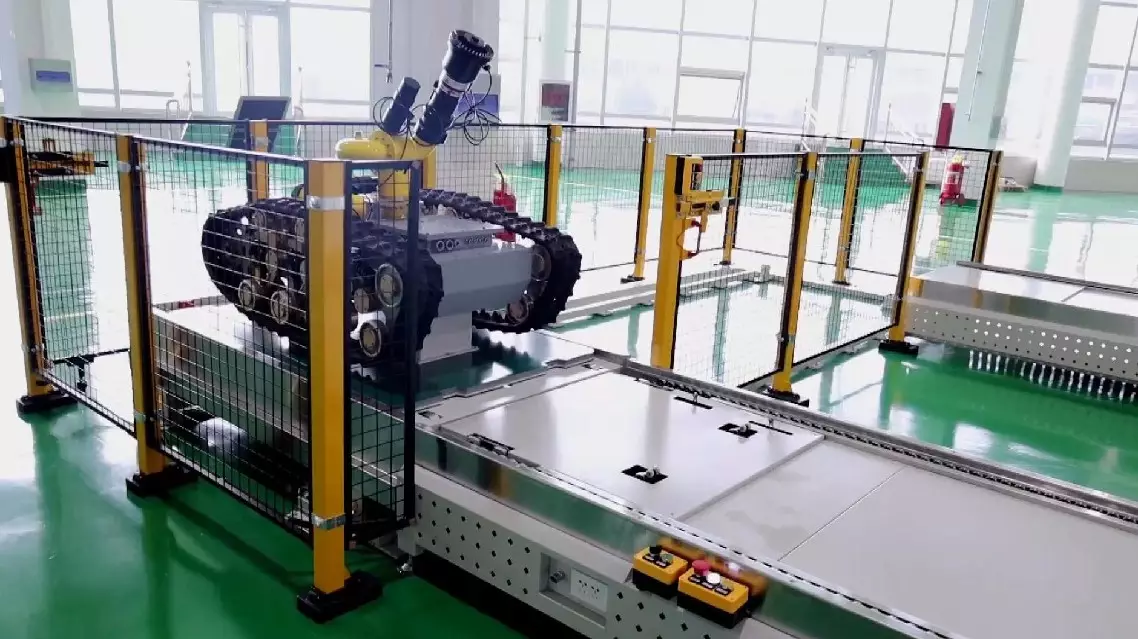
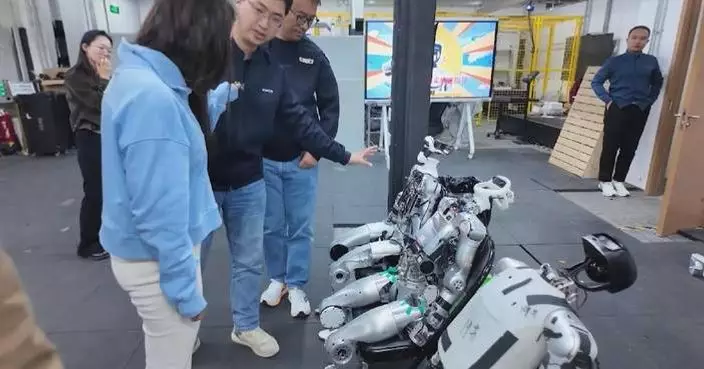
Within the advanced manufacturing exhibition area, a standout display features an explosion-proof firefighting robot equipped with a 360-degree camera that transmits real-time images to the central control system. This robot is capable of assessing changes at the scene of the fire, thanks to its central control system.

A special robot comprises hundreds of components. What sets it apart from traditional robots is right here - its powerful "brain".

The "super brain" of specialized robots can assess surrounding toxic gases, oxygen levels, temperature, dust, humidity, and others, each of which requires continuous fine-tuning and adjustment by technical personnel at the robotics research and development center in Tangshan City of north China's Hebei Province.

"We are all young people, and we are quite hardworking. Basically, we produce 10,000 to 20,000 drawings a year," said Min Guiyuan, an engineer of robotics research and development.

"Some iterations of new technologies are the result of our collective efforts," said Wang Bingnan, another engineer of robotics research and development.

In Tangshan today, a robot industry cluster has been initially formed, centered around industrial robots, with a focus on specialized robots, integrating research and development, production, and services.

Over the years, China's robot industry has made great progress in innovation and development, and new breakthroughs have been achieved in the research and development of bionic perception, cognition, planning and control technologies.
China's advanced manufacturing empowers robot industry
China's advanced manufacturing empowers robot industry
Iran's official news agency IRNA said on Sunday the country has rejected taking part in the second round of the peace talks with the United States, after U.S. President Donald Trump said new negotiations would take place in Pakistan on Monday evening.

"My Representatives are going to Islamabad, Pakistan -- They will be there tomorrow evening, for Negotiations," Trump wrote in his Truth Social post on Sunday.

Trump also said that the U.S. has offered a "fair and reasonable" deal, and if Iran reject the deal, the U.S. will "knock out every single Power Plant, and every single Bridge, in Iran."

Iran's absence from the second round of talks "stems from what it called Washington's excessive demands, unrealistic expectations, constant shifts in stance, repeated contradictions, and the ongoing naval blockade, which it considers a breach of the ceasefire," IRNA said in a post on its English account on social media platform X.

In another report published in Farsi, IRNA said reports released about the second round of peace talks between Tehran and Washington in Islamabad are "not true."

It described the reports released by the United States as part of a "media game and in line with the blame game" to pressure Iran, stressing that the U.S. "excessive, illogical and unrealistic demands, frequent changing of positions, constant contradictory remarks, continuation of the so-called naval blockade" have so far prevented the negotiations' progress.

IRNA added under the present circumstances, there is "no bright prospect" for fruitful negotiations.

On Feb. 28, Israel and the United States launched joint attacks on Tehran and several other Iranian cities, killing Iran's then Supreme Leader Ali Khamenei, along with senior military commanders and civilians. Iran responded by launching waves of missile and drone strikes targeting Israel and U.S. bases and assets in the Middle East, and exercising tight control over the Strait of Hormuz.

A ceasefire was achieved between the warring parties on April 8, which was followed by lengthy talks between the Iranian and U.S. delegations in Pakistan's capital Islamabad on April 11 and 12. After the peace negotiations in Islamabad collapsed, the United States imposed its own blockade on the waterway.

The Iranian and U.S. delegations were reportedly expected to hold another round of peace talks in Pakistan soon.

Trump affirms new round of talks in Pakistan while Iran rejects

Trump affirms new round of talks in Pakistan while Iran rejects

Recommended Articles