China's Shenzhou-19 crew has carried out multiple tasks in an orderly manner during their one-month stay aboard the orbiting Tiangong space station, including scientific experiments, space station maintenance and health monitoring.
China launched the Shenzhou-19 crewed spaceship at the end of October, sending three astronauts - Cai Xuzhe, Song Lingdong and Wang Haoze - to its space station for a six-month mission.
During their stay in space, the Shenzhou-19 crew will carry out 86 space science research and technology experiments. At present, experimental projects in fields such as in-space life sciences and aerospace medicine are being carried out simultaneously.
China launched the cargo craft Tianzhou-8 on Nov 15 to deliver supplies for Tiangong space station.
Tianzhou-8 sent fruit flies into space for the first time. Fruit fly genes are highly similar to humans, and can provide valuable theoretical basis and technical guidance for long-term human survival in space.
Cytological research is also ongoing, and the crew has completed the installation of new samples, the startup of equipment, manual observation of sample images and other related work.
The installation, replacement and maintenance of experimental equipment such as biotechnology experiment cabinets, high-temperature material science experiment cabinets, and fluid physics experiment cabinets have also been completed, ready for subsequent experiments and research.
In terms of station management, the crew has performed regular cleaning, inspection, and sorting and transferring of materials. They also completed the inspection and maintenance of the space treadmill and the maintenance of the regenerative life support system.
The crew has also regularly undergone a range of medical examinations as required, including cardiovascular ultrasounds, ECGs, dynamic heart and blood pressure monitoring, bone density measurement, and strength tests.
In close cooperation with ground scientific researchers, the Shenzhou-19 crew also completed the first full-system stress emergency drill and in-orbit medical rescue training since its arrival.
During the mission, the crew will carry out extravehicular activities and perform a number of tasks, including installing space debris protection devices on the space station.
To get ready for the mission, the three astronauts have completed the regular inspection and maintenance of their extravehicular spacesuits and the setting of their storage status as planned to ensure they are in good condition.
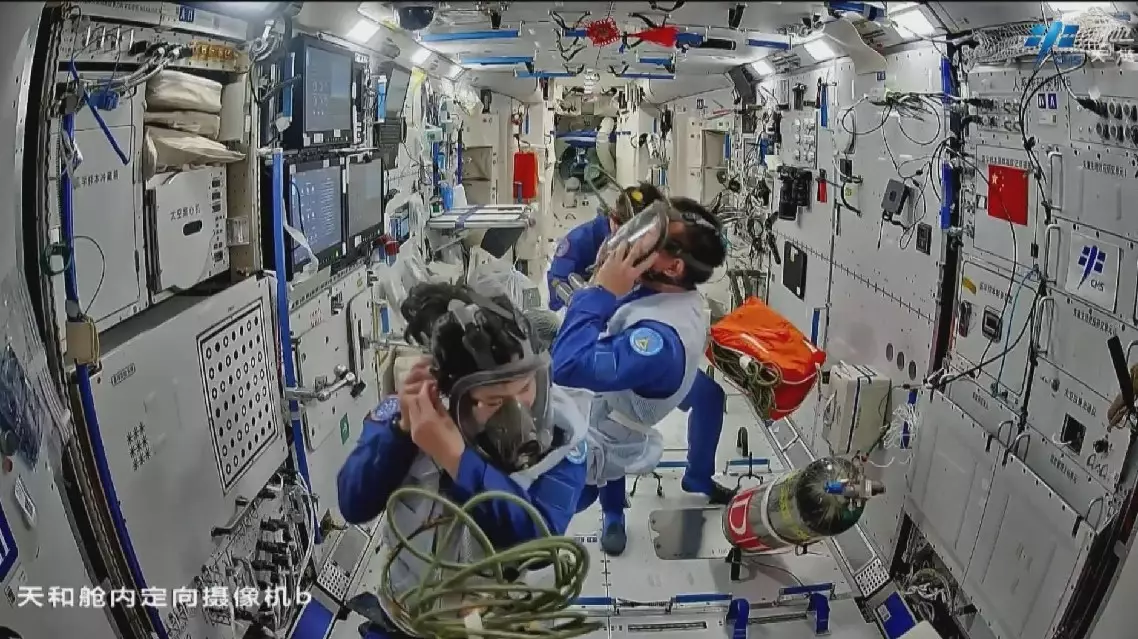
Shenzhou-19 crew fulfills missions orderly during month-long stay in space