China's ice and snow economy is experiencing a notable boom this winter, driven by growing demand for winter sports, related entertainment events, and tourism.
As winter sets in, cities in north China's Inner Mongolia launched a series of exciting snow and ice events to draw in tourists and stimulate the local economy.
In Tongliao City, for example, an ice and snow carnival is taking place, with fun activities like tug-of-war and Mongolian-style wrestling matches on the snow, providing both participants and visitors with a thrilling and festive experience.
"The event offers many ice and snow activities, such as skiing, snowboat racing, and snow soccer. There are also many local specialties from Tongliao and creative cultural products. It's a good place for sightseeing and photography," said a visitor surnamed Zou.
In addition, Hulun Buir City has combined its winter entertainment events with local folk culture, making the events even more interesting. Visitors can enjoy not only traditional local activities, such as snow hockey and board games, but also unique experiences like horse riding on the snowy plains and immersing themselves in the festive atmosphere of Nadam, a traditional Mongolian festival.
"The grassland in Old Barag Banner (an area under the administration of Hulun Buir) is truly breathtaking. It is completely natural and absolutely stunning," said visitor named Zhiwei.
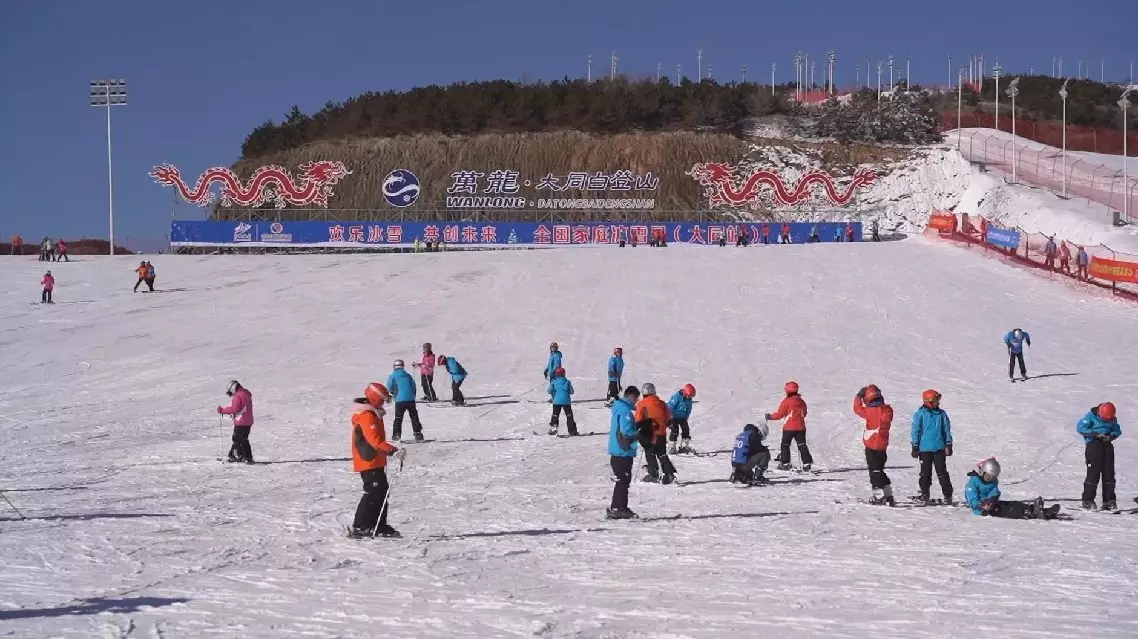
To further generate excitement and interest among the public for winter activities, Datong City in north China's Shanxi Province has recently hosted various winter sports events, drawing more than 400 athletes from across the country.
"I find skiing to be an exhilarating sport that can inspire people to strive for improvement and offers a sense of accomplishment," said Zha Aijia, a skiing enthusiast from a university in Beijing.
A total of 19 winter sports events, including skiing, skating, and curling, are scheduled for Datong's ice and snow season this year, which is expected to attract more tourists.
The popularity of the snow and ice economy is growing not only in northern China but also in southern cities.
In Chengdu City of southwest China's Sichuan Province, local businesses are creating new opportunities by integrating ice and snow sports with tourism service, educational research activities and related training courses, bringing new vitality to winter economy.
Currently, Chengdu has over 60 winter sports venues, with over 2 million people taking part in related activities.
"The number of customers has increased by almost 20 percent year on year," said Yu Ronghui, a director of an indoor ski park in Chengdu.
"We will give out 20 million yuan (about 2.7 million U.S. dollars) in vouchers for ice and snow activities during the seventh Sichuan Ice and Snow Season to further turn the ice and snow business into a thriving economy," said Yang Chao, director of the Cultural and Sports Service Center of Dujiangyan, a county-level city administered by Chengdu.
Ice-snow economy booms across China
Major breakthroughs by Chinese scientists have laid the foundation for a future where space-based solar power stations are capable of wirelessly transmitting energy to Earth and spacecraft, though significant engineering problems remain.
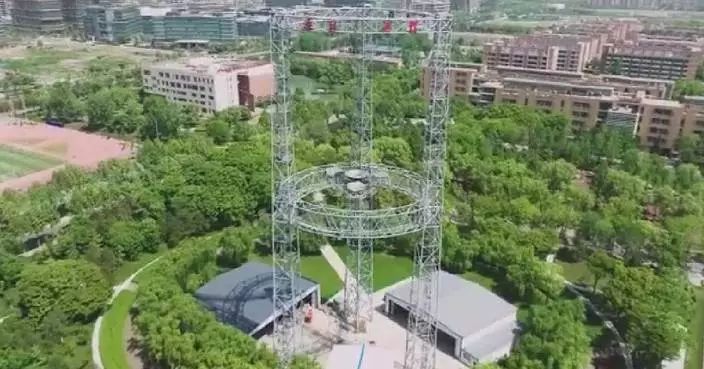
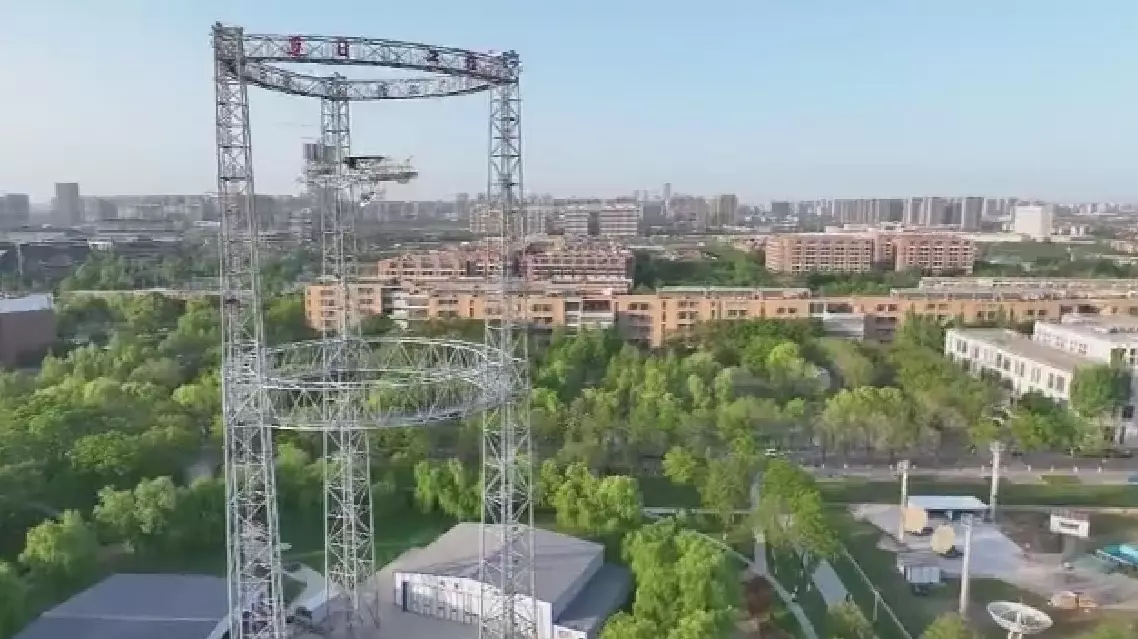
A research team from Xidian University in northwest China's Shaanxi Province has made significant progress on the Sun Chasing project, or "Zhuri" in Chinese. The team has developed a ground-based test system for wireless power transmission that can charge multiple moving targets at the same time.
In recent tests, the system achieved a wireless power transmission efficiency of 20.8 percent from direct current to direct current over a distance of 100 meters. It delivered 1,180 watts of power. The team has also built a wireless charging system for drones. In a test, a drone flying at 30 kilometers per hour was able to receive 143 watts of stable power from 30 meters away.
A space solar power station works exactly as its name suggests: a huge array of solar panels placed in orbit. It would collect sunlight in space, where the sun always shines, and then convert that energy into microwaves or lasers to beam down to Earth or directly to satellites and spacecraft. This could address two significant issues: supplying uninterrupted power for space missions and alleviating energy shortages on the ground.
"The construction of space solar power stations could become a major undertaking in the future. One potential benefit is access to a virtually unlimited power supply. Because energy can be collected continuously in space 24 hours a day, electricity could be supplied on an uninterrupted basis," said Fan Guanheng, an associate professor at the School of Mechano-Electronic Engineering at Xidian University.
"Secondly, it could reduce our dependence on fossil fuels, thereby lowering carbon emissions and helping protect the environment. Thirdly, it could support the development of charging infrastructure in space and enable wireless microwave charging for spacecraft, changing the way power is supplied to space vehicles," the professor added.
In 2018, the research team launched the first phase of the Sun Chasing project to build a ground test system. By June 2022, they had completed the world's first full-link, full-system ground validation system for a space solar power station. Now, the team has moved to phase two. The goal now is to solve the challenges of generating high power in space and transmitting it efficiently over long distances.
According to Duan Baoyan, an expert at Xidian University and an academician of the Chinese Academy of Engineering, recent breakthroughs include improving the efficiency of solar energy collection and conversion, increasing the precision of microwave beam control to reduce energy loss, and making the transmitting and receiving antennas smaller and lighter, which is critical for space application.
The team has also solved the problem of how to power multiple moving targets at once using a single transmitter. This means that in the future, one space power station could potentially supply electricity to several satellites or ground vehicles at the same time, Duan said.
Despite the advances in ground-based validation, a series of technical challenges must still be overcome before the technology can be deployed in space.
"The first issue that needs to be addressed is the adaptability of components to the space environment, as conditions in space are completely different from those on Earth, including radiation exposure and extreme temperatures. Another challenge involves the deployment and retraction design of transmitting and receiving antennas. We also need to develop thermal management systems to cope with extreme temperatures and temperature fluctuations in space. These are all areas where further breakthroughs are needed," said Qian Sihao, an associate professor at the School of Mechano-Electronic Engineering at Xidian University.
"We have now completed the development and validation of a ground-based test system, and our next step is to carry out in-orbit wireless microwave power transmission," Fan said.
With ground validation complete, the team now turns its attention to overcoming the harsh realities of space, aiming to demonstrate in-orbit wireless power transmission and bring the vision of orbital solar energy closer to reality.
Space-to-earth solar power moves closer to reality although hurdles remain: scientists