Skip to Content Facebook Feature Image

Chinese company leverages tech to secure reliable coal transport during winter

China

China

China

Chinese company leverages tech to secure reliable coal transport during winter

2024-12-13 06:03 Last Updated At:07:17

A company in north China's Inner Mongolia Autonomous Region has adopted a smart management system and cutting-edge technologies to maintain coal transport trains, guaranteeing a steady energy supply during the winter months.

Inside the maintenance workshop of the National Energy Group Railway Equipment Company in Baotou City, large coal transport trains were disassembled into individual parts for careful examination.

Traditionally, at least two workers were required to complete the procedures of disassembly, overhaul, inspection and assembly, and manually transfer heavy components and parts, up to tons, a day.  Now, a single robot can do the job more quickly, safely, and efficiently.

The use of intelligent technologies, including ultrasonic testing for detecting defects in train axles, has greatly improved the accuracy and efficiency of inspections. It also offers diagnosis results for follow-up maintenance.

Additionally, smart devices are also incorporated to conduct "X-ray" inspections to check the defects in train components.

To prevent potential accidents, it will be done by both humans and devices for quality guarantee.

"As of December 2, we have conducted maintenance on more than 18,000 trains and 1.01 million carriages annually and solved more than 50,000 faults of various types to ensure stable and orderly energy supply in winter," said Qin Riqiang, a staff member of the company.

Chinese company leverages tech to secure reliable coal transport during winter

Chinese company leverages tech to secure reliable coal transport during winter

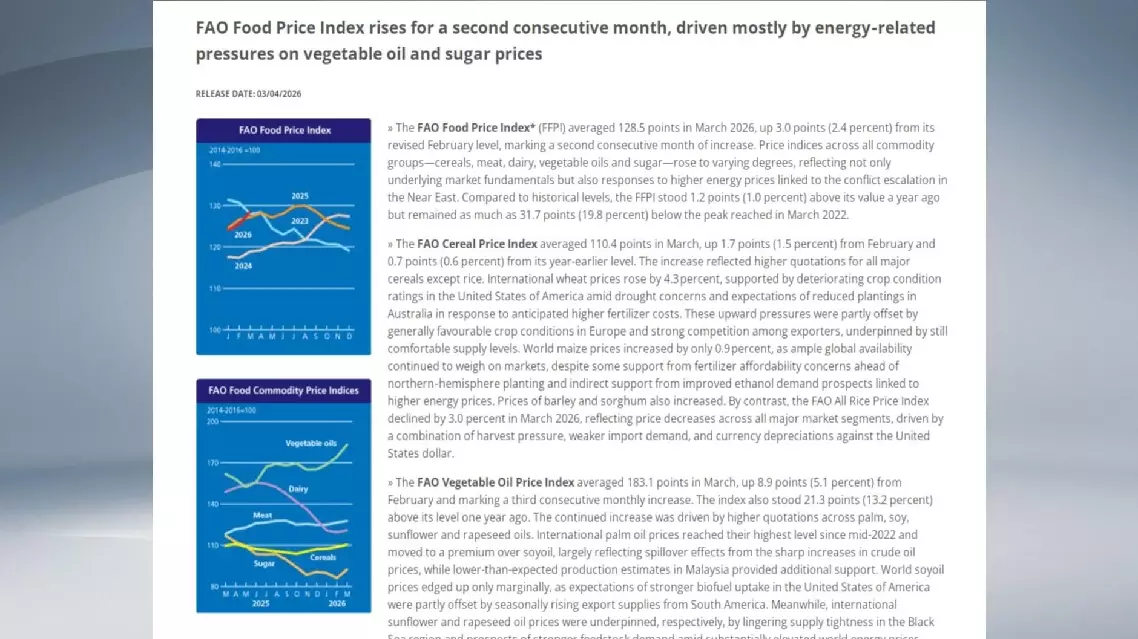
Global food commodity prices climbed for a second consecutive month in March, driven mainly by higher energy costs linked to escalating conflict in the Middle East, the Food and Agriculture Organization of the United Nations (FAO) said in report released on Friday.

The FAO Food Price Index, which tracks monthly changes in the international prices of a basket of globally traded food commodities, averaged 128.5 points in March, up 2.4 percent from February and 1.0 percent above its level a year ago.

According to the report, the FAO Vegetable Oil Index and Sugar Price Index showed the largest increases, up 5.1 percent and 7.2 percent, respectively.

The FAO Cereal Price Index increased by 1.5 percent from the previous month, driven primarily by higher world wheat prices, which rose 4.3 percent.

The FAO Meat Price Index rose by 1.0 percent from the previous month, and the FAO All-Rice Price Index declined by 3.0 percent in March, according to the report.

FAO stated that rising energy and fertilizer prices have been driving up agricultural input costs.

If the conflict stretches beyond 40 days, farmers will have to choose to farm the same with fewer inputs, plant less, or switch to less intensive fertilizer crops, according to FAO Chief Economist Maximo Torero.

These choices will hit future yields and shape food supply and commodity prices for the rest of this year and beyond, Torero said.

Global food prices rise for 2nd consecutive month in March amid Middle East conflict: FAO

Global food prices rise for 2nd consecutive month in March amid Middle East conflict: FAO

Recommended Articles