On Football analyzes the biggest topics in the NFL from week to week. For more On Football analysis, head here.
The NFL was already planning to explore the onside kick before Dan Campbell made a regrettable decision to try one at an unusual time.
Detroit’s ultra-aggressive coach called for an onside kick with the Lions trailing the Bills by 10 points and 12 minutes remaining. Buffalo’s Mack Hollins recovered the kick, ran it back to the 5 and the Bills scored on the next play on their way to a 48-42 victory Sunday in a potential Super Bowl preview.
Bringing back surprise onside kicks would benefit coaches like Campbell, who aren’t afraid to take risks. Nobody likes to gamble more than Campbell, who isn’t shy about going for it on fourth down no matter the situation.
Campbell attempted this onside kick out of desperation. Detroit’s injury-riddled defense couldn’t stop Josh Allen and the Bills. Buffalo had five touchdowns, one field goal and one missed field goal in its first nine possessions when the Lions tried the onside kick.
“I thought we’d get that ball,” Campbell said. “I wish I hadn’t done it.”
The Bills knew it was coming because teams must declare an onside kick and can only try it in the fourth quarter under the league’s overhauled kickoff rules. The element of surprise — the Saints once executed an onside kick to start the second half in a Super Bowl — has been eliminated this season due to the new rules, which further reduced the success rate.
Executing successful onside kicks began to decline in 2018 when the NFL banned running starts on kickoffs. The success rate was cut in half to 8.6% since that change.
Entering Week 15, only 3 of 41 (7.3%) onside kicks were recovered.
NFL executive Troy Vincent said last week the competition committee has to consider options to revive the onside kick because it has become “a dead play.” The league made dynamic changes to the kickoff rules in the offseason to bring back returns. That has worked at the expense of the onside kick.
“I think all has to be on the table,” Vincent said. “When we adjusted the kickoff five, six years ago, that also (impacted) the onside kick. You used to have overload, attack blocks, trap blocks that occurred on that play, which was a pretty dangerous play. You can set people up for failures is what we would say.
“I think you have to look at all aspects. You should be able to do that in any quarter. It’s not a surprise onside kick. I think all of those things have to come back to the table. We should explore. Our effort should be to make every single play a competitive play and that includes that play whether it’s first quarter or fourth quarter.”
Perhaps the best option would be giving a team an opportunity to run one play to gain a certain number of yards to keep possession. Because it’ll be difficult to revise the onside kick without changing the overall formation all kickoffs, this radical idea may be the best solution.
The Eagles proposed an onside kick alternative that would’ve let teams try a fourth-and-20 from their own 20. Club owners rejected it in a vote during the league’s annual spring meetings.
“It has garnered (more votes from) where we started and the votes that it received and where it ended a year ago,” Vincent said. “There has been progress, but those are all the things that we should be exploring. We have to be creative. And I think our coaches, they can be creative enough to come up with a good solid, competitive play to bring some excitement back in those situations.”
There’s no telling how many onside kicks someone like Campbell would try if the element of surprise returned. The fourth-and-long alternative won’t be a surprise but it’s a better option than the current onside kick.
The reason Campbell even tried the onside kick early in the fourth quarter is a major problem for Detroit, which had its 11-game winning streak snapped. The depleted Lions (12-2) lost defensive tackle Alim McNeill and cornerback Carlton Davis III to potential season-ending injuries. They’re already missing star edge rusher Aidan Hutchinson and have more players on injured reserve than any other team.
“I’m not buying it, I don’t,” Campbell said about the injuries possibly catching up to the defense. “We can be better. We should’ve been better. We know how good they are but that team was more urgent than us.”
AP NFL: https://apnews.com/hub/nfl

Detroit Lions head coach Dan Campbell, bottom, reacts next to quarterback Jared Goff during the second half of an NFL football game against the Buffalo Bills, Sunday, Dec. 15, 2024, in Detroit. (AP Photo/Rey Del Rio)

Detroit Lions head coach Dan Campbell speaks at a news conference after an NFL football game against the Buffalo Bills, Sunday, Dec. 15, 2024, in Detroit. (AP Photo/Duane Burleson)
DUBAI, United Arab Emirates (AP) — Saudi Arabia bombed Yemen's port city of Mukalla on Tuesday after a weapons shipment from the United Arab Emirates arrived for separatist forces in the war-torn country, and warned that it viewed Emirati actions as “extremely dangerous.”
The bombing followed tensions over the advance of Emirates-backed separatist forces known as the Southern Transitional Council. The council and its allies issued a statement supporting the UAE's presence, even as others allied with Saudi Arabia demanded that Emirati forces withdraw from Yemen in 24 hours' time.
The UAE called for “restraint and wisdom” and disputed Riyadh’s allegations. But shortly after that, it said it would withdraw its remaining troops in Yemen. It remained unclear whether the separatists it backs will give up the territory they recently took.
The confrontation threatened to open a new front in Yemen's decade-long war, with forces allied against the Iranian-backed Houthi rebels possibly turning their sights on each other in the Arab world's poorest nation.
It also further strained ties between Saudi Arabia and the UAE, neighbors on the Arabian Peninsula that increasingly have competed over economic issues and regional politics, particularly in the Red Sea area. Tuesday’s airstrikes and ultimatum appeared to be their most serious confrontation in decades.
“I expect a calibrated escalation from both sides. The UAE-backed Southern Transitional Council is likely to respond by consolidating control,” said Mohammed al-Basha, a Yemen expert and founder of the Basha Report, a risk advisory firm.
“At the same time, the flow of weapons from the UAE to the STC is set to be curtailed following the port attack, particularly as Saudi Arabia controls the airspace.”
A military statement carried by the state-run Saudi Press Agency announced the strikes on Mukalla, which it said came after ships arrived there from Fujairah in the UAE.
“The ships’ crew had disabled tracking devices aboard the vessels, and unloaded a large amount of weapons and combat vehicles in support of the Southern Transitional Council’s forces,” the statement said.
“Considering that the aforementioned weapons constitute an imminent threat, and an escalation that threatens peace and stability, the Coalition Air Force has conducted this morning a limited airstrike that targeted weapons and military vehicles offloaded from the two vessels in Mukalla,” it added.
It wasn't clear if there were any casualties.
The Emirati Foreign Ministry hours later denied it shipped weapons but acknowledged it sent the vehicles “for use by the UAE forces operating in Yemen.” It also claimed Saudi Arabia knew about the shipment ahead of time.
The ministry called for “the highest levels of coordination, restraint and wisdom, taking into account the existing security challenges and threats.”
The Emirati Defense Ministry later said it would withdraw its remaining troops from Yemen over “recent developments and their potential repercussions on the safety and effectiveness of counter-terrorism operations.” It gave no timeline for the withdrawal. The UAE broadly withdrew its forces from Yemen years earlier.
Yemen’s anti-Houthi forces not aligned with the separatists declared a state of emergency Tuesday and ended their cooperation with the UAE. They issued a 72-hour ban on border crossings in territory they hold, as well as entries to airports and seaports, except those allowed by Saudi Arabia. It remained unclear whether that coalition, governed under the umbrella of Yemen's Presidential Leadership Council, would remain intact.
The Southern Transitional Council’s AIC satellite news channel aired footage of the strike's aftermath but avoided showing damage to the armored vehicles.
“This unjustified escalation against ports and civilian infrastructure will only strengthen popular demands for decisive action and the declaration of a South Arabian state,” the channel said.
The attack likely targeted a ship identified as the Greenland, a vessel flagged out of St. Kitts. Tracking data analyzed by the AP showed the vessel had been in Fujairah on Dec. 22 and arrived in Mukalla on Sunday. The second vessel could not be immediately identified.
Jens Laerke, a spokesperson for the U.N. humanitarian office, urged combatants to protect civilians and civilian infrastructure, like the port, saying any disruption to its operations “risks affecting the already dire humanitarian situation and humanitarian supply chains.”
Mukalla is in Yemen's Hadramout governorate, which the council seized in recent days. The port city is some 480 kilometers (300 miles) northeast of Aden, which has been the seat of power for anti-Houthi forces after the rebels seized the capital, Sanaa, in 2014.
Yemen, on the southern edge of the Arabian Peninsula off East Africa, borders the Red Sea and the Gulf of Aden. The war there has killed more than 150,000 people, including fighters and civilians, and created one of the world's worst humanitarian disasters.
The Houthis, meanwhile, have launched attacks on hundreds of ships in the Red Sea corridor over the Israel-Hamas war in the Gaza Strip, disrupting regional shipping. The U.S., which earlier praised Saudi-Emirati efforts to end the crisis over the separatists, has launched airstrikes against the rebels under both Presidents Joe Biden and Donald Trump.
Tuesday's strike in Mukalla comes after Saudi Arabia targeted the council in airstrikes Friday that analysts described as a warning for the separatists to halt their advance and leave the governorates of Hadramout and Mahra.
The council had pushed out forces there affiliated with the Saudi-backed National Shield Forces, another group in the anti-Houthi coalition.
Those aligned with the council have increasingly flown the flag of South Yemen, which was a separate country from 1967-1990. Demonstrators have been rallying to support political forces calling for South Yemen to secede again.
A statement Tuesday from Saudi Arabia's Foreign Ministry directly linked the council's advance to the Emiratis for the first time.
“The kingdom notes that the steps taken by the sisterly United Arab Emirates are extremely dangerous,” it said.
Allies of the council later issued a statement in which they showed no sign of backing down.
Associated Press writer Jamey Keaten in Geneva contributed to this report.
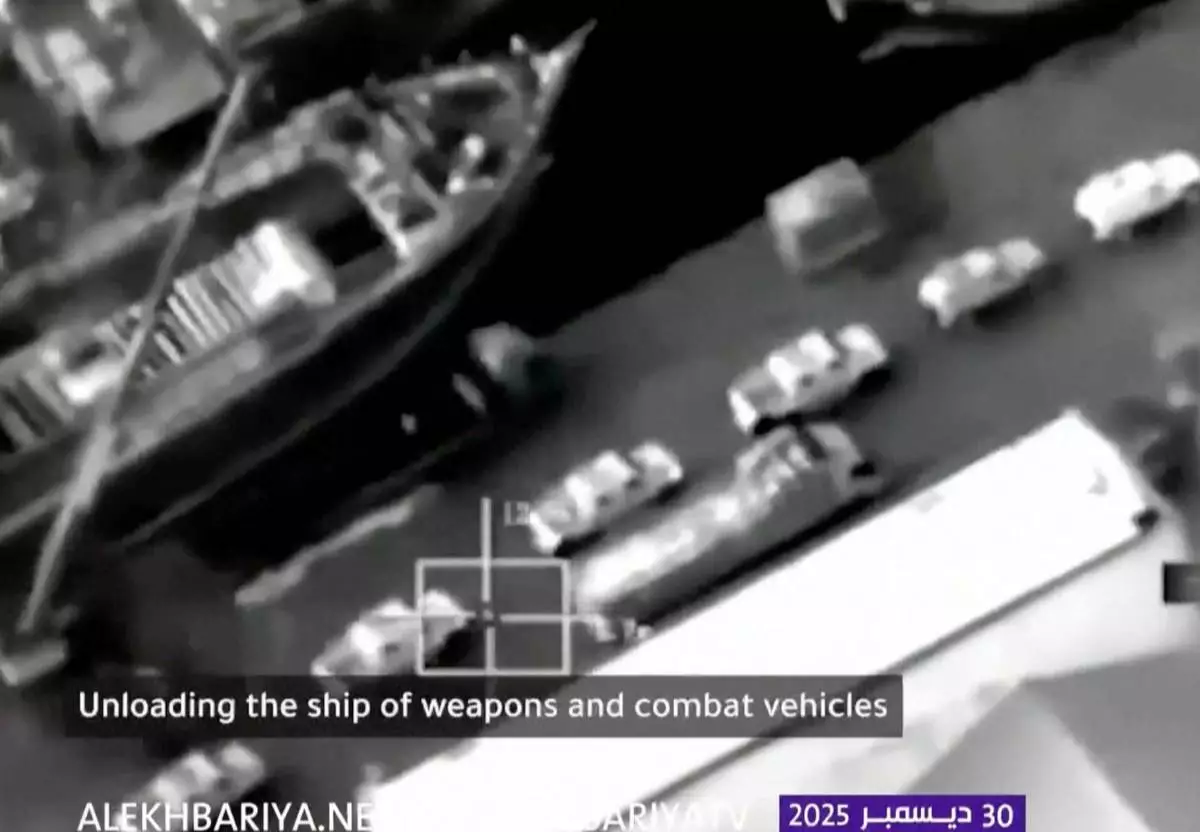
This frame grab from video broadcast by Saudi state television on Tuesday, Dec. 30, 2025, shows what the kingdom describes as a shipment of weapons and armored vehicles coming from the United Arab Emirates, at Mukalla, Yemen. (Saudi state television via AP)