Skip to Content Facebook Feature Image

An ethnic armed group in western Myanmar claims to have captured a major regional army headquarters

News

An ethnic armed group in western Myanmar claims to have captured a major regional army headquarters
News

News

An ethnic armed group in western Myanmar claims to have captured a major regional army headquarters

2024-12-20 23:10 Last Updated At:23:21

BANGKOK (AP) — A powerful ethnic armed group in western Myanmar claimed Friday to have scored a major victory in the war against the ruling military, even as neighboring nations at a meeting in Thailand were discussing efforts to end the conflict peacefully.

The capture by the Arakan Army of a strategically important regional army headquarters in Rakhine state would put it a step closer to seizing control of the entire state, a goal not achieved by any of the several other rebel groups in other parts of Myanmar.

More Images
Thailand's Foreign Minister Maris Sangiampongsa talks to reporters during a press conference after attending a six-country informal consultation to discuss ways in addressing shared concerns, with talks between foreign ministers from Myanmar, China, India, Laos and Bangladesh, in Bangkok, Thailand, Thursday, Dec. 19, 2024. (AP Photo/Chatkla Samnaingjam)
Thailand's Foreign Minister Maris Sangiampongsa talks to reporters during a press conference after attending a six-country informal consultation to discuss ways in addressing shared concerns, with talks between foreign ministers from Myanmar, China, India, Laos and Bangladesh, in Bangkok, Thailand, Thursday, Dec. 19, 2024. (AP Photo/Chatkla Samnaingjam)

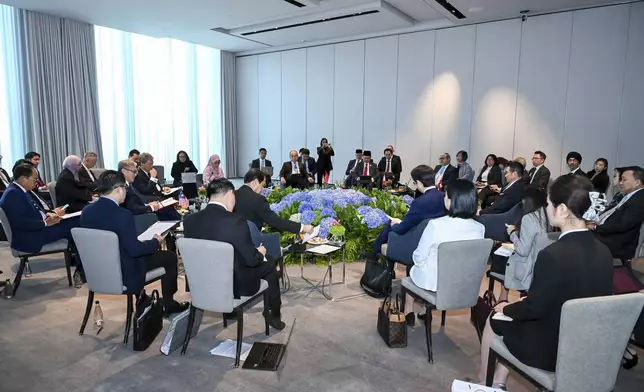
In this handout photo provided by Thailand Foreign Ministry, participants attend the Consultation amongst ASEAN Member States on Myanmar in Bangkok, Friday, Dec. 20, 2024. (Thailand Foreign Ministry via AP)
In this handout photo provided by Thailand Foreign Ministry, participants attend the Consultation amongst ASEAN Member States on Myanmar in Bangkok, Friday, Dec. 20, 2024. (Thailand Foreign Ministry via AP)

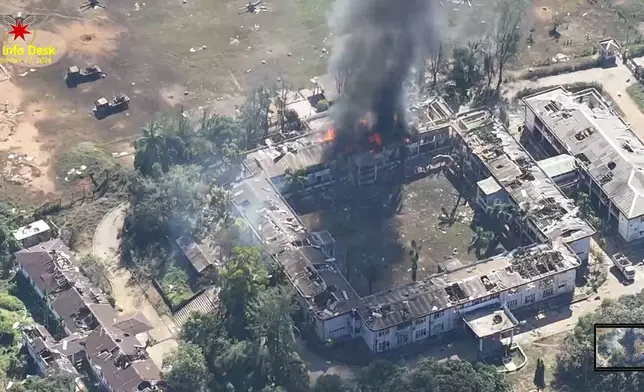
This video grab released by the Arakan Army shows burning buildings in the headquarters of the army's western command in Ann township, Rakhine state, Myanmar, Dec. 17, 2024. (The Arakan Army via AP)
This video grab released by the Arakan Army shows burning buildings in the headquarters of the army's western command in Ann township, Rakhine state, Myanmar, Dec. 17, 2024. (The Arakan Army via AP)

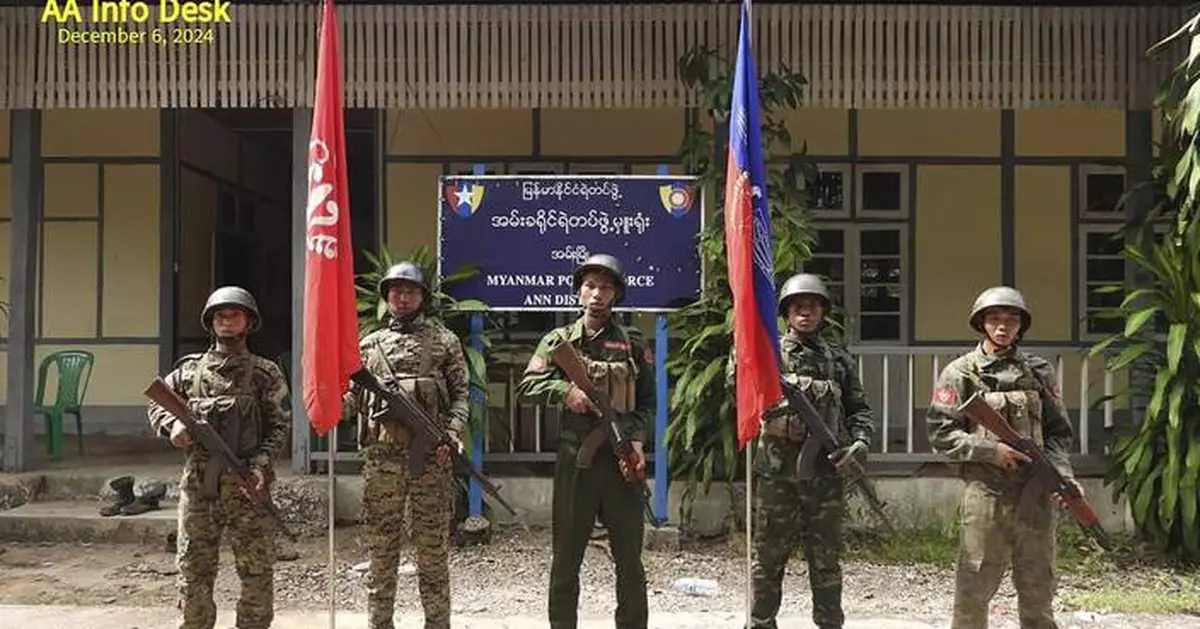
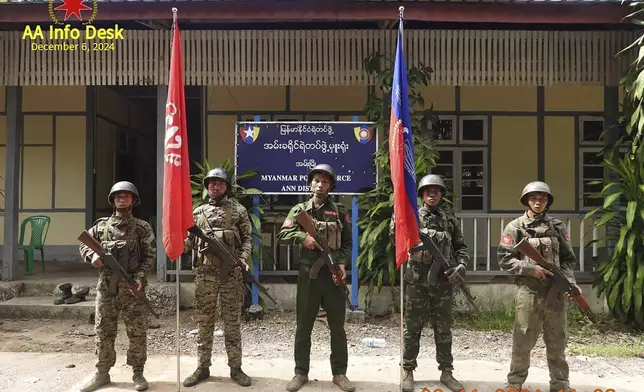
This photo released by the Arakan Army, shows members of the Arakan Army posing for a photograph in front of the captured district police office in Ann township, Rakhine state, Myanmar, Nov. 29, 2024. (The Arakan Army via AP)

This photo released by the Arakan Army, shows members of the Arakan Army posing for a photograph in front of the captured district police office in Ann township, Rakhine state, Myanmar, Nov. 29, 2024. (The Arakan Army via AP)

Rakhine has become a focal point for Myanmar’s nationwide civil war, in which pro-democracy guerrillas and ethnic minority armed forces seeking autonomy battle the country’s military rulers, who took power in 2021 after ousting the elected government of Aung San Suu Kyi.

The apparent fall of the military’s western command headquarters is the latest in a series of significant setbacks for the military government that began more than a year ago when a rebel alliance including the Arakan Army captured military bases, command centers, and strategic towns and cities along the Chinese border in Shan state in northeastern Myanmar.

In August this year, the Myanmar National Democratic Alliance Army, another force in the rebel alliance, was the first group to seize a regional command headquarters, in the city of Lashio in the northeast. Myanmar’s military has 14 important regional commands across the country.

Khaing Thukha, a spokesperson for the Arakan Army, told The Associated Press by audio message from an undisclosed location that his group had “completely captured and controlled the entire western regional military headquarters based in Ann township” on Friday at noon.

Most of the township was captured two weeks ago, leaving the headquarters encircled. The headquarters' deputy commander, Brig. Gen. Thaung Tun, and its chief operating officer, Brig. Gen. Kyaw Kyaw Than, were among those taken prisoner, Khaing Thukha said.

The headquarters had overseen operations in Rakhine and the southern part of neighboring Chin state, as well as Myanmar’s territorial waters in the Bay of Bengal.

The military government issued no news about the latest development, which could not be independently confirmed, because access to the internet and mobile phone services in the area is mostly cut off. The Arakan Army in its past official announcements has generally been conservative in its victory claims.

The Arakan Army is the well-trained and well-armed military wing of the Rakhine ethnic minority, and seeks autonomy from Myanmar’s central government. In September it launched its effort to capture Ann, about 395 kilometers (245 miles) northwest of Yangon. It began its offensive in Rakhine in November last year, and has now gained control of 13 of 17 townships, along with one in neighboring Chin state.

Rakhine, formerly known as Arakan, was the site of a brutal army counterinsurgency operation in 2017 that drove about 740,000 minority Rohingya Muslims to seek safety across the border in Bangladesh.

The Arakan Army has made extensive use of social media to document its operations and in recent days has used it to encourage the army's holdouts at the headquarters to surrender.

Separately in Thailand’s capital Bangkok, members of the Association of Southeast Asian Nations met Friday to renew their efforts to help bring peace to Myanmar. The meeting was described as an extended informal consultation.

ASEAN in early 2021 agreed on a “ Five-Point Consensus ” for peace, but the military leadership in Myanmar did virtually nothing to implement it, frustrating the group’s fellow members to the extent they have excluded members of Myanmar’s ruling military from attending their meetings. There were no representatives of Myanmar at Friday’s meeting.

The peace plan calls for the immediate cessation of violence in Myanmar, a dialogue among all concerned parties, mediation by an ASEAN special envoy, provision of humanitarian aid through ASEAN channels, and a visit to Myanmar by the special envoy to meet all concerned parties.

The foreign ministers and senior officials attending the Bangkok meeting reaffirmed their backing for the Five-Point Consensus.

Critics have expressed dissatisfaction at ASEAN’s conciliatory approach to Myanmar’s ruling generals. The military government is condemned by many countries and rights organizations for its brutal war and suppression of democracy.

“The principle laid down by ASEAN includes the words to find a Myanmar-owned and -led solution," said Nay Phone Latt, a spokesperson for Myanmar's opposition National Unity Government, or NUG. “Therefore, it will never get a Myanmar-owned and -led solution by working side by side with the terrorist military group that is not representing the people and killing them every day, instead of dealing with the revolutionary forces, including the NUG, which represents the people of Myanmar."

The NUG operates as a shadow government and stakes a claim to greater legitimacy than the ruling military.

Bryony Lau, deputy director for Asia at Human Rights Watch, told The Associated Press that “ASEAN has needed to shake up its approach to Myanmar’s crisis."

"But the meetings being held in Bangkok risk legitimizing the junta, which continues to commit war crimes and crimes against humanity with impunity against Myanmar’s people,” Lau said.

Thailand's Foreign Minister Maris Sangiampongsa talks to reporters during a press conference after attending a six-country informal consultation to discuss ways in addressing shared concerns, with talks between foreign ministers from Myanmar, China, India, Laos and Bangladesh, in Bangkok, Thailand, Thursday, Dec. 19, 2024. (AP Photo/Chatkla Samnaingjam)

Thailand's Foreign Minister Maris Sangiampongsa talks to reporters during a press conference after attending a six-country informal consultation to discuss ways in addressing shared concerns, with talks between foreign ministers from Myanmar, China, India, Laos and Bangladesh, in Bangkok, Thailand, Thursday, Dec. 19, 2024. (AP Photo/Chatkla Samnaingjam)

In this handout photo provided by Thailand Foreign Ministry, participants attend the Consultation amongst ASEAN Member States on Myanmar in Bangkok, Friday, Dec. 20, 2024. (Thailand Foreign Ministry via AP)

In this handout photo provided by Thailand Foreign Ministry, participants attend the Consultation amongst ASEAN Member States on Myanmar in Bangkok, Friday, Dec. 20, 2024. (Thailand Foreign Ministry via AP)

This video grab released by the Arakan Army shows burning buildings in the headquarters of the army's western command in Ann township, Rakhine state, Myanmar, Dec. 17, 2024. (The Arakan Army via AP)

This video grab released by the Arakan Army shows burning buildings in the headquarters of the army's western command in Ann township, Rakhine state, Myanmar, Dec. 17, 2024. (The Arakan Army via AP)

This photo released by the Arakan Army, shows members of the Arakan Army posing for a photograph in front of the captured district police office in Ann township, Rakhine state, Myanmar, Nov. 29, 2024. (The Arakan Army via AP)
This photo released by the Arakan Army, shows members of the Arakan Army posing for a photograph in front of the captured district police office in Ann township, Rakhine state, Myanmar, Nov. 29, 2024. (The Arakan Army via AP)
PARIS (AP) — Bernadette Chirac, the steel-willed former first lady of France who spent 12 years at the Élysée Palace from 1995 to 2007 beside President Jacques Chirac while building her own political power in rural Corrèze and turning a children’s hospital charity into a national institution, has died. She was 93.

President Emmanuel Macron confirmed her death Saturday, saying he and his wife Brigitte had learned with “great sadness” of the passing of a woman who marked French history beside Jacques Chirac, who died in 2019, and changed the lives of millions of patients through her charitable work.

“A great lady of the heart has departed,” Macron said.

For more than half a century, Chirac was the fixed point in her late husband’s restless climb — through Parliament, two terms as prime minister, 18 years as mayor of Paris and, in 1995, the presidency.

She appears in the official photographs with her chin lifted, blond hair lacquered into place, a small handbag on her arm, looking less like a spouse than like an institution.

But the caricature never quite contained her.

The Chanel suits, dark glasses, nasal voice and withering judgments became part of the national image.

Beneath them was a relentless worker and a cold-eyed political operator who, almost alone among the wives of French presidents, built a base of power that was her own.

She was born Bernadette Thérèse Marie Chodron de Courcel on May 18, 1933, in Paris, into money, lineage and Catholic duty.

Her father’s family included soldiers, industrialists and diplomats; an uncle had served as an aide to Charles de Gaulle in wartime London.

But her life would be most marked by her time at the prestigious Sciences Po university in Paris, where she met Jacques Chirac, a handsome and much-courted young man whose appetite for politics would come to define them both.

They married in March 1956. The union lasted 63 years and was, by her own account, a long lesson in endurance.

Jacques Chirac was famous for his warmth, appetite and instinctive connection with crowds. Bernadette’s gifts were different, observers said.

She was controlled, socially formidable, devout, exacting and sometimes devastatingly funny.

The Catholic philosopher Jean Guitton called her the “last queen of France,” and she did little to discourage the idea.

Her husband’s reputation as a womanizer was an open secret she chose, after much pain, to meet with dry humor.

Swarmed by photographers in Corrèze in 1998 — after rumors that Jacques Chirac had been unreachable the night Princess Diana died because he was with an actress — she stepped from her car and deadpanned: “Calm down. I’m not Claudia Cardinale. Or Lollobrigida.”

“At first, it was hard. I was very heartbroken, and then I got used to it,” she said years later in a television documentary.

“I told myself that was how things were and that I had to accept it with as much dignity as possible.”

Sent to tend her husband’s rural stronghold in Corrèze while he pursued power in Paris, she did far more than tend it. In 1971, she was elected municipal councilor in Sarran. In 1979, she became a general councilor in Corrèze and held the seat until 2015.

Her influence grew after Jacques Chirac became president in 1995. The role of first lady in France has no constitutional power, but she made the Élysée a place where her approval mattered.

She could be loyal, cutting and unforgiving, and understood that campaigns are made not only of speeches and polls but of debts, slights and resentments.

Yet she also carved out a space for female authority inside a male political culture that had little interest in sharing power — making it quietly clear that she would not be reduced to “the wife of.”

Her deepest grief stayed mostly private.

The Chiracs’ elder daughter, Laurence, developed severe anorexia after meningitis in adolescence and attempted suicide more than once. She never fully recovered and died in 2016 at 58.

That ordeal pushed Chirac toward the charitable work that reshaped her public image.

In 1994, she took over a medical charity that collected coins for children in hospitals. To millions of French viewers, the woman once mocked for hauteur became the face of hospitalized children and families living around hospital beds.

She continued running it until 2019, when she handed it to Brigitte Macron, the wife of France's current president, and became honorary president.

By then, she had long since become a political force in her own name.

“My husband no longer does politics, but I do,” she said to journalists, after Jacques Chirac left office in 2007.

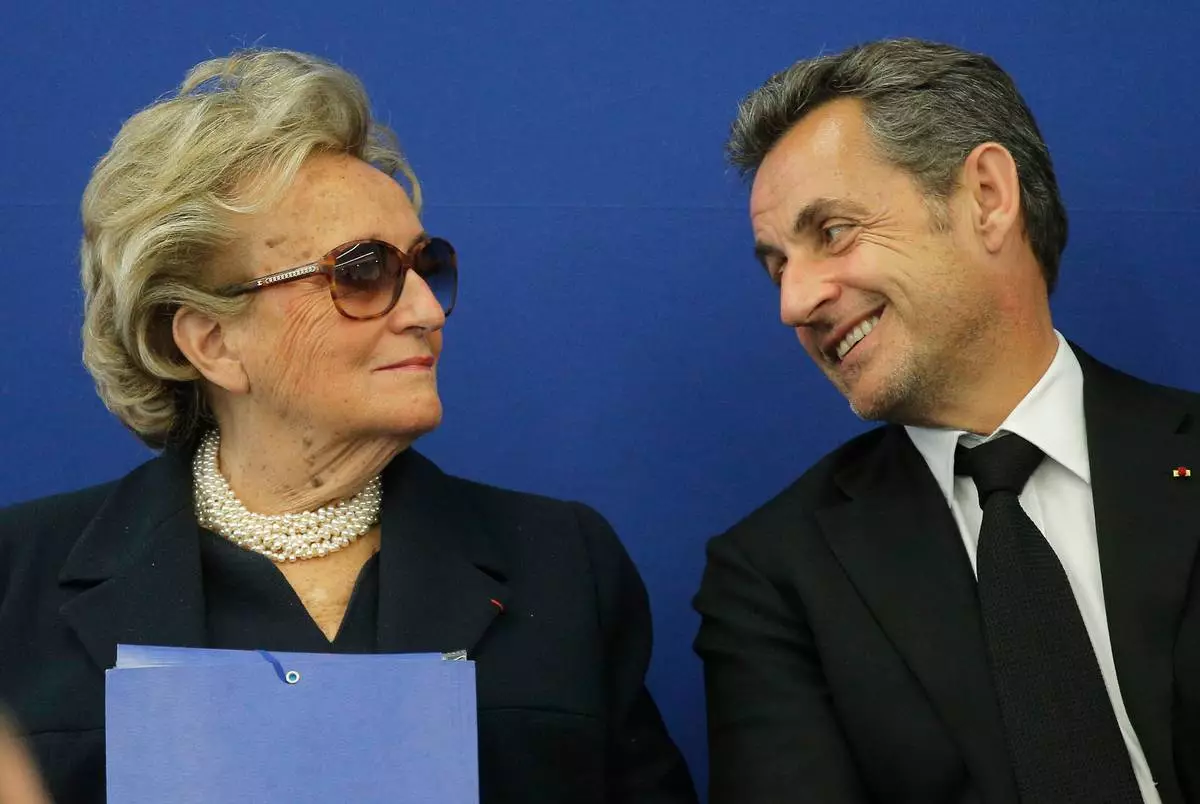
She famously nicknamed Dominique de Villepin, the Élysée official she distrusted, “Nero,” yet also reportedly helped engineer her husband’s reconciliation with Nicolas Sarkozy, the former protégé who had betrayed him politically.

Her 2001 memoir, “Conversation,” written with journalist Patrick de Carolis, sold hundreds of thousands of copies and introduced the French to a franker, funnier and more independent woman than many had assumed.

After Jacques Chirac left the Élysée, his health declined and his public voice faded. Hers remained sharper for longer. Asked how he was, according to French media, she answered in her flat, unmistakable voice: “He keeps the dog.”

Age and grief eventually drew her out of public view.

By the time Jacques Chirac died in 2019, she was too fragile to take part in the public farewell where France and foreign leaders honored him.

FILE - Former French President Nicolas Sarkozy speaks with former first lady Bernadette Chirac during the inauguration of the Foundation Claude Pompidou, Centre teaching and research on Alzheimer's disease, Monday, March 10, 2014, in Nice, southeastern France. (AP Photo/Lionel Cironneau, File)

FILE - Former French President Nicolas Sarkozy speaks with former first lady Bernadette Chirac during the inauguration of the Foundation Claude Pompidou, Centre teaching and research on Alzheimer's disease, Monday, March 10, 2014, in Nice, southeastern France. (AP Photo/Lionel Cironneau, File)

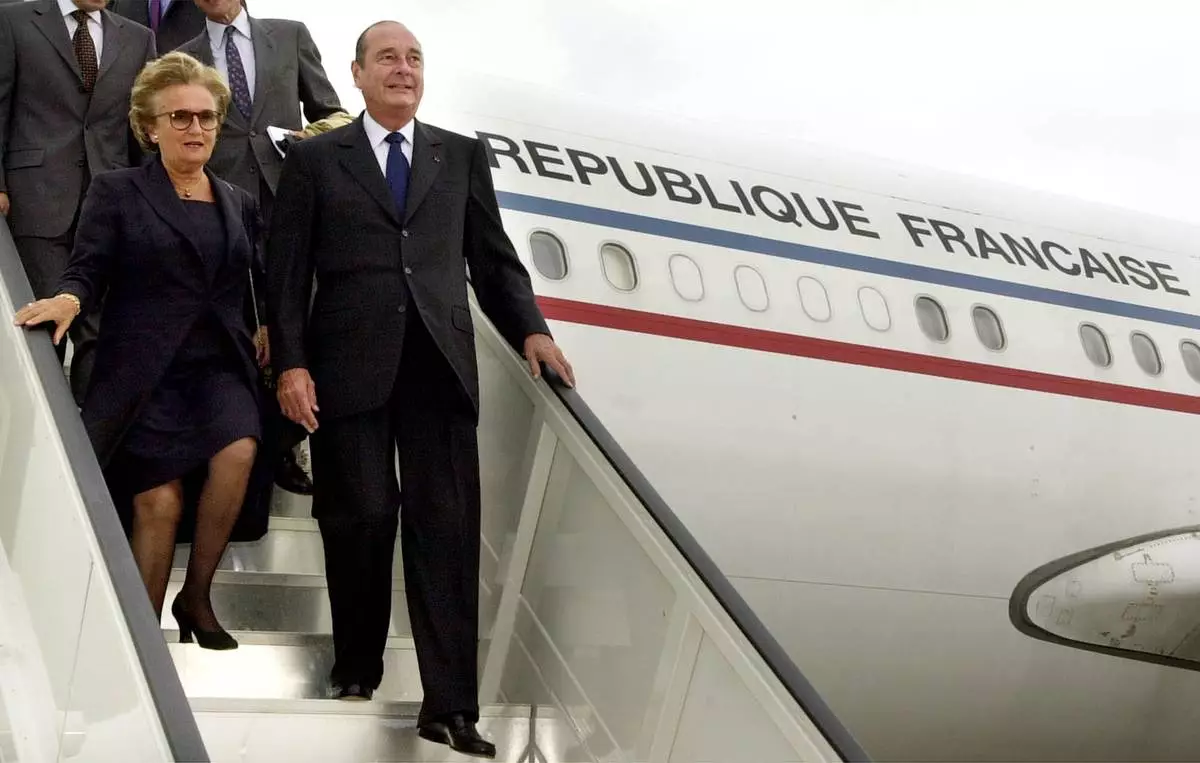
FILE - French President Jacques Chirac and his wife Bernadette arrive at the airport in Hanover, Germany on Sunday, June 25, 2000. (AP Photo/Jens Meyer, File)

FILE - French President Jacques Chirac and his wife Bernadette arrive at the airport in Hanover, Germany on Sunday, June 25, 2000. (AP Photo/Jens Meyer, File)

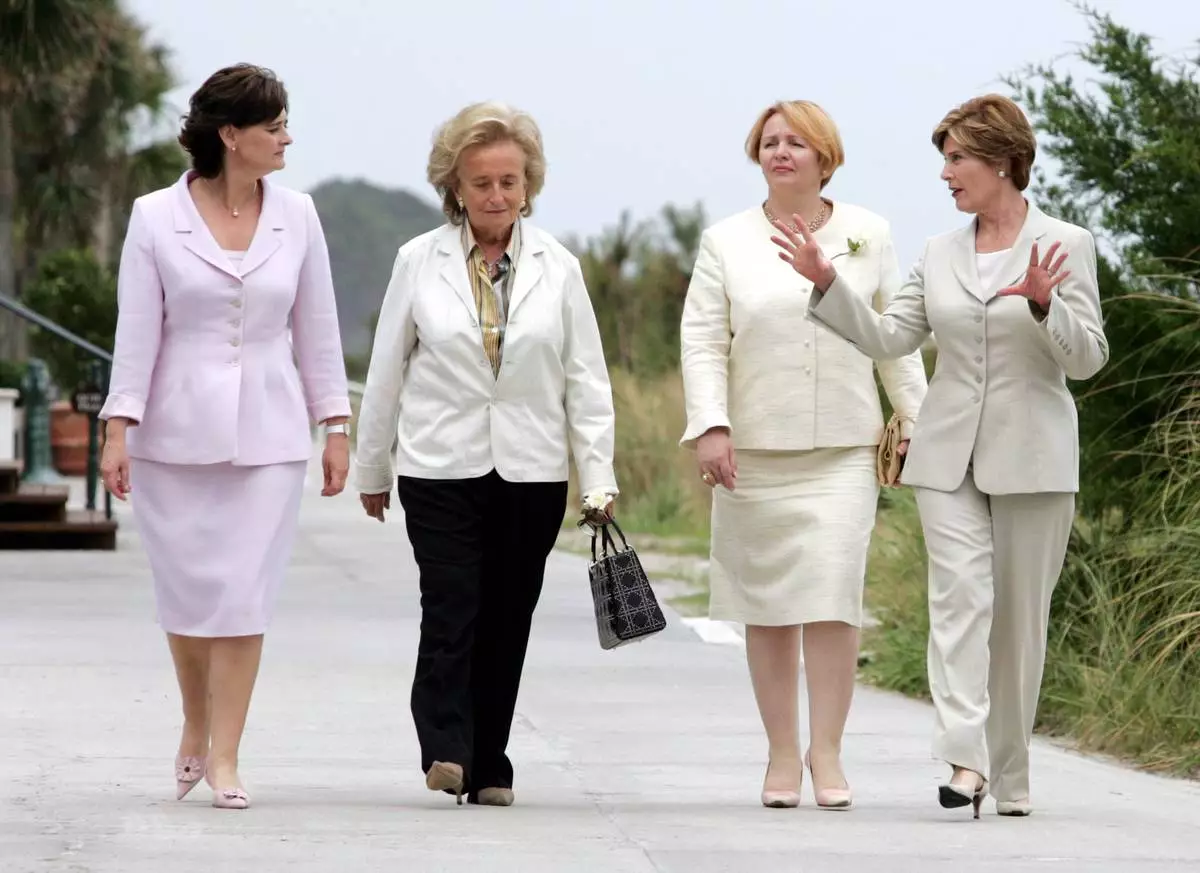
FILE - From left: Cherie Blair, wife of British Prime Minister Tony Blair Bernadette Chirac, wife of French President Jacques Chirac, Lyudmila Putina, wife of Russian President Vladimir Putin, and First Lady Laura Bush, converse as they walk to a press conference site at the G-8 Summit on Sea Island, Ga., Wednesday, June 9, 2004. (AP Photo/Ric Feld, File)

FILE - From left: Cherie Blair, wife of British Prime Minister Tony Blair Bernadette Chirac, wife of French President Jacques Chirac, Lyudmila Putina, wife of Russian President Vladimir Putin, and First Lady Laura Bush, converse as they walk to a press conference site at the G-8 Summit on Sea Island, Ga., Wednesday, June 9, 2004. (AP Photo/Ric Feld, File)

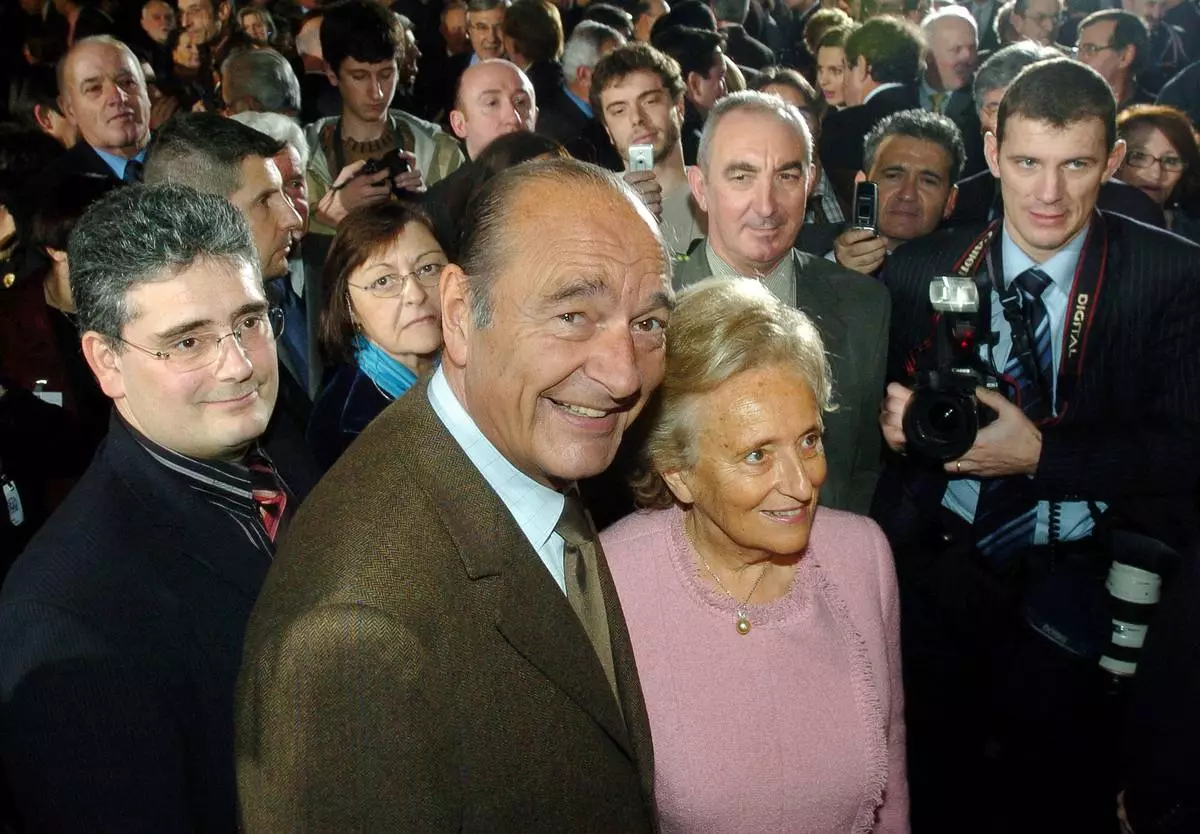
FILE - French President Jacques Chirac, center left, and his wife First Lady Bernadette Chirac are surrounded by the crowd after addressing New Year wishes to the inhabitants of the region of Correze, in Tulle, southwestern France, Saturday, Jan. 14, 2006. (AP Photo/Bob Edme, File)

FILE - French President Jacques Chirac, center left, and his wife First Lady Bernadette Chirac are surrounded by the crowd after addressing New Year wishes to the inhabitants of the region of Correze, in Tulle, southwestern France, Saturday, Jan. 14, 2006. (AP Photo/Bob Edme, File)

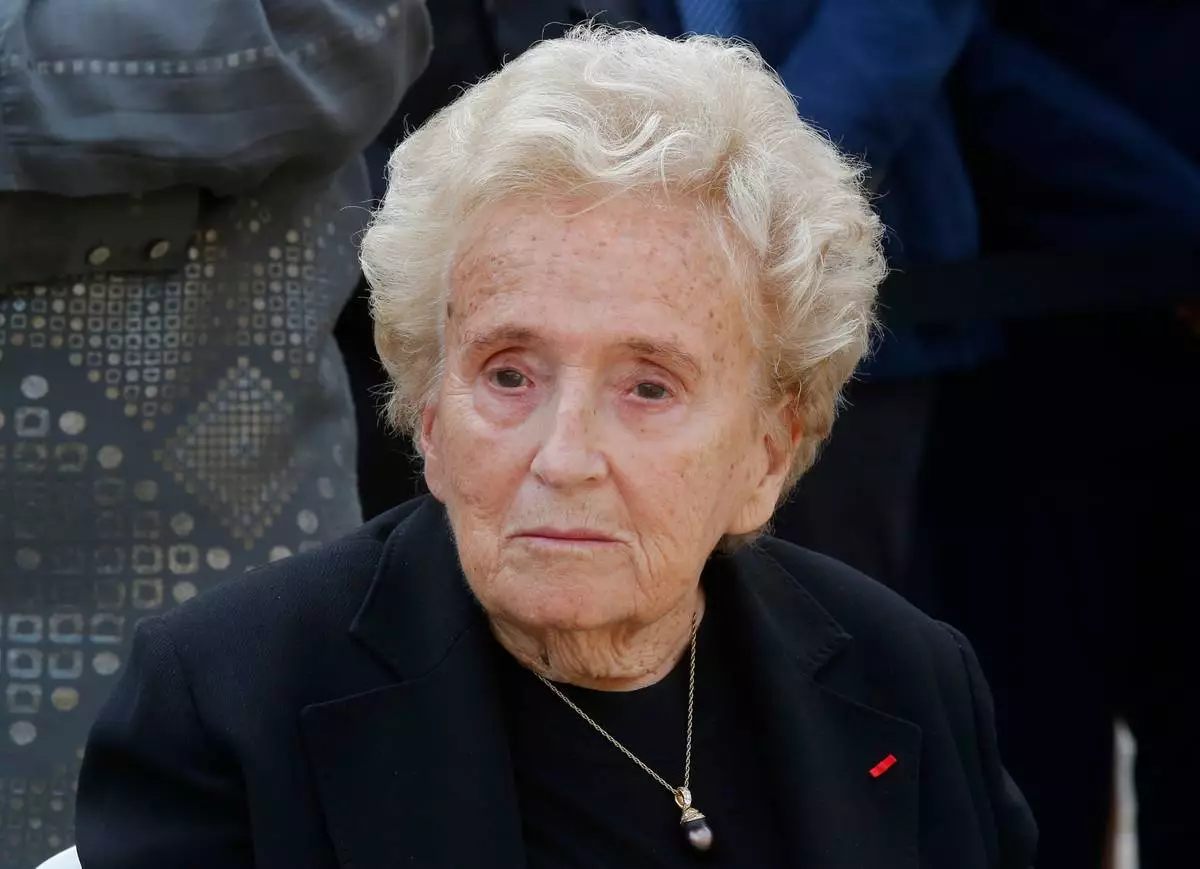
FILE - Bernadette Chirac, wife of former French President Jacques Chirac attends a ceremony to pay tribute to Simone Veil in the courtyard of the Invalides in Paris, France, Wednesday, July 5, 2017. (AP Photo/Michel Euler, File)

FILE - Bernadette Chirac, wife of former French President Jacques Chirac attends a ceremony to pay tribute to Simone Veil in the courtyard of the Invalides in Paris, France, Wednesday, July 5, 2017. (AP Photo/Michel Euler, File)

Recommended Articles