China's 41st Antarctic expedition team recently departed from the Zhongshan Station, a Chinese research base in Antarctica, heading toward the inland areas for a series of scientific research projects.
Among them, 17 team members will travel past the Taishan Station before reaching the Kunlun Station, located at an elevation of 4,087 meters on the highest point of the Antarctic ice sheet, where they will carry out various scientific investigations.
"Our team will travel to the Kunlun Station, located 1,260 kilometers from the Zhongshan Station. We will conduct environmental surveys along the way, as well as research on space physics and multi-dimensional astronomical observations at the Kunlun Station. Additionally, we will verify the performance of domestically-made snow sledges and high-pressure oxygen chambers in the field," said Jin Xinmiao, head of both the Kunlun and Taishan stations.
Meanwhile, another eight team members will head for the Grove Mountains in east Antarctica, an area with an average altitude exceeding 2,000 meters.
"We will conduct ice radar and phase-sensitive radar surveys in the Qilin Subglacial Lake," said Yao Xu, one of the team members.
As the second-largest buried lake discovered so far in Antarctica, the Qilin Subglacial Lake was named by China in 2022 and is located in the Princess Elizabeth Land in the East Antarctic inland ice sheet.
The Chinese expedition team will also conduct active-source seismic measurements, GNSS monitoring, and material balance observations in the Qilin Subglacial Lake, as well as the collection of snow and ice samples. The data will provide scientific basis for selecting drilling sites for subglacial lake exploration.
The Qilin Subglacial Lake, located beneath 3,600 meters of ice, is characterized by extreme conditions, including high pressure, darkness, low temperatures, and low nutrients. Over the past 3 million years, it has remained a stable site ideal for cutting-edge scientific research on life processes in extreme environments, the evolution of the Antarctic ice sheet, and climate change on Earth.
Moreover, the lake serves as a valuable analog between early Earth environments and extraterrestrial bodies, providing crucial reference for understanding the evolution of life on Earth and for the search for extraterrestrial life.
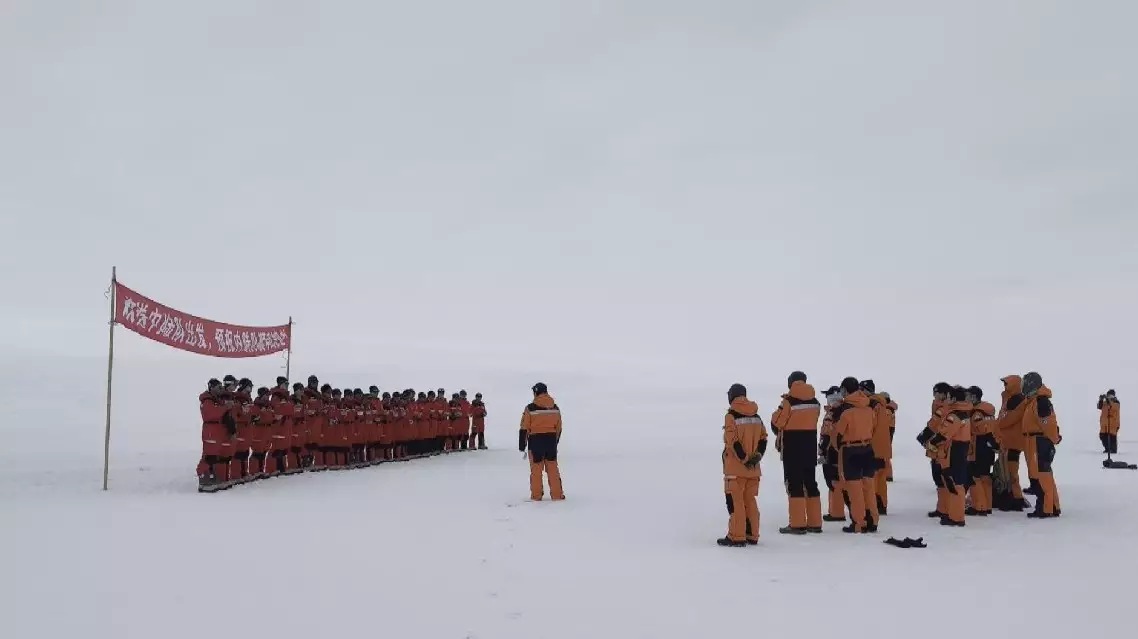
Chinese expedition team heads for Antarctic interior for scientific research