China's marketing service system for agricultural products has been further improved so far this year, as a result of in-depth implementation of the program for cultivating high-quality agricultural brands.
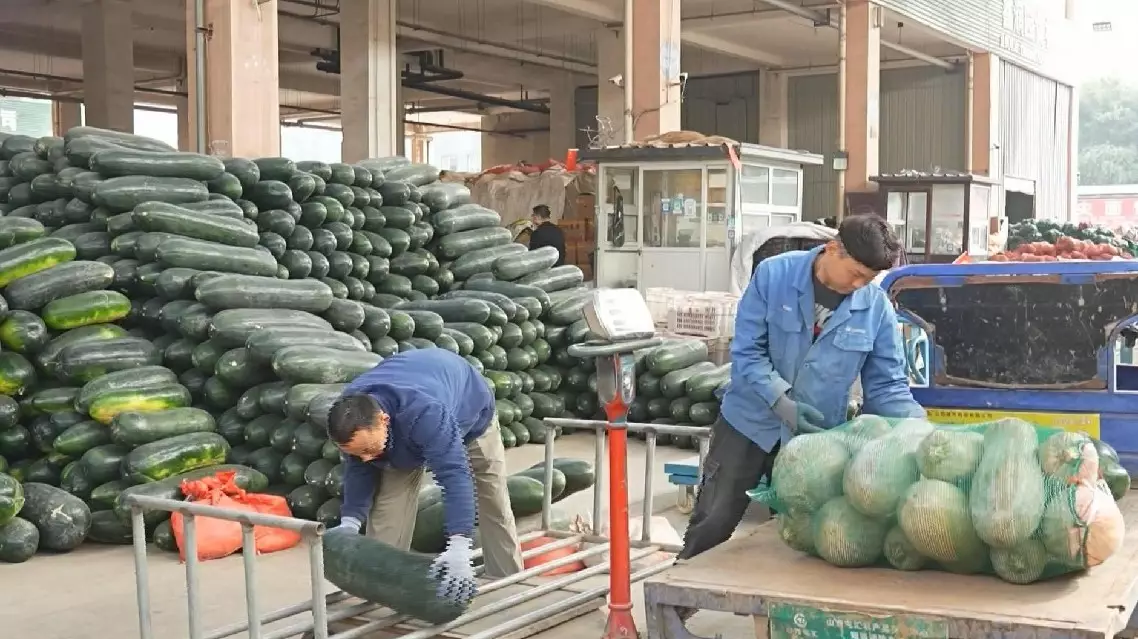
The Ministry of Agriculture and Rural Affairs, in collaboration with 20 of the 31 provincial-level regions on the Chinese mainland, has spearheaded the development of 33 national-level farm produce markets and approved the designation of 663 farm produce wholesale markets so far in 2024. Besides, a first batch of 55 key counties (or county-level cities) have been designated to build cold-chain logistics hubs in them, along with the establishment of 500 cold-chain collection and distribution centers.
These efforts are intended to create essential cold-chain circulation hubs linking urban and rural areas while building integrated service platforms that seamlessly connect production with marketing.
In Yongxing County, central China's Hunan Province, farmers were busy harvesting and packing fresh oranges from a 200-mu (approximately 13.33 hectares) orchard for delivery to the Guangdong-Hong Kong-Macao Greater Bay Area in south China, one of China's most economically vibrant regions.
To make sure that the oranges reach consumers faster, the local postal service has established "mobile courier points" in the fields during the harvest season. These facilities bring shipping services directly to the orchards, streamlining processes and addressing challenges such as excessive transit links, high fruit damage rates, and delivery delays.
"A mobile courier point like this one handles over 10,000 parcels daily, with the peak volume reaching around 30,000. We also allocate delivery vehicles based on the orchard size. Currently, over 30 delivery vehicles are dispatched to the orchards daily," said Zhou Xin, a staff member at the Yongxing branch of China Post.
Beyond these mobile facilities, the region has established over 30 fixed service stations so far this year, extending courier services to more villages. These advancements enable agricultural products to be packaged and shipped directly from the fields.
Across China's rural areas, over 100 million parcels now move in and out daily, with express delivery services covering 90 percent of villages.
Looking ahead, the Ministry of Agriculture and Rural Affairs plans to further enhance logistics infrastructure, promote the cultivation and protection of competitive agricultural brands, and accelerate transition from the adoption of traditional sales methods to the application of modern distribution systems.
China's marketing service system for farm produce further improved