GOTHENBURG, Sweden (AP) —
Burial associations in Sweden are looking to acquire enough land for something they hope they'll never have to do: bury thousands of people in the event of war.
The search follows recommendations from the Church of Sweden’s national secretariat, which reflect crisis preparedness guidelines from the Swedish Civil Contingencies Agency (MSB) and the Swedish Armed Forces.
The preparedness guidelines have been put in a new light by Sweden's decision to join NATO and tensions with Russia in the Baltic Sea region.
According to the Church of Sweden provisions, supported by legal paragraphs in Sweden’s Burial Act, burial associations are responsible for ensuring the availability of enough land to bury roughly 5 percent of the population within a parish, if needed.
The Goteborg Burial Association, which operates in Sweden’s second-largest city, is currently trying to navigate the challenge of acquiring at least 10 acres (40,470 square meters) of land to ensure it can handle urgent casket burials for some 30,000 dead in case of war. That is in addition to another 15 acres (60,700 square meters) of land needed for building graveyards for regular use in Goteborg.
”The (recommendations) mean that we need more land for burial grounds and this is a phenomenon in the big cities, and a problem in the big cities, where land resources are scarce to begin with and not always sufficient to meet burial ground needs even in times of calm and peace,” said Katarina Evenseth, senior advisor at the Goteborg Burial Association.
Together with the local municipality, which has a monopoly in making decisions about land usage in Goteborg, the burial association has identified a vast area appropriate for building a large-scale cemetery for the intended purpose.
But a lengthy approval and building process means it could take approximately 10 years to complete, posing further challenges in uncertain times.
Meanwhile, the Swedish Civil Contingencies Agency (MSB) continues to stress the importance of crisis preparedness and highlights the efforts of the Church of Sweden.
”Already back in 2015 the Government assigned various authorities to once again start engaging in civil defense planning, and many organizations have started planning, with the Church of Sweden being at the forefront of that planning,” said Jan-Olof Olsson, Critical Infrastructure Protection (CIP) expert at MSB.
“Unfortunately it is the case that we are reminded to a greater degree that war could happen and that we simply need to be prepared for that,” Olsson said.
Sweden pursued a policy of neutrality from the early 19th Century, including during World War II.
But public opinion shifted sharply in 2022 after Russia launched a full-scale invasion of Ukraine, leading to Sweden and Finland applying to join the transatlantic alliance out of concern about the threat from their newly aggressive Russian neighbor across the Baltic Sea.
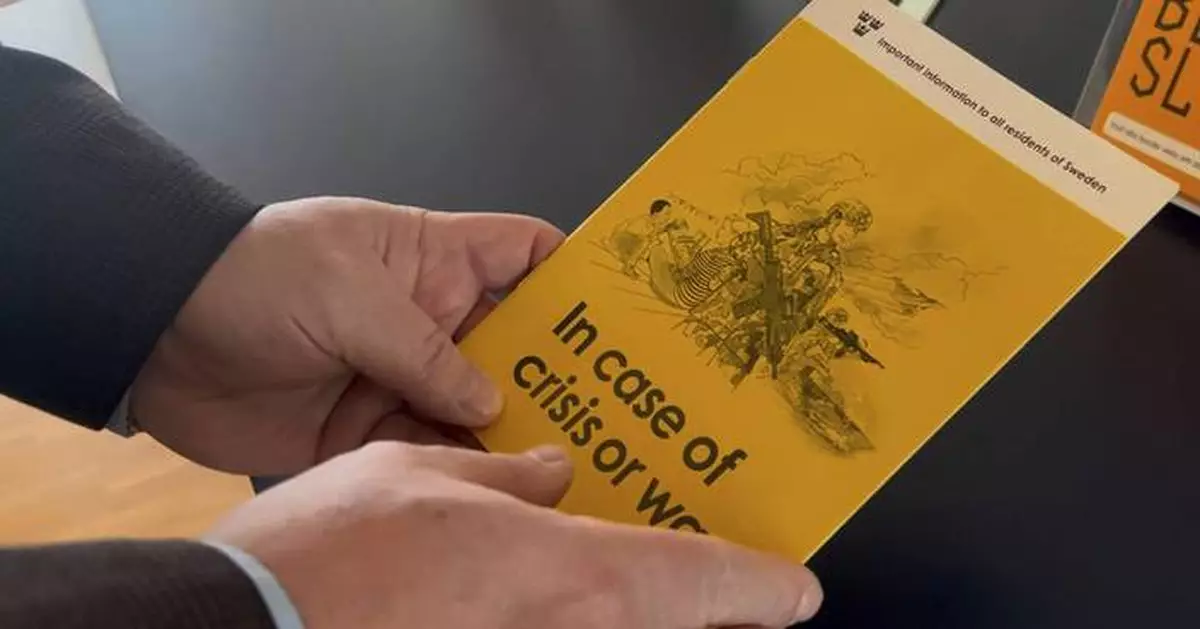
Sweden and Finland sent out updated civil preparedness guides in November with instructions on how to survive in war. The guides are similar to those in Denmark and Norway, though they don't mention Russia by name.

A view of the entrance sign at Östra Kyrkogården, one of the largest cemeteries in Gothenburg, Sweden, Friday, Dec. 20, 2024. (AP Photo/Mimmi Montgomery)

Hundreds of old graves at Östra Kyrkogården, one of the largest cemeteries in Gothenburg, Friday, Dec. 20, 2024 in Gothenburg, Sweden. (AP Photo/Mimmi Montgomery)

Jan-Olof Olsson, Critical Infrastructure Protection (CIP) expert at the Swedish Civil Contingencies Agency (MSB) holds a yellow crisis preparedness brochure titled "In case of crisis or war", which was distributed to all Swedish households, Thursday, Dec. 26, 2024, in Karlstad, Sweden. (AP Photo/Mimmi Montgomery)
NAKHON RATCHASIMA, Thailand (AP) — A construction crane crashed onto a moving passenger train in northeastern Thailand on Wednesday, triggering a fiery derailment that killed at least 32 people and injured dozens more.
The crash occurred in Nakhon Ratchasima, some 200 kilometers (135 miles) northeast of Bangkok, on a section of a planned high-speed rail project that is intended to eventually connect China with much of Southeast Asia.
The province's Public Health Provincial Office said there were 32 fatalities and 64 injured victims, including seven with severe injuries. There were still three passengers missing among the 171 believed to have been on board the train, it said in a statement issued as night fell.
Authorities said the crane was being used to build an elevated part of the railway when it fell as the train was traveling from the capital, Bangkok, to Ubon Ratchathani province. Thailand's Rail Transport Department said the crane was what is called a launching gantry crane, a self-supporting structure with vertical legs that usually runs on rails or wheels for mobility, allowing it to progress along with the construction project that it straddles. Such cranes are often used to help build elevated roads.
Images published in Thai media showed plumes of white, then dark, smoke rising from the crash site, with construction equipment dangling from girders between two concrete support pillars.
Rescue workers stood on top of overturned railway carriages, some of them with gaping holes torn on their sides, video from public broadcaster ThaiPBS showed. What appeared to be sections of the crane were scattered along the track.
Sixty-two year-old Samai Teechantuek, whose house is about 100 meters (yards) from the site of the accident, told The Associated Press of the horror of witnessing the accident, and hearing “the noises screeching, and then bam, bam, bam, all the way over there.”
“When the dust settled, I saw the top of the train carriage. I heard people shouting ‘save the children first!’” she said. "A conductor pulled people out. I saw them pulling many people out. People from the shop over there also ran out to help.”
“My legs were shaking. I was standing there shaking. I didn’t dare going any closer,” she said.
Transport Minister Phiphat Ratchakitprakarn said he ordered an investigation.
In August 2024, a railway tunnel on the planned route, also in Nakhon Ratchasima, collapsed, killing three workers. Days of heavy rainfall were believed to have been a factor in the collapse.
The elevated segment that collapsed is a part of a Thai-Chinese high-speed railway project linking the capital to the northeastern province of Nong Khai, bordering Laos. The two-stage rail project has a total investment cost of more than 520 billion baht ($16.8 billion) and is associated with an ambitious plan to connect China with Southeast Asia under Beijing's Belt and Road Initiative. The section where the accident took place had a budget of more than 179 billion baht ($5.7 billion) and according to its original plans was expected to start operating in 2027.
Anan Phonimdaeng, acting governor of the State Railway of Thailand, said the project's contractor is Italian-Thai Development, with a Chinese company responsible for design and construction supervision.
He said authorities will examine the responsibilities of both parties, and the Railway Department plans to take legal action against the contractor as a first step. Damage to the train was estimated to be more than 100 million baht ($3.2 million), while construction equipment suffered limited damage, said Anan.
A statement posted on the company's website expressed condolences to the victims and said the company would take responsibility for paying compensation to the families of the dead and hospitalization expenses for the injured.
The main contractor for the route's first stage between Bangkok and Nakhon Ratchasima, Italian-Thai Development, was also the directly responsible for construction of the segment where Wednesday's accident occurred.
The rail accident sparked outrage because the company, also known as Italthai, was also the co-lead contractor for the State Audit Building in the Thai capital Bangkok, which collapsed during construction in March during a major earthquake.
About 100 people were killed in the collapse, which was the only major structure in Thailand to suffer such serious damage. Dozens of executives were indicted in connection with the disaster but none have yet been tried.
The involvement of Chinese companies in both projects has also drawn attention, as has Italthai's and Chinese companies' involvement in the construction of several expressway extensions in and around Bangkok where several accidents, some fatal, had occurred.
Prime Minister Anutin Charnvirakul, who was interior minister when the State Audit Building collapsed, said that the Comptroller General’s Department and Transport Ministry are responsible for blacklisting contractors, and the laws could not be amended in the brief time he was interior minister to expedite the matter.
In Beijing, Chinese Foreign Ministry spokesperson Mao Ning said the government was aware of the reports about the accident and had expressed condolences.
“The Chinese government attaches great importance to the safety of projects and personnel, and we are also learning about the situation,” he said. “At present, it appears that the relevant section is being constructed by a Thai company, and the cause of the accident is still under investigation.”
Wasamon reported from Bangkok.
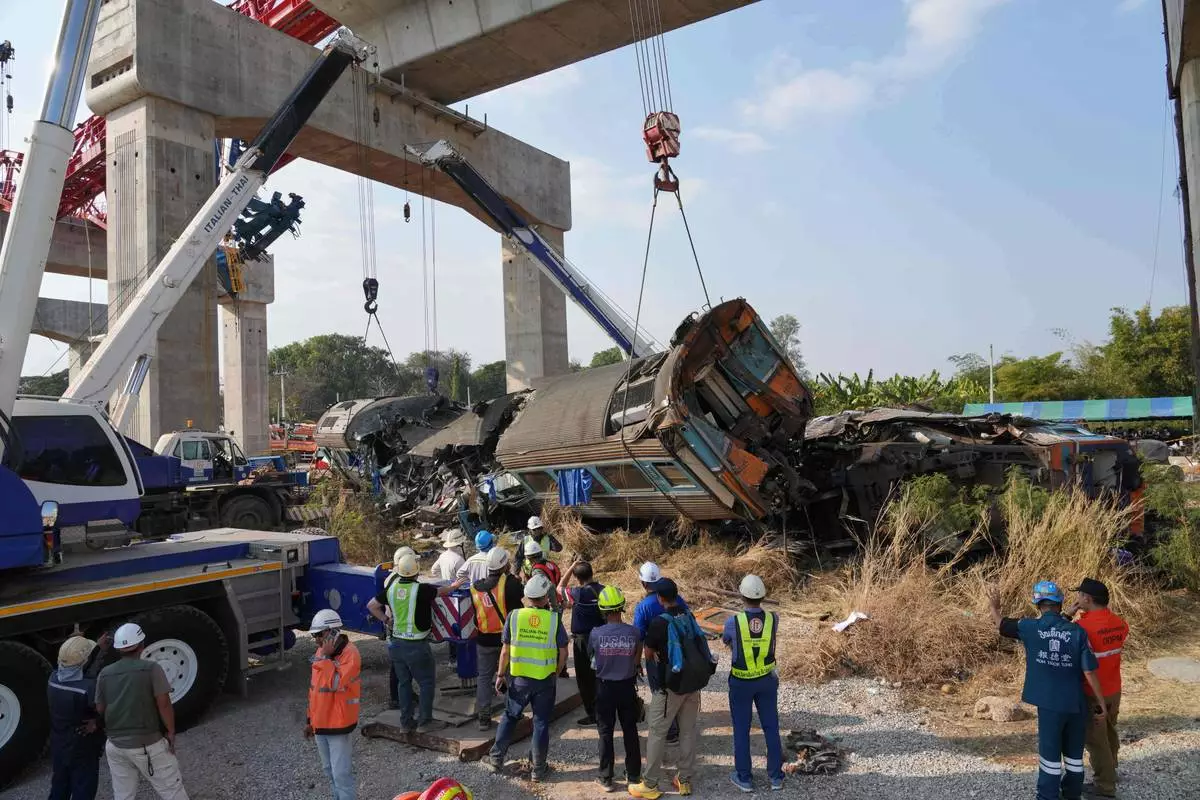
Rescuers try to lift the wreckage after a construction crane fell into a passenger train in Nakhon Ratchasima province, Thailand, Wednesday, Jan.14, 2026. (AP Photo/Sakchai Lalit))
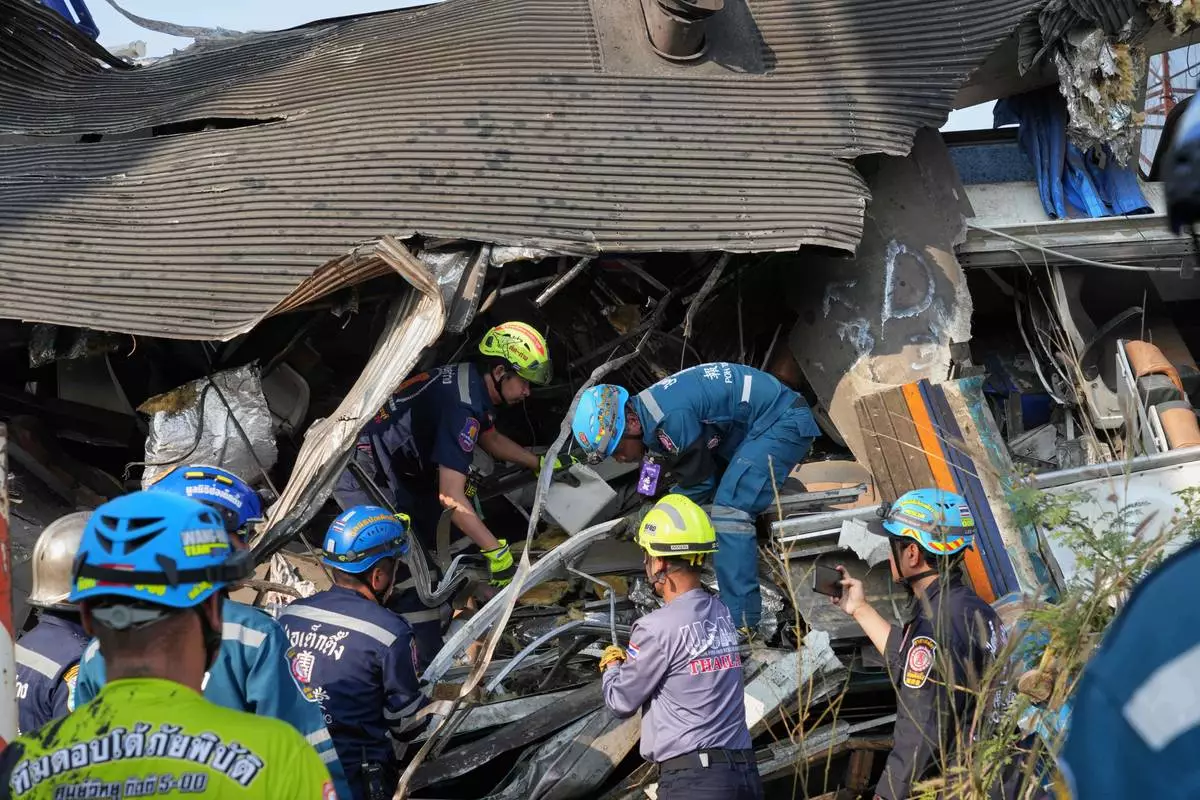
Rescuers work amid the wreckage after a construction crane fell into a passenger train in Nakhon Ratchasima province, Thailand, Wednesday, Jan.14, 2026. (AP Photo/Sakchai Lalit))
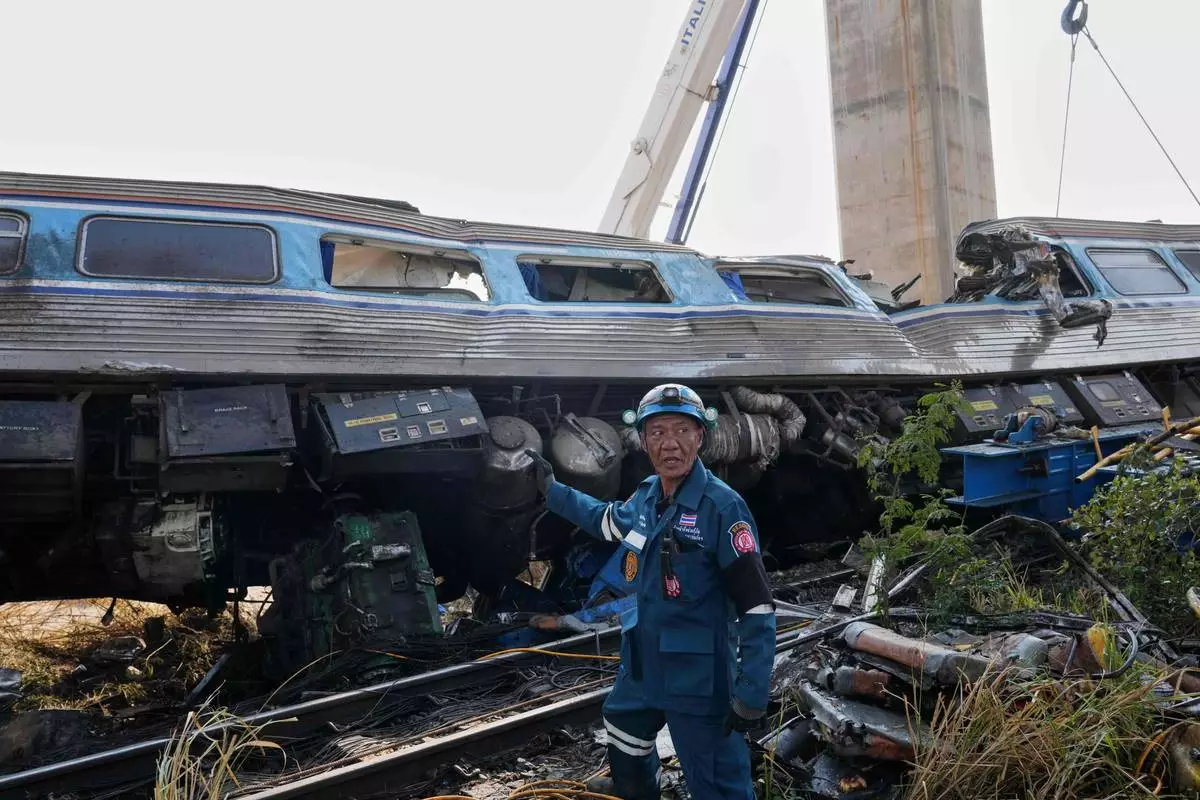
A rescuer stands near the wreckage after a construction crane fell into a passenger train in Nakhon Ratchasima province, Thailand, Wednesday, Jan.14, 2026. (AP Photo/Sakchai Lalit))
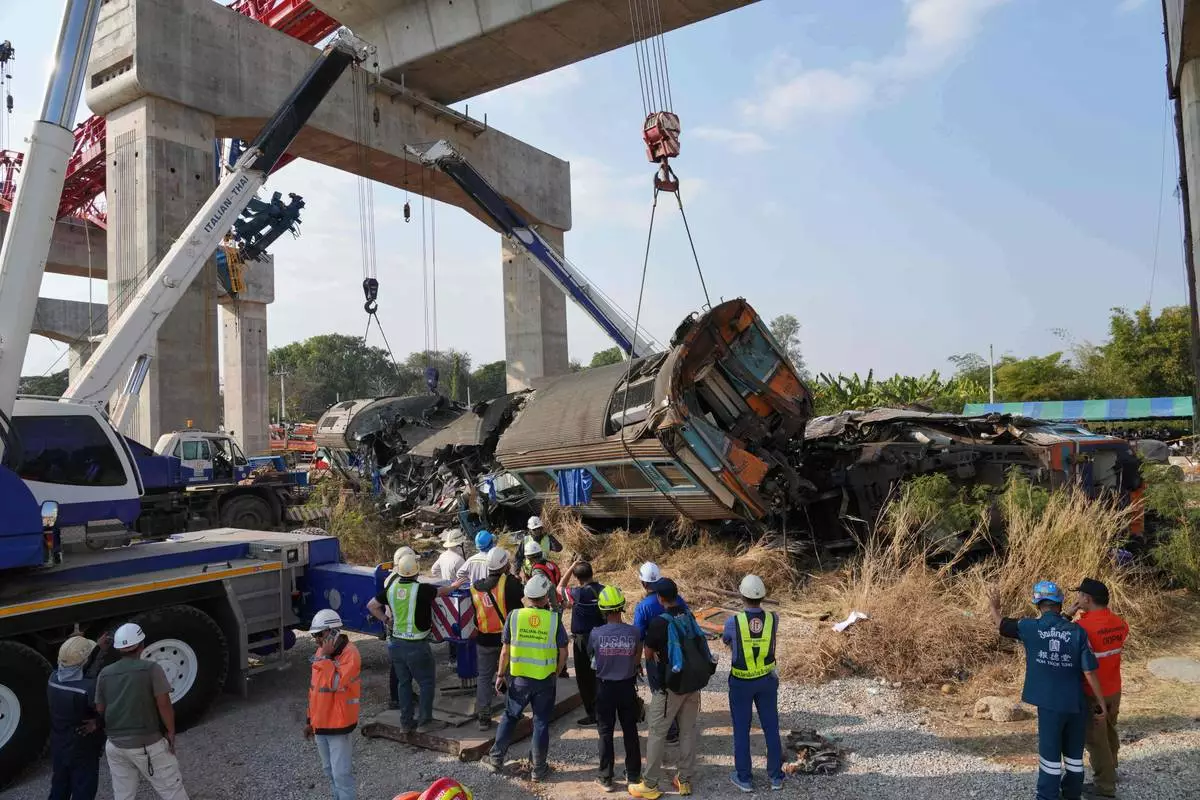
Rescuers try to lift the wreckage after a construction crane fell into a passenger train in Nakhon Ratchasima province, Thailand, Wednesday, Jan.14, 2026. (AP Photo/Sakchai Lalit))
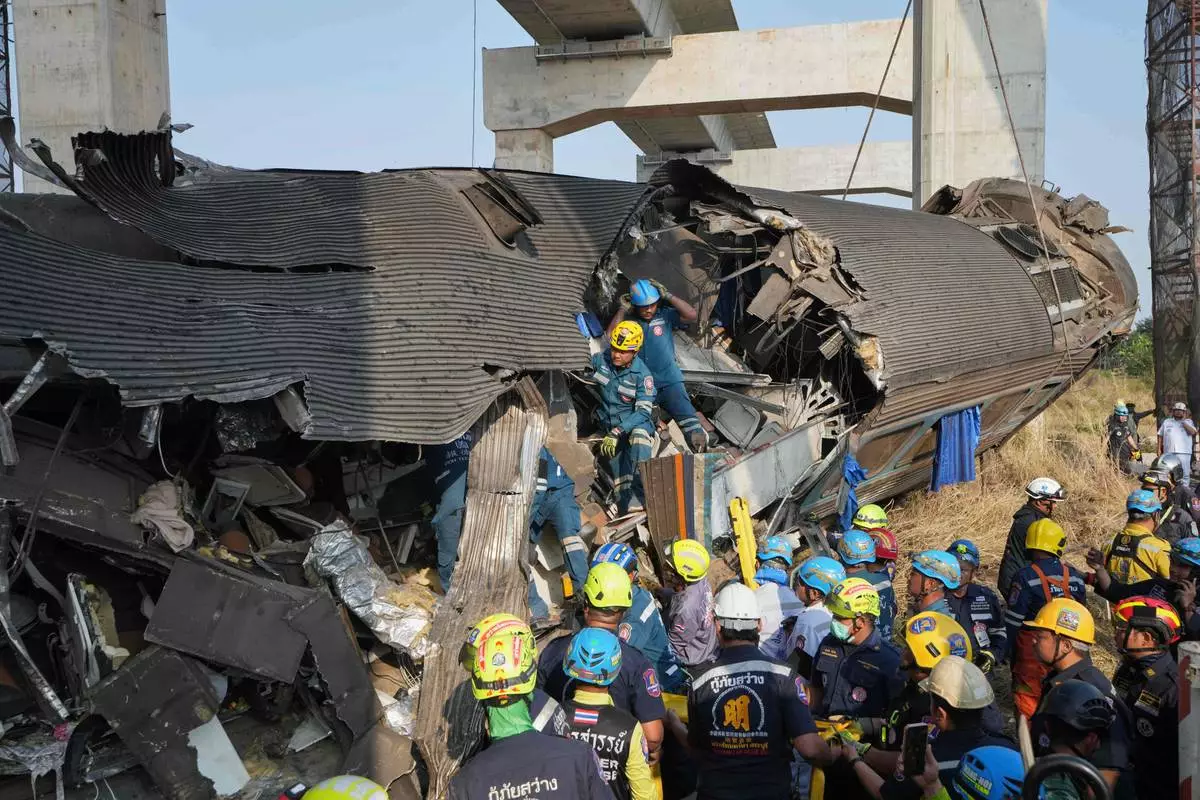
Rescuers work amidst the wreckage after a construction crane fell into a passenger train in Nakhon Ratchasima province, Thailand, Wednesday, Jan.14, 2026. (AP Photo/Sakchai Lalit))
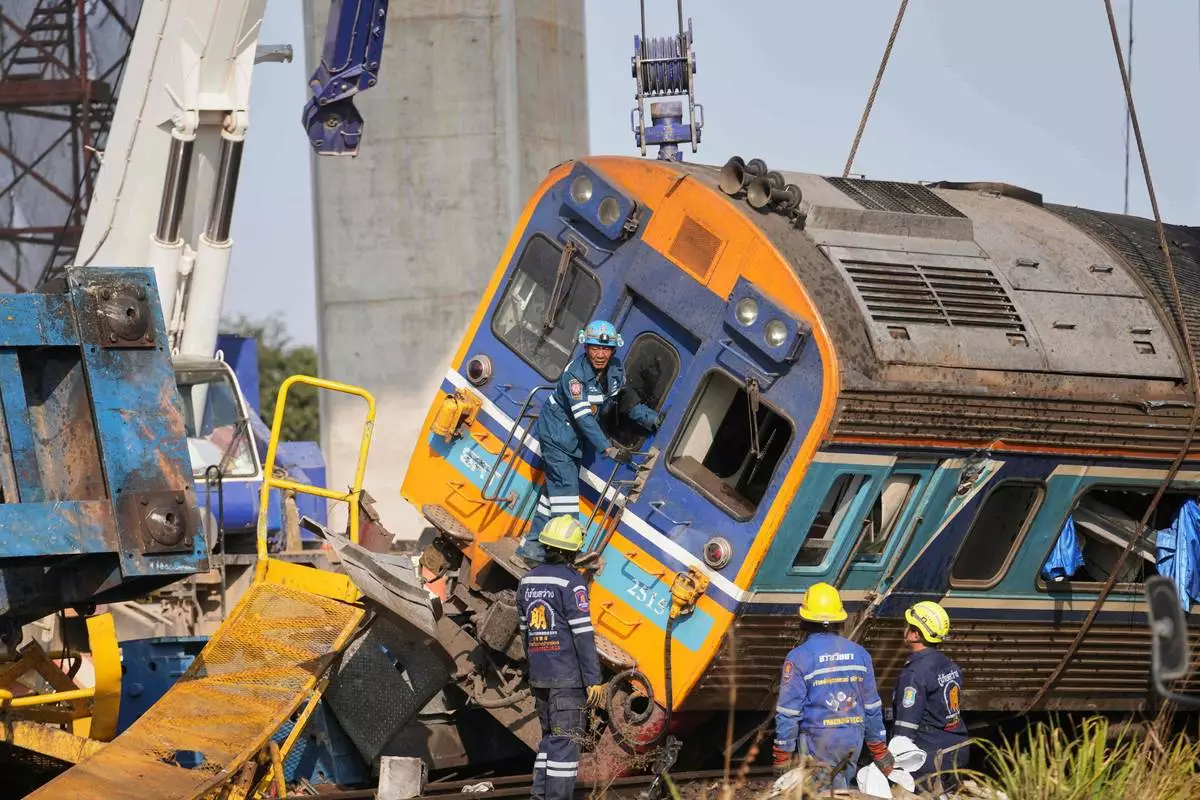
Rescuers work amidst the wreckage after a construction crane fell into a passenger train in Nakhon Ratchasima province, Thailand, Wednesday, Jan.14, 2026. (AP Photo/Sakchai Lalit))
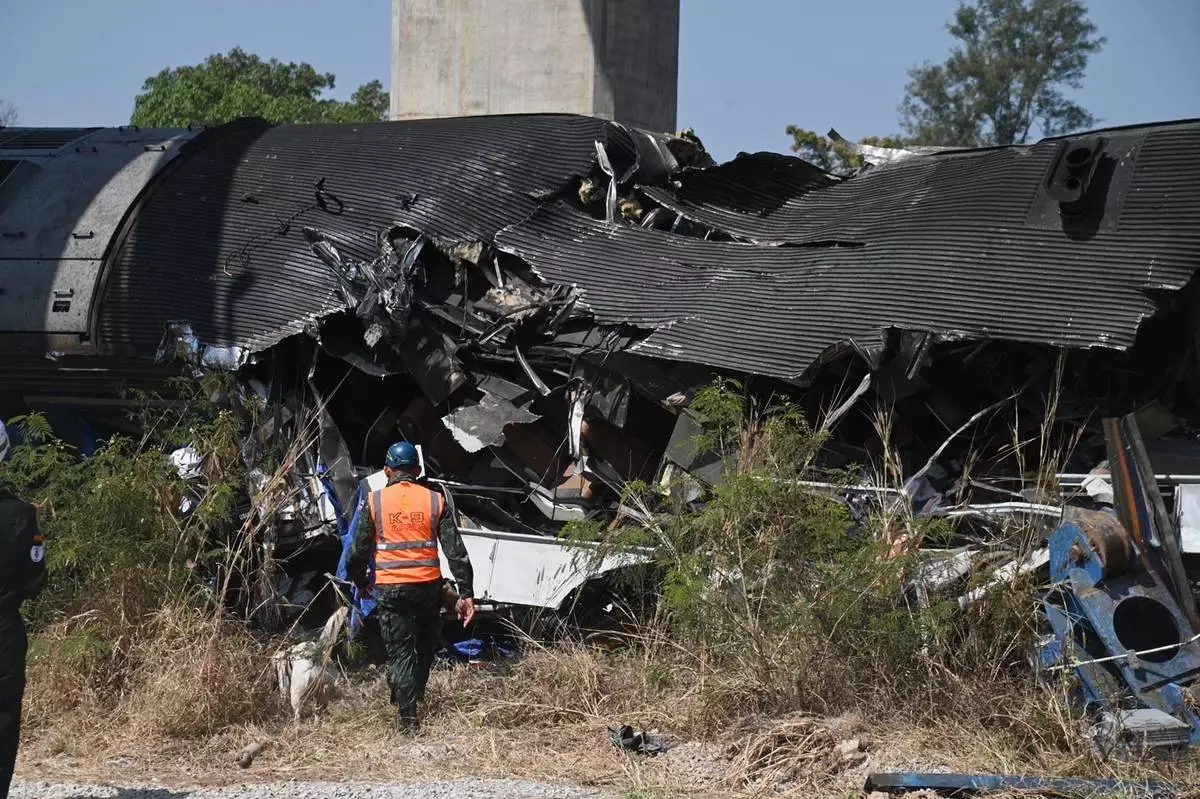
An aid workers at the scene after a construction crane fell into a passenger train in Nakhon Ratchasima province, Thailand, Wednesday, Jan. 14, 2026. (AP Photo/Nathathida Adireksarn)
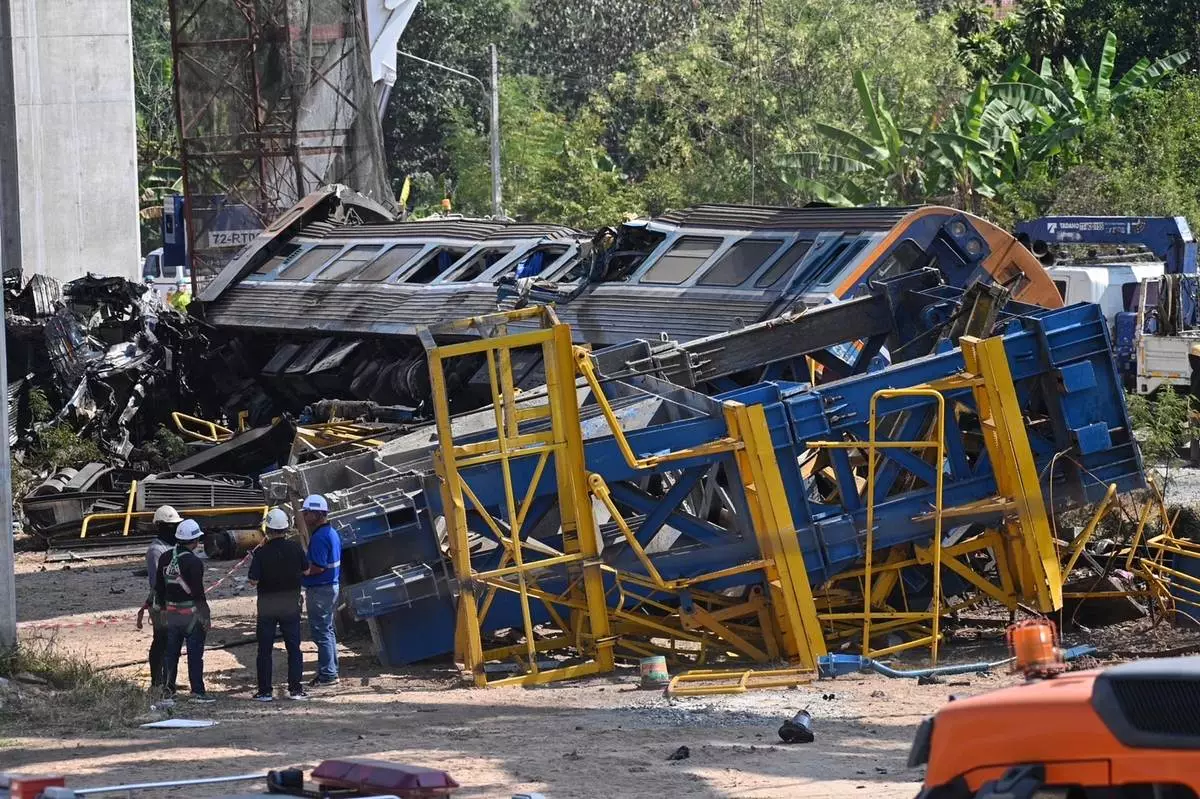
The wreckage after a construction crane fell into a passenger train in Nakhon Ratchasima province, Thailand, Wednesday, Jan. 14, 2026. (AP Photo/Nathathida Adireksarn)
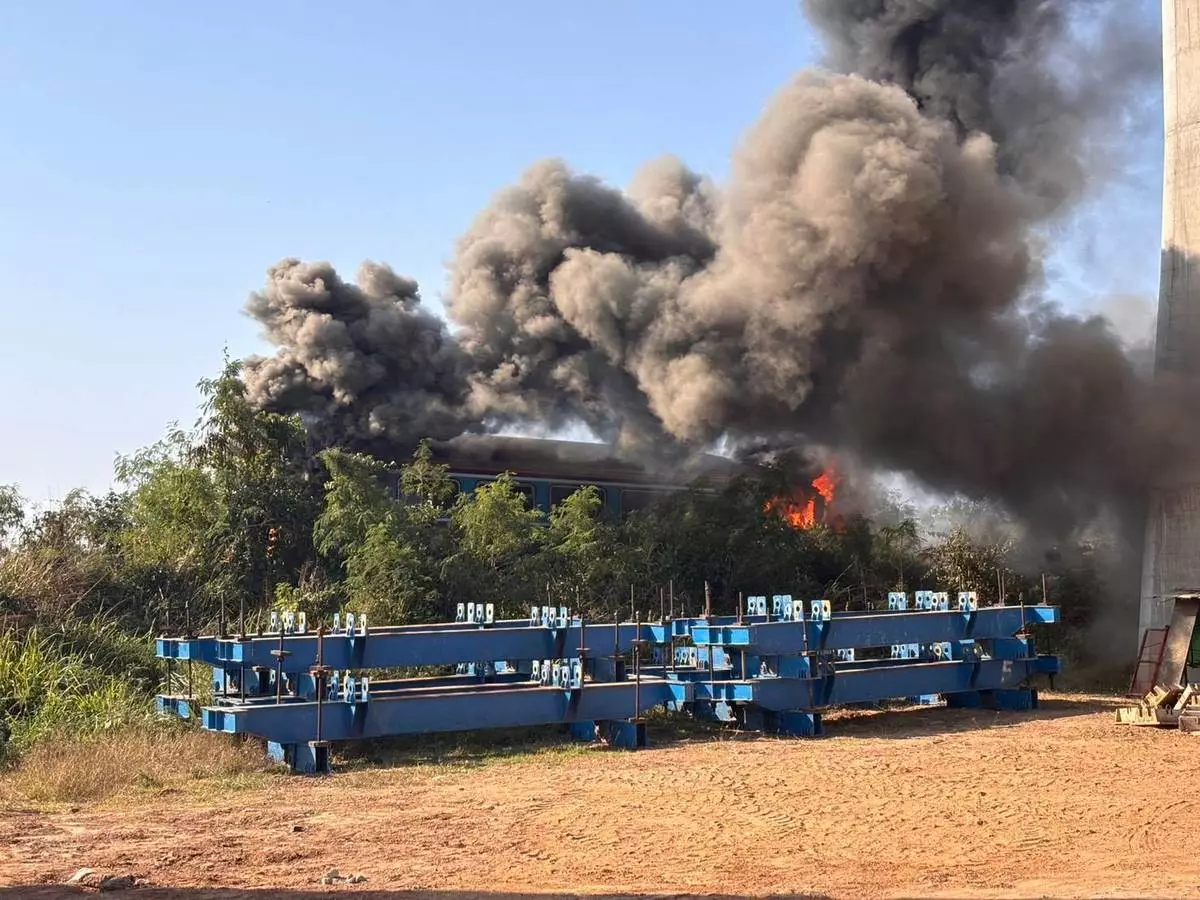
This photo released from Thailand's Ministry of Transport, shows a scene after a construction crane fell into a passenger train in Nakhon Ratchasima province, Thailand Wednesday, Jan. 14, 2026. (Ministry of Transport via AP)
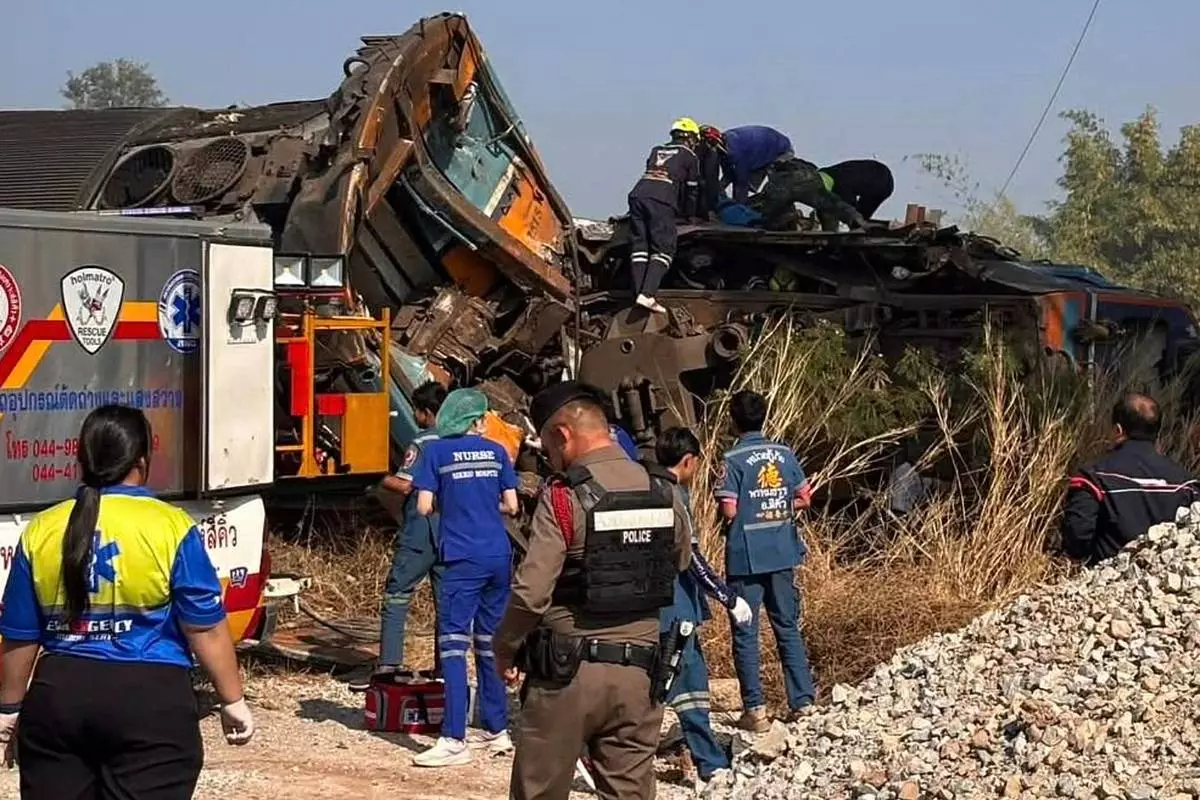
This photo released from State Railway of Thailand, shows aid workers after a construction crane fell into a passenger train in Nakhon Ratchasima province, Thailand Wednesday, Jan. 14, 2026. (State Railway of Thailand via AP)
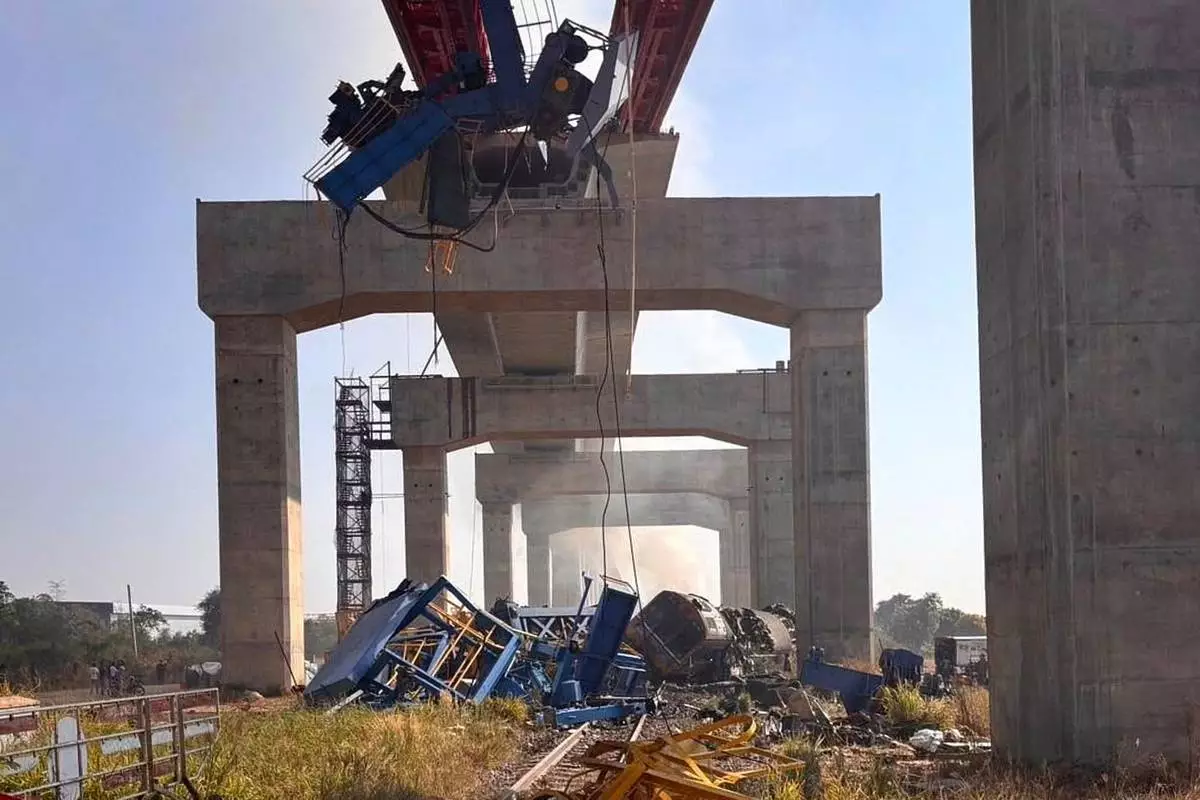
This photo released from State Railway of Thailand, shows a scene after a construction crane fell into a passenger train in Nakhon Ratchasima province, Thailand Wednesday, Jan. 14, 2026. (State Railway of Thailand via AP)
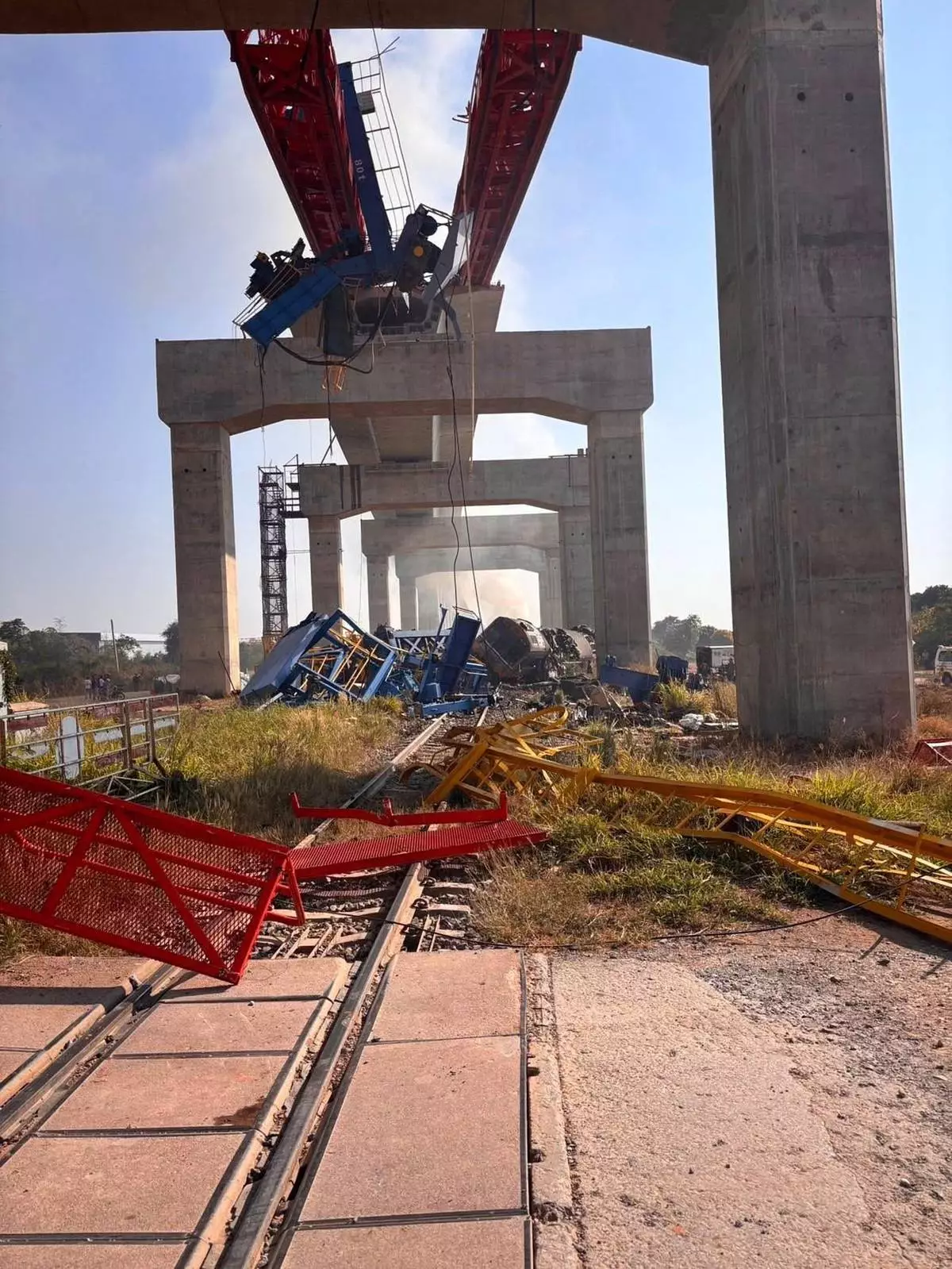
This photo released from State Railway of Thailand, shows a scene after a construction crane fell into a passenger train in Nakhon Ratchasima province, Thailand Wednesday, Jan. 14, 2026. (State Railway of Thailand via AP)
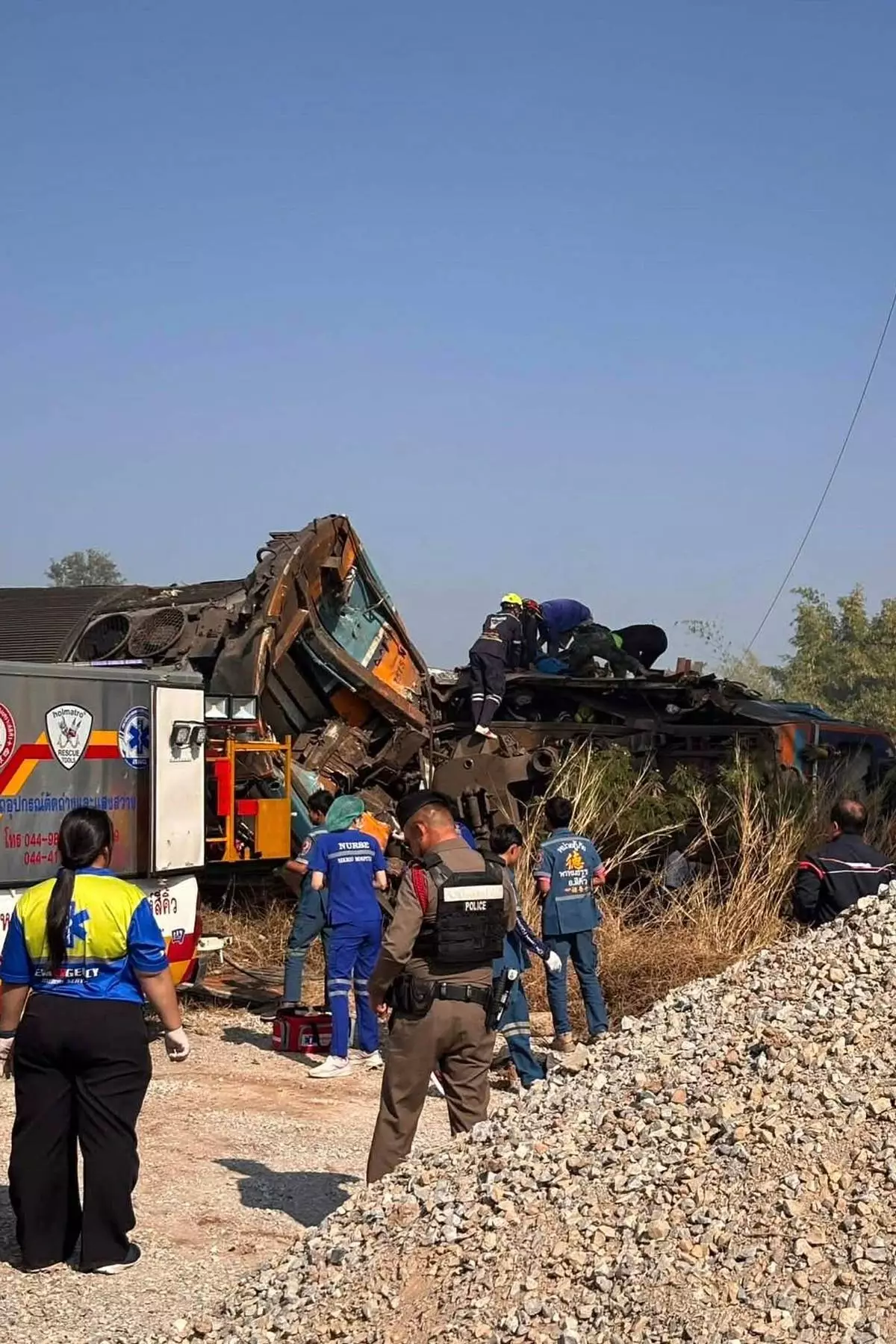
This photo released from State Railway of Thailand, shows aid workers after a construction crane fell into a passenger train in Nakhon Ratchasima province, Thailand Wednesday, Jan. 14, 2026. (State Railway of Thailand via AP)
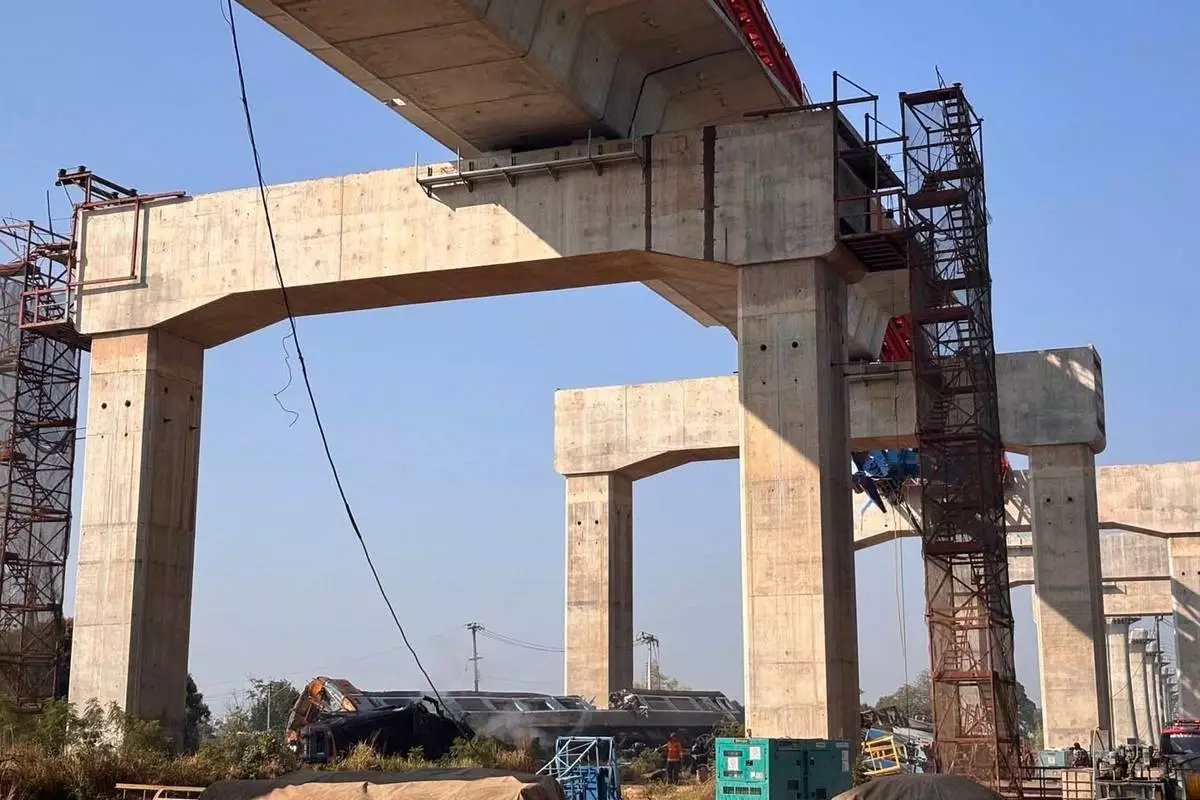
This photo provided by State Railway of Thailand shows a scene after a construction crane fell into a passenger train in Nakhon Ratchasima province, Thailand Wednesday, Jan. 14, 2026. (State Railway of Thailand via AP)