Flower sellers across China are seeing their auspicious varieties sought after by customers who began to decorate their home in the run-up to the traditional Spring Festival.
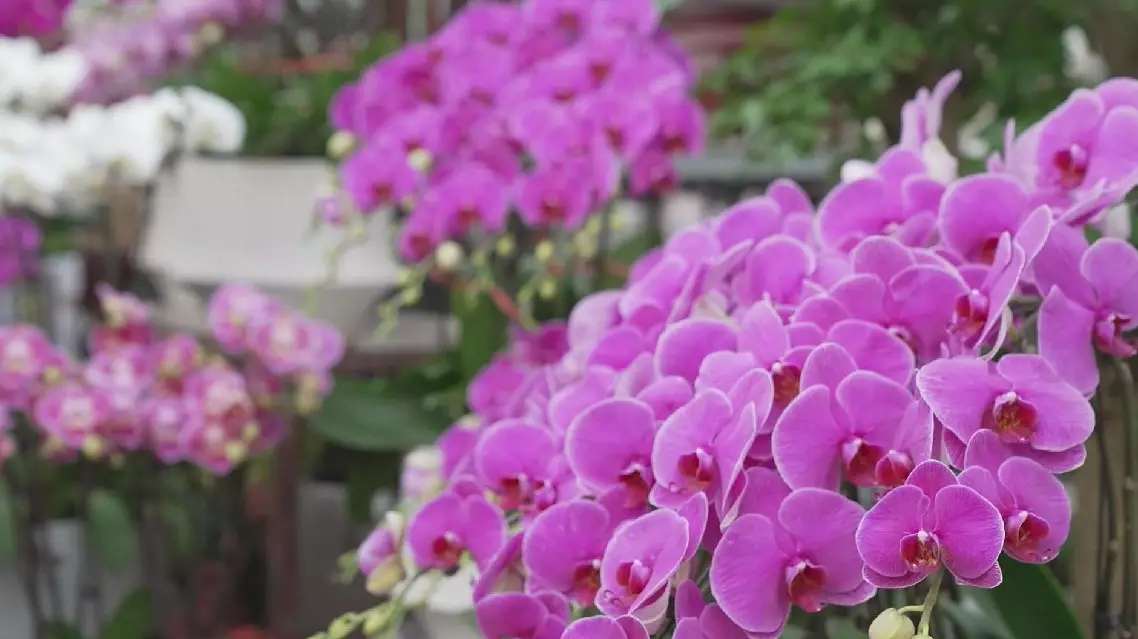
Colorful bromeliads and butterfly orchids are typically seen as lucky symbols for the new year, and this year in flower markets across China, they are in plenty supply as usual.
In Luohe City, central China's Henan Province, flower farmers said butterfly orchids are now the prime choice for customers coming to pick a plant to decorate their houses and many of them said they choose butter orchids because of their bright colors.
"The Spring Festival is just around the corner and I've come to buy some potted flowers to decorate my home. Butterfly orchids have bright colors, so I plan to put some of them in my home to warm up the atmosphere for the near year," said Luo Xiaobei, a customer.
Boxes of potted bromeliads are also sent to south China's Guangdong-Hong Kong-Macao Greater Bay Area city cluster from Ganzhou City of east China's Jiangxi Province. The auspicious plants have a long flowering period and are thus highly welcomed on the market.
The rising demand is at the same time fueling the development of flower cultivation technologies. In Hangzhou City, east China's Zhejiang Province, butterfly orchid farmers have been cooperating with universities and research institutes to develop new varieties and technologies and they said that annual sales of the flower reached over 200 million yuan (over 27 million U.S. dollars) over the recent years.
"Technologies are used to promote flower induction and to prevent and control pests and plant diseases. We have also made the pots with more permeable materials and are using air-conditioners to simulate the natural environment so that we can induce flowering throughout the whole year and ensure plenty supply to the market," said Zhu Guangchang, a butterfly orchid farmer.
The upcoming Chinese Lunar New Year falls on Jan 29, 2025, with an eight-day public holiday running from Jan 28 to Feb 4.
Auspicious flowers win favor of Chinese customers as Spring Festival draws near
A new China Global Television Network (CGTN) documentary explores how the historic Long March spirit is driving modern innovation, as young Chinese researchers and engineers are channeling this relentless drive to overcome critical bottlenecks in the EV and AI industries.
Titled "The Source of AI: Not a Single Rock Goes to Waste", the documentary highlights the pioneering journeys of Zhong Yu and He Pengyu.
Two years ago, Zhong made a pivotal career shift, leaving a long-established automaker to return to China and join Farasis Energy, a homegrown battery manufacturer based in Ganzhou City of east China's Jiangxi Province.
Working around the clock, Zhong and his team are developing solid-state batteries. This next-generation technology promises higher energy density and enhanced safety, having the potential to completely disrupt the current automotive landscape.
Through his research, Zhong is determined to establish China as a global leader in the battery sector.
While Zhong focuses on the power sources of the future, He Pengyu is tackling the foundational raw materials required for the EV and AI boom.
The rapid expansion of these sectors has triggered a massive surge in demand for copper and rare earth elements. However, extracting and separating these valuable minerals from raw ore has long been a formidable technical hurdle.
Without advanced equipment, China's mining industry once relied on grueling, inefficient manual sorting.
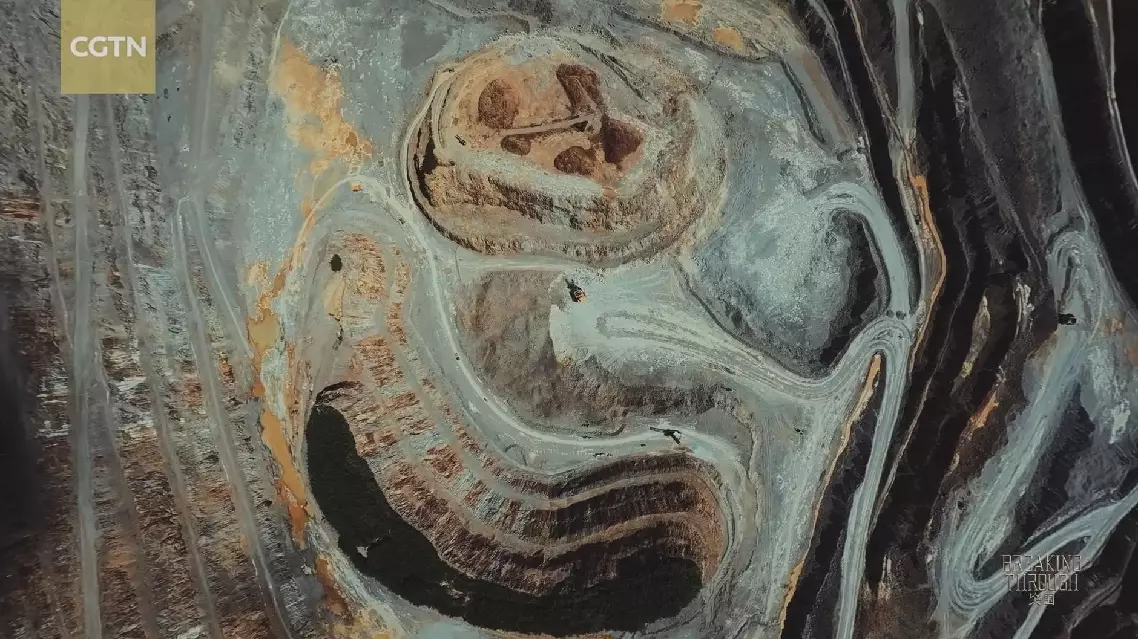
Determined to change this paradigm after returning from his studies in France, He founded HPY Sorting. The company has developed a revolutionary AI-driven optical ore sorting system capable of automatically separating waste rock from valuable ore.
Processing up to 300 tons of ore per hour, this intelligent sorting technology is now deployed in mines across the world, replacing tasks that once relied on human experience with precision-driven algorithms and automated machinery.
He Pengyu hopes that through his innovation, not a single rock goes to waste.
The documentary is part of CGTN's "Breaking Through" series, which traces China's journey from the historic Long March undertaken by the Red Army nine decades ago to its modern-day achievements, highlighting the resilience, ingenuity, and determination of its people.
Long March spirit drives critical breakthroughs in China's EV, AI industries: documentary