Business leaders from Chinese manufacturing sector shared their insights for Chinese brands to go global at a China Media Group (CMG) event, highlighting the role of cutting-edge technology and the importance of high-quality products.
The CMG's business channel recorded its New Year's Eve Speech program at the National Aquatics Center in Beijing on Dec 26, with business insiders from leading Chinese enterprises discussing their thoughts on expanding into global markets.
Yang Dongsheng, the chairman of Chinese construction machinery manufacturer Xuzhou Construction Machinery Group (XCMG), highlighted the power of heavy equipment.
As the world's third-largest producer by share of construction equipment sales worldwide, the XCMG has exported its products to over 190 countries and regions, covering more than 95 percent of the areas along the Belt and Road Initiative routes, Yang said, making it a representative of China's major industrial equipment reaching the global stage.
"The AI technology expands the boundaries of human intelligence, while the construction machinery enhances human strength, allowing us to continually push the limits of physical power. The machinery made by the XCMG has left a solid and shining footprint on the global stage, and was used in the projects including the large-scale wind power bases in Europe, the world's largest single refinery, the Pan-Asian Railway, the China-Pakistan Economic Corridor, Saudi Arabia's futuristic city NEOM, and the world's largest iron ore mine in Simandou, drawing a grand blueprint for human interaction and integration," said Yang.
Apart from going global, Yang said the company is also stepping up efforts in the development of autonomous driving technology, and taking the lead in the digital transformation of construction machinery industry.
"There is an open-pit coal mine with an annual production capacity of 35 million tons by the Yimin River in Inner Mongolia Autonomous Region. At the coal mine, the coal transport trucks operate in an orderly and efficient manner. And the trucks have no driver, nor driver's cabin. Such equipment not only improves the safety of mining operations, but also contributes to reducing carbon emissions," said Yang.
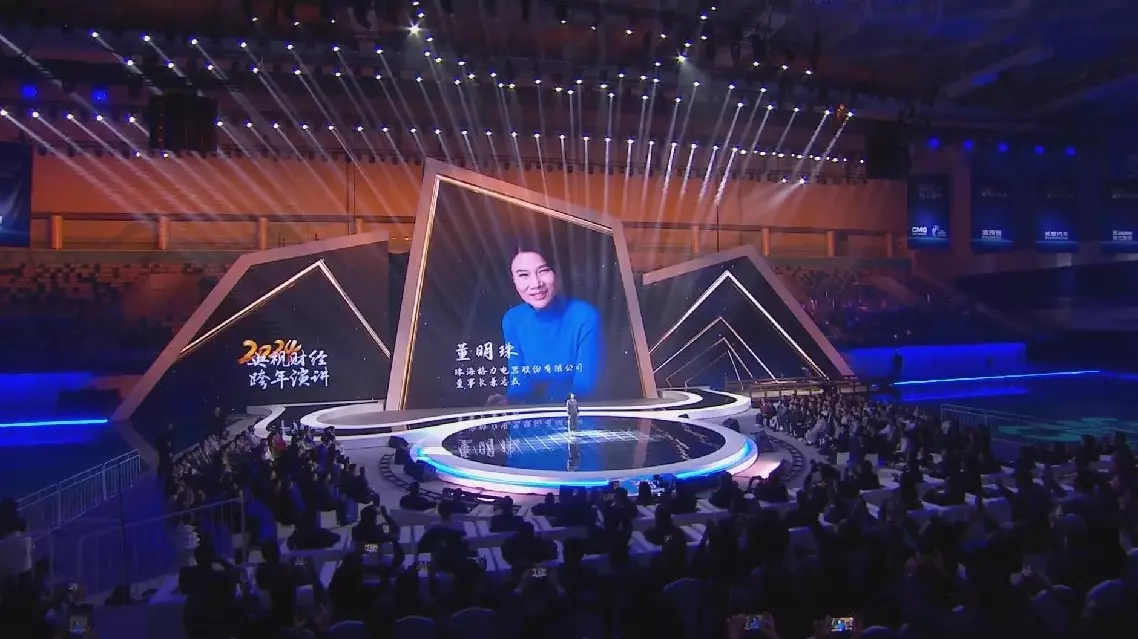
Dong Mingzhu, the chairwoman of China's household appliance giant Gree, emphasized the quality of the products in her speech at the event.
In 2021, Gree launched its "10-Year Guaranteed Repair Policy" for air conditioning products. Dong said that while the policy presented challenges for the company, it also motivated Gree to produce high-quality products that could earn and maintain customers' trust and confidence.
Dong said the company values both domestic customers and global buyers. She noted that over 600 million Gree air conditioners worldwide have been in use for more than 10 years, and the company is now offering a trade-in service to consumers globally.
"More than a decade ago, when people talked about 'made in China', what did they think of? Products with low price and low quality. At the same time, we also know that in some countries, the products they made for domestic use are of good quality, and the products they export to other countries aren't as good and are made with different standards. We strive to make all our products with the same standards around the world. We want all consumers to enjoy the most advanced technology, and hold ourselves to the highest standards," said Dong.
Chinese manufacturers highlight technology, quality for brands going global
Major breakthroughs by Chinese scientists have laid the foundation for a future where space-based solar power stations are capable of wirelessly transmitting energy to Earth and spacecraft, though significant engineering problems remain.
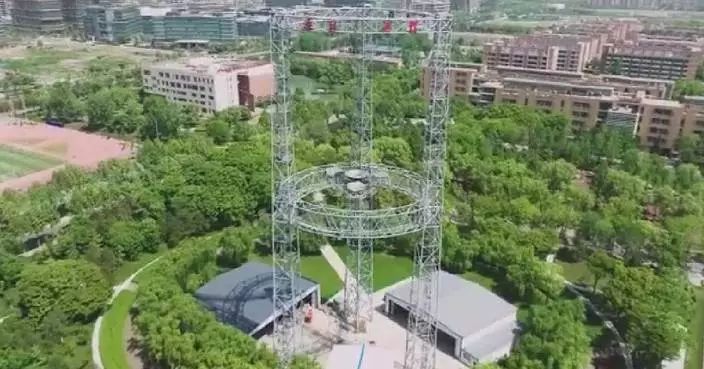
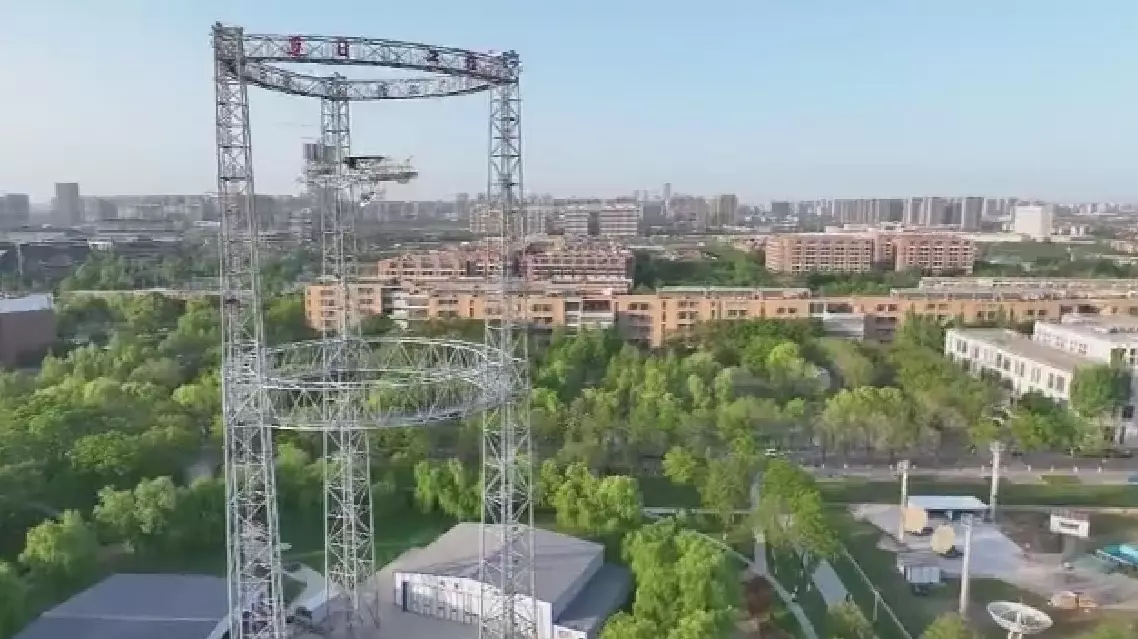
A research team from Xidian University in northwest China's Shaanxi Province has made significant progress on the Sun Chasing project, or "Zhuri" in Chinese. The team has developed a ground-based test system for wireless power transmission that can charge multiple moving targets at the same time.
In recent tests, the system achieved a wireless power transmission efficiency of 20.8 percent from direct current to direct current over a distance of 100 meters. It delivered 1,180 watts of power. The team has also built a wireless charging system for drones. In a test, a drone flying at 30 kilometers per hour was able to receive 143 watts of stable power from 30 meters away.
A space solar power station works exactly as its name suggests: a huge array of solar panels placed in orbit. It would collect sunlight in space, where the sun always shines, and then convert that energy into microwaves or lasers to beam down to Earth or directly to satellites and spacecraft. This could address two significant issues: supplying uninterrupted power for space missions and alleviating energy shortages on the ground.
"The construction of space solar power stations could become a major undertaking in the future. One potential benefit is access to a virtually unlimited power supply. Because energy can be collected continuously in space 24 hours a day, electricity could be supplied on an uninterrupted basis," said Fan Guanheng, an associate professor at the School of Mechano-Electronic Engineering at Xidian University.
"Secondly, it could reduce our dependence on fossil fuels, thereby lowering carbon emissions and helping protect the environment. Thirdly, it could support the development of charging infrastructure in space and enable wireless microwave charging for spacecraft, changing the way power is supplied to space vehicles," the professor added.
In 2018, the research team launched the first phase of the Sun Chasing project to build a ground test system. By June 2022, they had completed the world's first full-link, full-system ground validation system for a space solar power station. Now, the team has moved to phase two. The goal now is to solve the challenges of generating high power in space and transmitting it efficiently over long distances.
According to Duan Baoyan, an expert at Xidian University and an academician of the Chinese Academy of Engineering, recent breakthroughs include improving the efficiency of solar energy collection and conversion, increasing the precision of microwave beam control to reduce energy loss, and making the transmitting and receiving antennas smaller and lighter, which is critical for space application.
The team has also solved the problem of how to power multiple moving targets at once using a single transmitter. This means that in the future, one space power station could potentially supply electricity to several satellites or ground vehicles at the same time, Duan said.
Despite the advances in ground-based validation, a series of technical challenges must still be overcome before the technology can be deployed in space.
"The first issue that needs to be addressed is the adaptability of components to the space environment, as conditions in space are completely different from those on Earth, including radiation exposure and extreme temperatures. Another challenge involves the deployment and retraction design of transmitting and receiving antennas. We also need to develop thermal management systems to cope with extreme temperatures and temperature fluctuations in space. These are all areas where further breakthroughs are needed," said Qian Sihao, an associate professor at the School of Mechano-Electronic Engineering at Xidian University.
"We have now completed the development and validation of a ground-based test system, and our next step is to carry out in-orbit wireless microwave power transmission," Fan said.
With ground validation complete, the team now turns its attention to overcoming the harsh realities of space, aiming to demonstrate in-orbit wireless power transmission and bring the vision of orbital solar energy closer to reality.
Space-to-earth solar power moves closer to reality although hurdles remain: scientists