Skip to Content Facebook Feature Image

PetroChina-led operations push Iraqi oilfield to record output

China

China

China

PetroChina-led operations push Iraqi oilfield to record output

2025-01-05 00:24 Last Updated At:01:47

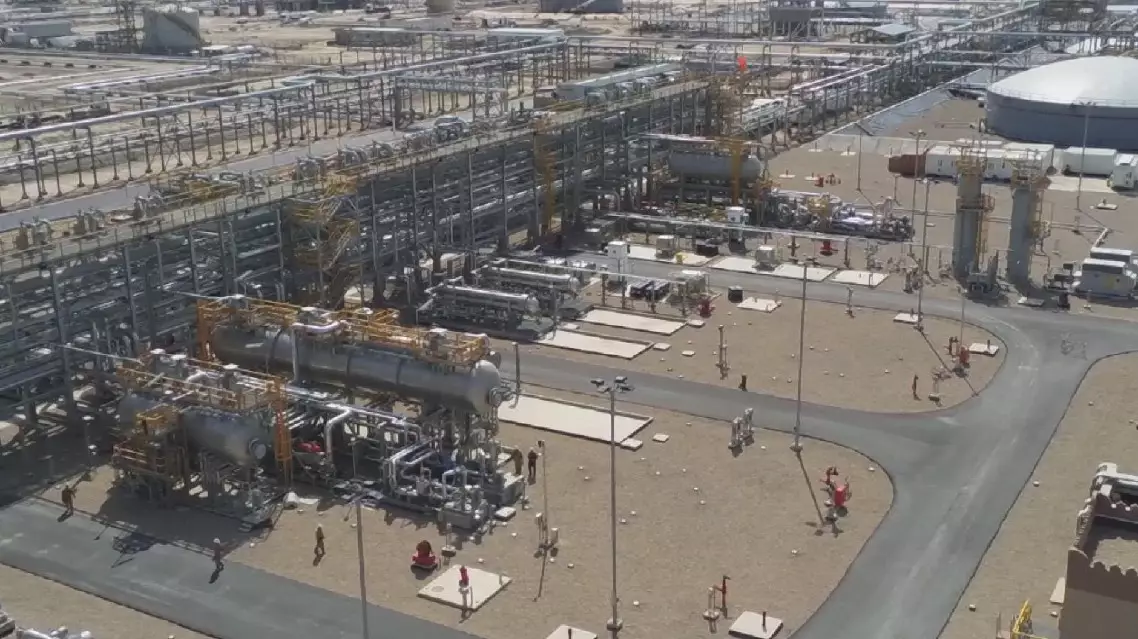
The West Qurna-1 oilfield in Iraq, one of the world's largest oilfields, has reached a production milestone in PetroChina's first year as the lead contractor.

Located 50 kilometers northwest of Basra in southern Iraq, the West Qurna-1 oilfield holds geological reserves of 10 billion tons, with an estimated remaining recoverable amount of 3.06 billion tons. It's annual output of crude oil exceeds 25 million tons.

PetroChina, one of China's major oil and gas producers and distributors, replaced ExxonMobil as the lead contractor for the West Qurna-1 oilfield, holding the largest stake, with development officially kicking off on Jan 1, 2024.

Since then, PetroChina has helped steadily increase production at the oilfield to 550,000 barrels per day.

The Iraqi government has given credit to PetroChina for Iraq's energy development sector.

"The oilfield is currently being developed by PetroChina, which has made significant efforts to continue its development, increasing its daily production to 550,000 barrels. The company also prioritizes regional public welfare, delivering benefits to the local community by rebuilding roads, providing essential services, and creating more jobs in the area," said Hayyan Abdul Ghani, Iraqi deputy prime minister for energy affairs and minister of oil.

Looking ahead, the oilfield is aiming for further production increases.

"With the help of PetroChina, we have witnessed significant progress in both oilfield production and local livelihoods. The company has also provided services to local communities living near the oilfield. There have been notable improvements in the oilfield's development plans, production capacity, and crude oil quality. We are confident that we will ultimately achieve a daily production of 800,000 barrels, and even reach 1.2 million barrels," said Bassem Al-Ghalabi, deputy general manager of Basra Oil Company.
PetroChina-led operations push Iraqi oilfield to record output
PetroChina-led operations push Iraqi oilfield to record output

European countries and international organizations have widely condemned Israeli air strikes on Lebanon which have resulted in more than 1,000 civilian casualties, including children, and have caused damage to civilian infrastructure.

Israel launched large-scale air raids across Lebanon on Wednesday, saying it had carried out 100 strikes within a matter of minutes on positions they claimed belonged to the Hezbollah group.

Lebanon's Ministry of Public Health reported more than 300 had been killed in the attacks, with roughly 1,150 wounded.

The attacks came after a two-week ceasefire agreement was reached by the United States and Iran. However, both Israel and the United States have maintained Lebanon is not included in the truce.

Spanish Foreign Minister Jose Manuel Albares on Thursday accused Israel of violating international law to carry out the air strikes on Lebanon, calling the attacks "a shame on the conscience of all humanity".

Earlier on Thursday, Albares announced that Spain would reopen its embassy in Tehran in the hope of achieving peace in the region.

Italian Prime Minister Giorgia Meloni said that Israel had "disrespected" the two-week ceasefire with Iran by carrying out the strikes.

Meloni also warned of further economic turmoil if U.S.-Israeli strikes on Iran flare ​up again, and said the European Union should consider a temporary suspension of the Stability and Growth Pact, an agreement which ensures economic stability within the European Union, in order to handle the potential monetary consequences.

Meanwhile, German Chancellor Friedrich Merz on Thursday warned that Israel's military operations in Lebanon could cause the entire peace process as a whole to fail, telling a press conference in Berlin "that must not happen."

Merz announced that the German government will resume direct talks with Iran in order to support the newly agreed two-week ceasefire between Washington and Tehran.

He also stated that a window of opportunity for a negotiated solution has opened for the first time since the outbreak of the conflict, though he cautioned that the situation in the Middle East remains "fragile."

The UK's Foreign Secretary Yvette Cooper said on Thursday that she is "deeply troubled" by Israel's escalating attacks on Lebanon, expressing hope that Lebanon will be included in the current ceasefire arrangement.

Cooper also reiterated the importance of reopening the Strait of Hormuz, saying that the effective closure of the vital shipping chokepoint had been "deeply damaging for the world", while stressing how crucial the passageway is to the entire global economy.

French Foreign Minister Jean-Noel Barrot described the Israeli strikes on Lebanon as "intolerable."

In a radio interview, Barrot said France strongly condemns "the massive strikes" which seriously undermine the temporary ceasefire reached earlier between the United States and Iran. The European Union's foreign policy chief Kaja Kallas said Thursday that Israel's latest strikes on Lebanon, which killed hundreds overnight, could not be considered as an act of self-defense.

"Israel's right to defend itself does not justify inflicting such massive destruction," Kallas said in a post on the social media platform X. She warned that the strikes risk further destabilizing the region and added that Israel's actions were putting the U.S.-Iran ceasefire under severe strain.

Despite this widespread criticism, Israeli Prime Minister Benjamin Netanyahu insisted on Thursday there would be no ceasefire in Lebanon, signaling that Israel will continue its military operations while pursuing planned negotiations with Beirut.

"There is no ceasefire in Lebanon," Netanyahu said in a video address to residents of northern Israel, adding: "We continue to strike Hezbollah with force and we will not stop until we restore your security."

Netanyahu said he had instructed his cabinet to open direct talks with Lebanon following what he described as repeated requests from the Lebanese government.

The negotiations, which are expected to begin next week in Washington, aim to disarm Hezbollah and reach a "historic and lasting" peace agreement, Netanyahu added. Delegations will be led by the Lebanese and Israeli ambassadors to the United States.

Israel and Lebanon have no formal diplomatic relations and technically remain in a state of war.

European Leaders widely condemn Israeli attacks on Lebanon

European Leaders widely condemn Israeli attacks on Lebanon

Recommended Articles