Skip to Content Facebook Feature Image

Official explains reasons behind China's high-quality trade development in 2024

China

China

China

Official explains reasons behind China's high-quality trade development in 2024

2025-01-13 17:07 Last Updated At:18:57

A customs official on Monday cited three key factors behind China's high-quality trade development in 2024 and expressed his firm belief that the world's second largest economy will maintain stable growth in imports and exports this year.

Wang Lingjun, deputy head of the General Administration of Customs, told a press conference in Beijing that China consolidated its position as the world's largest trading nation in goods when in 2024, its total goods imports and exports reached 43.85 trillion yuan (about 6.1 trillion U.S. dollars), up five percent year on year.

Wang said a package of polices took effect in a coordinated way, giving a shot in the arm to the country's robust foreign trade growth last year.

"A new round of measures were swiftly introduced to stabilize growth of foreign trade, which effectively helped the country's foreign trade in the fourth quarter to hit a quarterly record high of 11.51 trillion yuan. The Q4 growth rate was 0.4 percentage points higher than that in the third quarter. In particular, China's imports and exports grew 6.8 percent in December to over 4 trillion yuan for the first time, a new monthly high," Wang said.

Wang went on to note that the upgraded manufacturing sector and the vast Chinese market inject more impetus into the high-quality development of China's foreign trade.

"We have a complete industrial system with technological innovations continuously fostering new quality productive forces and upgrading Made in China to provide more high-end, green and intelligent products to our trading partners," he said.

For example, smart home appliances drove China's home appliance exports to grow by 15.4 percent last year, he said.

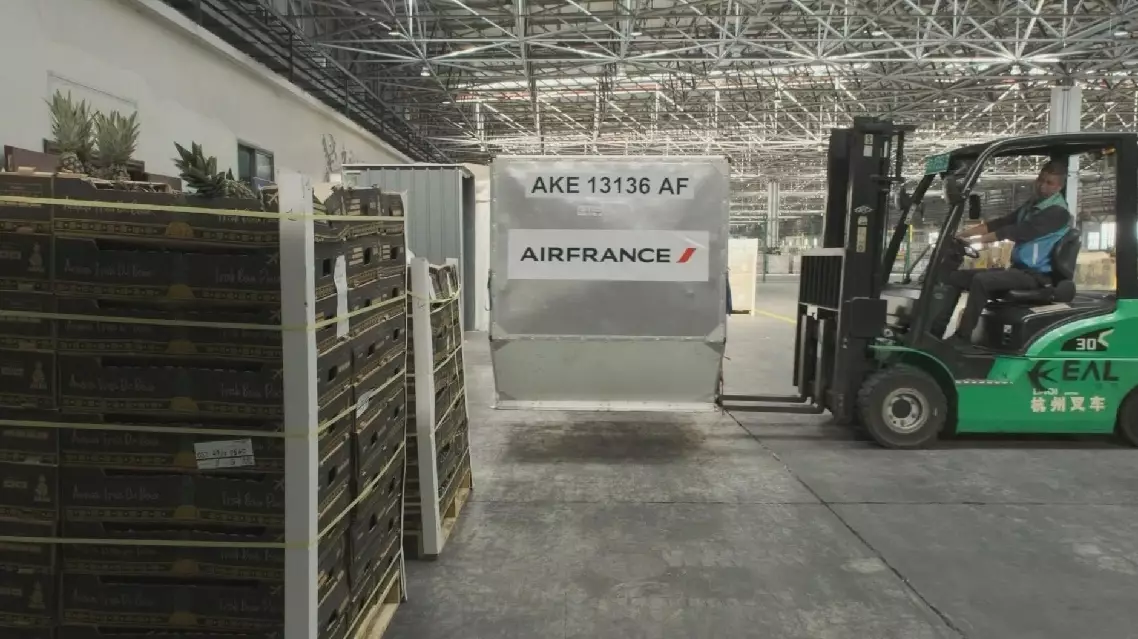
Meanwhile, China has the world's most promising market. Last year, China imported nearly three billion tons of bulk commodities, over seven trillion yuan of mechanical and electrical products, and nearly 1.8 trillion yuan of consumer goods, meeting the diverse production and consumption needs, Wang noted.

The official stressed that the business entities forged ahead with bold steps in the past year, providing sustained impetus for the high-quality development of China's foreign trade.

Despite severe external challenges, China will continue to promote its high-quality trade development in the new year, he said.

"Major international economic organizations have predicted that global trade in goods will maintain growth this year. The fundamentals of the Chinese economy underpinned by a stable foundation, multiple advantages, strong resilience, and great potential stay unchanged, and the supporting factors for promoting the high-quality development of China's foreign trade remain solid," Wang said.
Official explains reasons behind China's high-quality trade development in 2024


Official explains reasons behind China's high-quality trade development in 2024
Business activity in the UK has slowed to a six-month low in March with cost pressures surging sharply, as escalating tensions in the Middle East have weighed on demand and disrupted supply chains, a closely watched survey showed on Tuesday.

The S and P Global Flash UK Composite Purchasing Managers' Index (PMI) fell to 51.0 in March from 53.7 in February, signaling only marginal expansion in private sector output.

The slowdown was broad-based. The services activity index dropped to 51.2 from 53.9, while manufacturing output edged down to 50.1 from 52.5, close to stagnation. A reading above 50 indicates growth, while a reading below that reflects contraction. The headline manufacturing PMI came in at 51.4, a three-month low.

Survey data showed that new business declined for the first time in four months, reflecting weaker confidence among firms and consumers. Companies widely linked the deterioration in demand to the Middle East conflict, citing heightened uncertainty, rising prices and more cautious spending.

At the same time, cost pressures intensified markedly. Input price inflation rose to its highest level in more than three years, driven by higher fuel, transportation and raw material costs. Manufacturing firms reported the sharpest increase in input costs since October 2022, with the pace of acceleration the strongest in decades.

Rising costs were increasingly passed on to customers, leading to the fastest increase in output prices since April 2025. The combination of slowing growth and rising prices points to mounting inflationary pressure across the economy.

External demand also weakened. Export orders declined, particularly in the services sector, amid reduced international travel and delays to projects linked to the Middle East. Meanwhile, supply disruptions, including longer shipping routes and production stoppages in energy-related industries, led to extended delivery time and lower inventories.

Chris Williamson, chief business economist at S and P Global Market Intelligence, said the Middle East conflict has "stalled growth while driving inflation sharply higher," as firms face weaker demand alongside rising energy and supply chain costs.

He added that the Bank of England now faces a difficult trade-off between containing inflation and avoiding further damage to growth, warning that "downside risks to growth and upside risks to inflation have already materialized."

The flash PMI survey, conducted between March 12 and 20, provides an early snapshot of economic conditions and is closely watched by markets and policymakers.

UK business growth hits six-month low as Middle East tensions drive up costs

UK business growth hits six-month low as Middle East tensions drive up costs

Recommended Articles