Despite being bound to a wheelchair due to illness, Ma Jun, a young award-winning author, has shown great courage, talent, determination and perseverance in overcoming arduous challenges in his life, finding solace through literary creation and earning a prestigious award through his heartfelt works.
Ma, born in Xiji County, northwest China's Ningxia Hui Autonomous Region, won the 13th National Ethnic Minority Literary Creation Junma Award, one of the highest honors in China's ethnic minority literature field.
A Hui minority by birth, he earned this award with his prose collection named "Qing Bai Shi Jie" (The Green and White Stone Steps), which he wrote under the pen name Liu Kexing.
Upon reflection on receiving the trophy, Ma still finds the experience somewhat unbelievable.
"I was sitting under the big willow tree in front of my house, reading Liu Liangcheng's 'Ben Ba,' when I learned about winning the award. I had just completed a section and was closing the book when my phone started ringing. Upon checking, I saw many friends sending their congratulations. In that moment, I felt especially joyful," he said.
At birth, Ma was no different from other children, but when the time came for him to learn to walk, his parents found that his body was too weak to walk. After traveling in search of medical treatment, Ma was diagnosed with spinal muscular atrophy.
Despite understanding the dangers of the illness, Ma Jun's parents never gave up hope. They operate a small grocery store near their house to make money for medical expenses. Whenever they had free time, they would take Ma for rehabilitation training.
Even though his body movement was constrained by his illness, Ma did not want his mind to be imprisoned as well. From a young age, he would carefully observe everything happening around him.
Later, when he had a younger sister, they often sat together on the green and white stone steps in front of their house, watching other children playing.
When both Ma Jun and his sister reached the age for education, the idea of studying also sprouted in Ma's mind as he watched his sister go to school.
Feeling Ma's eagerness to go to school, his parents finally fulfilled his desire. Ma Jun and his father then embarked on the journey of going to school together, rain or snow.
"When it snows, Ma Jun's father would push the bicycle as it gets too slippery to ride, one hand supporting the child and the other hand stabilizing the bike as they move forward," said Su Jinxia, Ma Jun's mother.
Ma studied hard under his father's meticulous care during his school years.
"What impressed me the most was when Ma first started school, his hands had no strength. He struggled to write even a single character, unable to grip the pencil due to his lack of strength. He would cry in frustration when he couldn't complete his assignments," said Ji Zhouhang, a Chinese language teacher at Xiji County No.1 Primary School.
During Ma's 12 years of schooling, his younger brother was born. Unfortunately, his brother was paralyzed on one side due to illness at birth. Witnessing the growing burden on his family, even though Ma Jun was admitted to university, he decided to forgo his university education.
"One time, I was lying in bed when I saw my father carrying my younger brother on his back to school. It deeply moved me. I realized that if I pursued further studies, my brother would be left alone at home, possibly even lonelier than I was when I used to sit on the green and white stone steps. I felt that I had already had enough education, and it was his turn," Ma said.
Being forced to abruptly halt his academic pursuits plunged Ma into the darkest period of his life. He shut himself inside his small room all day, pondering over the path his future should take. Amidst this confusion, a book became a light in Ma's life.
"In a moment of confusion and despair, one of my high school classmates brought me three books, including 'The Temple of Earth and I'. Like savoring a cup of sweet spring water, I read it all at once. In that moment, I felt that Mr. Tiesheng had the courage to confront the outside world long ago. He found the strength to leave his home and journey to his Temple of Earth. Why couldn't I do the same?" Ma said.
"The Temple of Earth and I" was authored by Shi Tiesheng, a prominent Chinese writer who became paralyzed in both legs due to illness at the age of 21. Shi endured disabilities and other illnesses and created numerous exceptional works.
Wang Peng, Ma's high school classmate who gave him the books, has been a key figure in his life. Throughout their high school years, they often engaged in conversations about their dreams and shared interests, thus forging a deep friendship.
"In the 10 years that we have known each other, he has rarely complained about fate being unfair or destiny playing tricks on him. However, every time we discuss it, he appears somewhat regretful about not being able to attend university. While we have all moved forward, he remains in the same place, in his small room, undoubtedly feeling extremely despondent. Since the experiences of the author of 'The Temple of Earth and I' were quite similar to that of Ma Jun, I though it might serve as spiritual encouragement for him," Wang said.
From then on, Ma braced himself up. In 2016, on his birthday, his parents gifted him his first electric wheelchair. He started exploring the hometown where he had lived for nearly two decades. With each venture outside, Ma would document what he saw and felt.
In the library, Ma read various styles of literary works, which further fueled his desire to write.
"After reading the works by Lin Qingxuan, Zhang Xianliang, Garcia Marquez, O. Henry, and many others, I ventured beyond my life confined to a wheelchair to observe the life scenes of those around me and pen down stories," Ma said.
In 2019, Ma's first prose was published. In 2021, he won a newcomer award for literature in Xiji County. By the end of 2023, "Qing Bai Shi Jie" was published. In this book, he uses "green" and "white" as metaphors for life, reflecting on those moments in life that are worth pausing for.
"The doctor said I wouldn't live past 20 years old, but somehow, I created a miracle. I wrote a book, got it published, and even won an award. So, everything is a kind of faith. As long as you have the belief to live faithfully, things will gradually get better," said Ma, who is now in his thirties.
After winning the award for "Qing Bai Shi Jie," Ma became popular. Various media interviews and lecture invitations came his way. But soon he found himself back in the state of reading during the day and writing at night.
The lake in his hometown is Ma's "Temple of Earth" in his heart. He still often visits this place to seek inspiration for his works.
"Literature resides in my heart, granting me a second lease on life. By sincerely and quietly embracing it, I find contentment. It brings me dignity. People do not label me as disabled. They recognize me as a writer. I'm content as long as I can write about the true kindness and beauty to comfort my soul," Ma said.
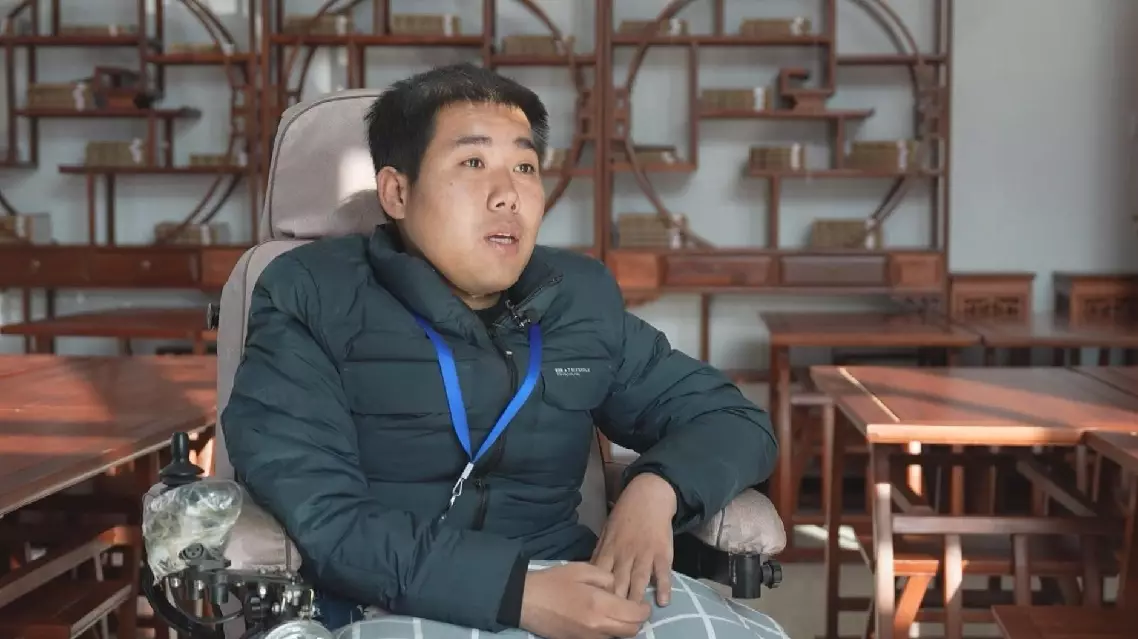
Wheelchair-bound author triumphs over life's challenges with courage, talent, determination