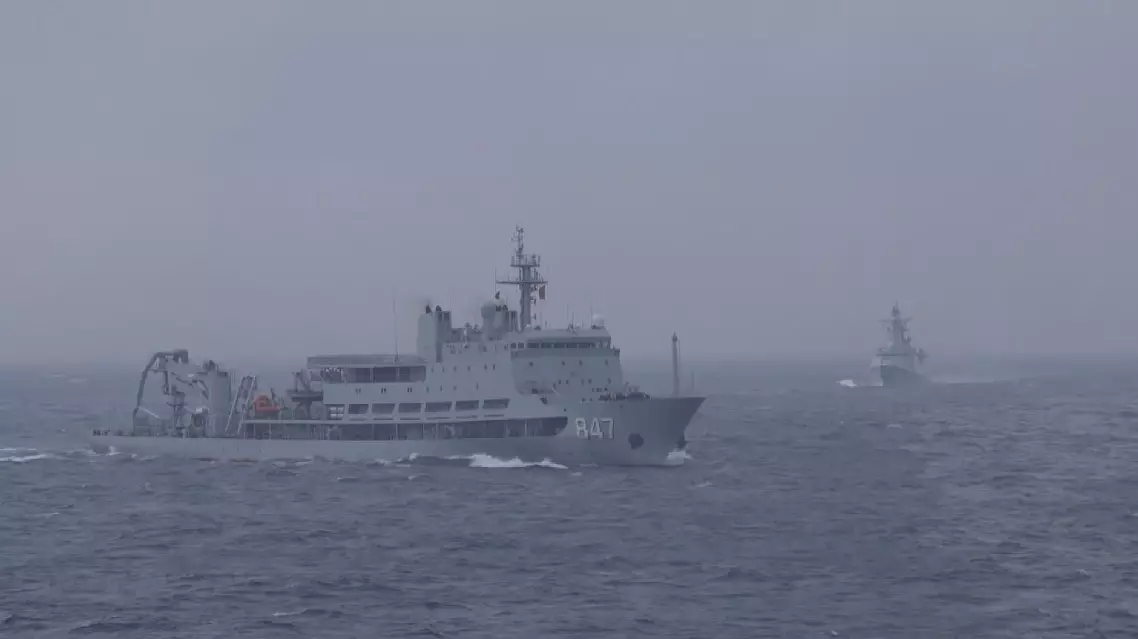
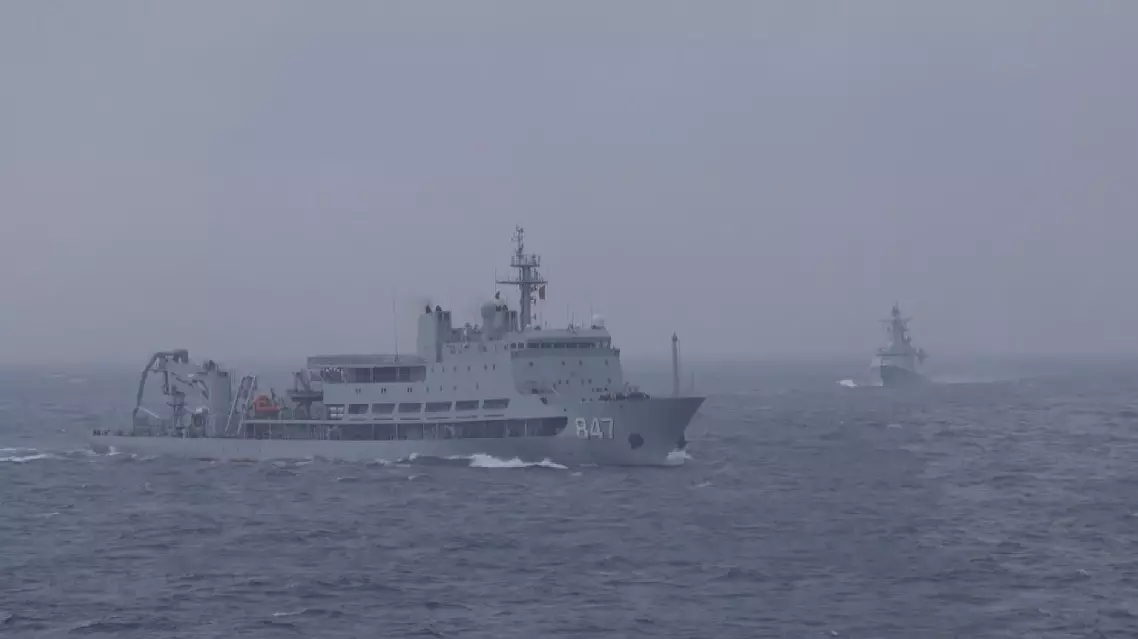
China and Russia on Saturday wrapped up the large-scale live-fire maritime drills in the six-day "Joint Sea-2026" exercise off the coast of Qingdao City in east China's Shandong Province, testing the two countries' combined combat capabilities and further strengthening their military partnership.
The drills, which began on Thursday, were the last phase of the three-part exercise. Over the past three days, the participating Chinese and Russian naval fleets successfully completed the drills on joint reconnaissance, air defense and anti-missile defense, and coordinated submarine search and rescue operations, significantly enhancing their joint operational capabilities.
The maritime phase of the exercise involved eight surface vessels and two submarines from both navies, operating in a double-column formation.
The drills featured no fixed script. Instead, operations were dynamically adjusted based on real-time battlefield conditions, hydrometeorological factors, and evolving tactical scenarios. The participating forces were organized in mixed groupings, leveraging sea-, air- and submarine-based platforms to establish an integrated, multi-domain combat system.
The unscripted approach effectively tested both navies' capabilities in joint reconnaissance, early warning, command coordination and precision strikes under complex electromagnetic environments.
At one point during the drills, Russian guided-missile cruiser Varyag detected an "enemy" target and initiated a threat alert. The joint fleet quickly established a shared tactical picture, coordinated command decisions and executed a concentrated strike. Vessels from both nations took turns engaging the maritime target, successfully sinking the target.
Immediately after neutralizing the threat, Chinese guided-missile destroyer Kaifeng detected a group of low-altitude aerial targets approaching the fleet. The maritime command post issued an engagement order without delay. The Kaifeng and a Russian vessel alternately maneuvered into optimal firing positions to engage the incoming targets, while other ships provided supplementary fire, ultimately destroying all hostile aerial objects.
Speaking from the Kaifeng, Chinese naval officer Han Yuchen described the challenging conditions facing the crews on the vessel.
"During the drills, the sea conditions were rough, the weather was highly variable, and the ship's roll made the precision gunnery extremely difficult. However, our main gun system crews maintained close coordination and precise synchronization. We adjusted firing data promptly and accurately, selected the optimal engagement windows, and successfully destroyed the targets. In the following fulfillment of tasks, I look forward to further exchanges and cooperation with our Russian counterparts, so that we can learn from each other's experiences and continue improving our professional skills," he said.
In a dedicated air-defense and anti-missile drill, the participating Chinese and Russian vessels demonstrated clear division of labor and close interoperability, leveraging each platform's unique weapon-system advantages to intercept incoming threats in minimal time. The exercise validated the combined fleet's ability to conduct integrated air-defense operations.
Significantly, this year's exercise involved submarine and submarine-rescue assets for the first time, marking a strategic expansion of bilateral naval cooperation from surface-only operations to comprehensive three-dimensional combat capabilities.
Since its inception in 2012, the "Joint Sea" series of naval exercises have become a cornerstone platform for China-Russia naval cooperation. Liu Shishuai, a Chinese commander of the maritime drills, emphasized the significance of the partnership.
"During the drills, the participating Chinese and Russian forces have demonstrated seamless coordination, smooth communication and highly efficient cooperation, all while exhibiting exceptional professionalism. Since 2012, the 'Joint Sea' series have comprehensively enhanced professional exchanges and mutual trust between our navies, driven multidimensional improvements in joint maritime operational capabilities, and steadily strengthened our ability to collectively address security threats and challenges," he said.
This year's exercise began on Monday, with the two sides participating in force assembly and harbor-based planning before conducting the joint maritime drills.
Following the conclusion of the exercise, select units from both fleets will proceed to the Pacific Ocean for joint maritime patrols, continuing their commitment to maintaining international and regional peace and stability.
China, Russia conclude live-fire maritime drills of "Joint Sea-2026" exercise
China, Russia conclude live-fire maritime drills of "Joint Sea-2026" exercise