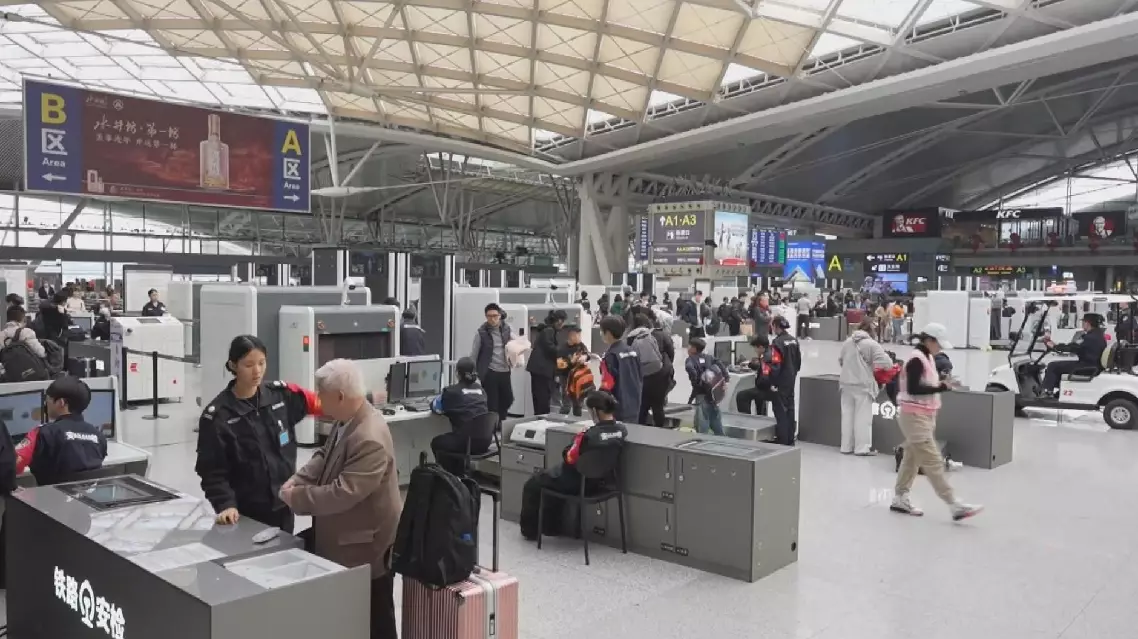
China's highway system is expected to handle 191 million passenger trips on Saturday, the fifth day of the annual Spring Festival travel rush, known as chunyun.
Waterway and air travel passenger trips are expected to reach 630,000 and 2.26 million, respectively, on the same day.
In the western provinces and regions of Xinjiang, Gansu, Qinghai, and Xizang, a collaborative multi-agency system has been established for managing the road network. This system facilitates real-time sharing of vital information on road conditions, weather, construction, and other factors during the Spring Festival travel rush.
A new system for ferry transportation across the Qiongzhou Strait in south China has been implemented recently. It can intelligently detect 23 types of waterway traffic anomalies and promptly identify potential risks, ensuring the safety of passengers traveling by sea.
The country's railway network is projected to manage 13.55 million passenger trips on Saturday, over 1 million trips more than Friday. The railway authorities plan to add 821 extra trains, significantly boosting capacity for key cities like Beijing, Shanghai, Guangzhou, and the Chengdu-Chongqing region.
In total, China's transportation system is expected to handle 207 million passenger trips on the day, marking a 7.4-percent increase over the previous period.
The Spring Festival, China's most important traditional holiday, falls on Jan 29 this year. The Spring Festival travel rush, or chunyun, is the world's largest annual human migration known for its high transportation demand as hundreds of millions return home for family reunions.
Chinese authorities expect an unprecedented 9 billion inter-regional trips during this year's chunyun. The 40-day travel period began on Tuesday and will continue through Feb. 22.
This year marks China's first chunyun after the United Nations Educational, Scientific and Cultural Organization (UNESCO) inscribed the Spring Festival on the Representative List of the Intangible Cultural Heritage of Humanity in December last year.
China's highways to see over 191 mln trips on 5th day of Spring Festival travel rush