BERLIN (AP) — Steffen Baumgart oversaw his first win as Union Berlin coach as his team ended its 11-game winless run with a 2-1 victory over Mainz in the Bundesliga on Sunday.
Goals from Benedict Hollerbach and Robert Skov gave Union its first win since October, and the first at the third attempt since former player Baumgart’s return as coach for the fired Bo Svensson.
Click to Gallery
Berlin's Leopold Querfeld, left, battles for the ball with Armindo Sieb of FSV Mainz during the German Bundesliga soccer match between 1. FC Union Berlin and 1. FSV Mainz 05 in Berlin, Germany, Sunday, Jan. 19, 2025. (Andreas Gora/dpa via AP)
Berlin's Jordan Siebatcheu, center, goes for the ball against Danny da Costa of FSV Mainz during the German Bundesliga soccer match between 1. FC Union Berlin and 1. FSV Mainz 05 in Berlin, Germany, Sunday, Jan. 19, 2025. (Andreas Gora/dpa via AP)
Berlin's Robert Skov, left, and his teammate Jordan Siebatcheu, right, celebrate their side's second goal during the German Bundesliga soccer match between 1. FC Union Berlin and 1. FSV Mainz 05 in Berlin, Germany, Sunday, Jan. 19, 2025. (Andreas Gora/dpa via AP)
Berlin's scorer Benedict Hollerbach, left, and his teammate Robert Skov, right, celebrate the opening goal during the German Bundesliga soccer match between 1. FC Union Berlin and 1. FSV Mainz 05 in Berlin, Germany, Sunday, Jan. 19, 2025. (Andreas Gora/dpa via AP)
Berlin's Robert Skov celebrates after scoring his side's second goal during the German Bundesliga soccer match between 1. FC Union Berlin and 1. FSV Mainz 05 in Berlin, Germany, Sunday, Jan. 19, 2025. (Andreas Gora/dpa via AP)
“Everyone was aware of the pressure, but the nice thing is that every run ends at some point and maybe one also begins,” Baumgart said.
Hollerbach got the home team off to a great start when he won the ball from Mainz defender Danny da Costa and fired between the legs of goalkeeper Robin Zentner in the first minute.
The visitors were given a prompt way back when Aljoscha Kemlein was penalized for a robust challenge on Jae-Sung Lee.
Nadiem Amiri wasn’t put off by whistles from the crowd as he equalized from the spot in the fifth. Amiri ran past the Union fans with his finger to his mouth, urging them to be quiet, then performed a short dance, prompting a vulgar chant in response.
There has long been animosity between the player and Union fans going back to when Amiri, a Germany player whose parents are from Afghanistan, was allegedly racially abused by Union player Florian Hübner when Amiri was playing for Bayer Leverkusen in 2021. Hübner was later cleared of racial abuse after Amiri told a federation investigation that he could not rule out that different words might have been used, but the bad feeling remained between fans and the player.
Union’s fans quickly forgot about Amiri’s equalizer when Dominik Kohr conceded another penalty for a foul on Hollerbach. Skov duly fired the home team back in front from the spot in the 24th.
It proved to be the winner with Mainz only mounting a threat in the final minutes.
“I don’t know when the last win was, so this does a lot of good,” Hollerbach said. “In that sense, today was a drop in the ocean. We have to just keep going, not to get in another negative spiral.”
Also Sunday, Samuel Essende scored twice to lead Augsburg to a 2-0 win at Werder Bremen in the late game.
League leader Bayern Munich stayed four points ahead of defending champion Bayer Leverkusen on Saturday, when both teams won their games against Wolfsburg and Borussia Mönchengladbach, respectively. The league rivals will play in Leverkusen on Feb. 15.
AP soccer: https://apnews.com/hub/soccer

Berlin's Leopold Querfeld, left, battles for the ball with Armindo Sieb of FSV Mainz during the German Bundesliga soccer match between 1. FC Union Berlin and 1. FSV Mainz 05 in Berlin, Germany, Sunday, Jan. 19, 2025. (Andreas Gora/dpa via AP)

Berlin's Jordan Siebatcheu, center, goes for the ball against Danny da Costa of FSV Mainz during the German Bundesliga soccer match between 1. FC Union Berlin and 1. FSV Mainz 05 in Berlin, Germany, Sunday, Jan. 19, 2025. (Andreas Gora/dpa via AP)

Berlin's Robert Skov, left, and his teammate Jordan Siebatcheu, right, celebrate their side's second goal during the German Bundesliga soccer match between 1. FC Union Berlin and 1. FSV Mainz 05 in Berlin, Germany, Sunday, Jan. 19, 2025. (Andreas Gora/dpa via AP)

Berlin's scorer Benedict Hollerbach, left, and his teammate Robert Skov, right, celebrate the opening goal during the German Bundesliga soccer match between 1. FC Union Berlin and 1. FSV Mainz 05 in Berlin, Germany, Sunday, Jan. 19, 2025. (Andreas Gora/dpa via AP)

Berlin's Robert Skov celebrates after scoring his side's second goal during the German Bundesliga soccer match between 1. FC Union Berlin and 1. FSV Mainz 05 in Berlin, Germany, Sunday, Jan. 19, 2025. (Andreas Gora/dpa via AP)
The U.N. Security Council scheduled an emergency meeting Thursday to discuss Iran's deadly protests at the request of the United States, even as President Donald Trump left unclear what actions he would take against the Islamic state.
Tehran appeared to make conciliatory statements in an effort to defuse the situation after Trump threatened to take action to stop further killing of protesters, including the execution of anyone detained in Tehran’s bloody crackdown on nationwide protests.
Iran’s crackdown on the demonstrations has killed at least 2,615, the U.S.-based Human Rights Activists News Agency reported. The death toll exceeds any other round of protest or unrest in Iran in decades and recalls the chaos surrounding the country’s 1979 Islamic Revolution.
Iran closed its airspace to commercial flights for hours without explanation early Thursday and some personnel at a key U.S. military base in Qatar were advised to evacuate. The U.S. Embassy in Kuwait also ordered its personnel to “temporary halt” travel to the multiple military bases in the small Gulf Arab country.
Iran previously closed its airspace during the 12-day war against Israel in June.
Here is the latest:
“We are against military intervention in Iran,” Turkish Foreign Minister Hakan Fidan told journalists in Istanbul on Thursday. “Iran must address its own internal problems… They must address their problems with the region and in global terms through diplomacy so that certain structural problems that cause economic problems can be addressed.”
Ankara and Tehran enjoy warm relations despite often holding divergent interests in the region.
Fidan said the unrest in Iran was rooted in economic conditions caused by sanctions, rather than ideological opposition to the government.
Iranians have been largely absent from an annual pilgrimage to Baghdad, Iraq, to commemorate the death of Imam Musa al-Kadhim, one of the twelve Shiite imams.
Many Iranian pilgrims typically make the journey every year for the annual religious rituals.
Streets across Baghdad were crowded with pilgrims Thursday. Most had arrived on foot from central and southern provinces of Iraq, heading toward the shrine of Imam al-Kadhim in the Kadhimiya district in northern Baghdad,
Adel Zaidan, who owns a hotel near the shrine, said the number of Iranian visitors this year compared to previous years was very small. Other residents agreed.
“This visit is different from previous ones. It lacks the large numbers of Iranian pilgrims, especially in terms of providing food and accommodation,” said Haider Al-Obaidi.
Europe’s largest airline group said Thursday it would halt night flights to and from Tel Aviv and Jordan's capital Amman for five days, citing security concerns as fears grow that unrest in Iran could spiral into wider regional violence.
Lufthansa — which operates Swiss, Austrian Airlines, Brussels Airlines and Eurowings — said flights would run only during daytime hours from Thursday through Monday “due to the current situation in the Middle East.” It said the change would ensure its staff — which includes unionized cabin crews and pilots -- would not be required to stay overnight in the region.
The airline group also said its planes would bypass Iranian and Iraqi airspace, key corridors for air travel between the Middle East and Asia.
Iran closed its airspace to commercial flights for several hours early Thursday without explanation.
A spokesperson for Israel’s Airport Authority, which oversees Tel Aviv’s Ben Gurion Airport, said the airport was operating as usual.
Iranian state media has denied claims that a young man arrested during Iran’s recent protests was condemned to death. The statement from Iran’s judicial authorities on Thursday contradicted what it said were “opposition media abroad” which claimed the young man had been quickly sentenced to death during a violent crackdown on anti-government protests in the country.
State television didn’t immediately give any details beyond his name, Erfan Soltani. Iranian judicial authorities said Soltani was being held in a detention facility outside of the capital. Alongside other protesters, he has been accused of “propaganda activities against the regime,” state media said.
New Zealand’s Foreign Minister Winston Peters said Thursday that his government was “appalled by the escalation of violence and repression” in Iran.
“We condemn the brutal crackdown being carried out by Iran’s security forces, including the killing of protesters,” Peters posted on X.
“Iranians have the right to peaceful protest, freedom of expression, and access to information – and that right is currently being brutally repressed,” he said.
Peters said his government had expressed serious concerns to the Iranian Embassy in Wellington.
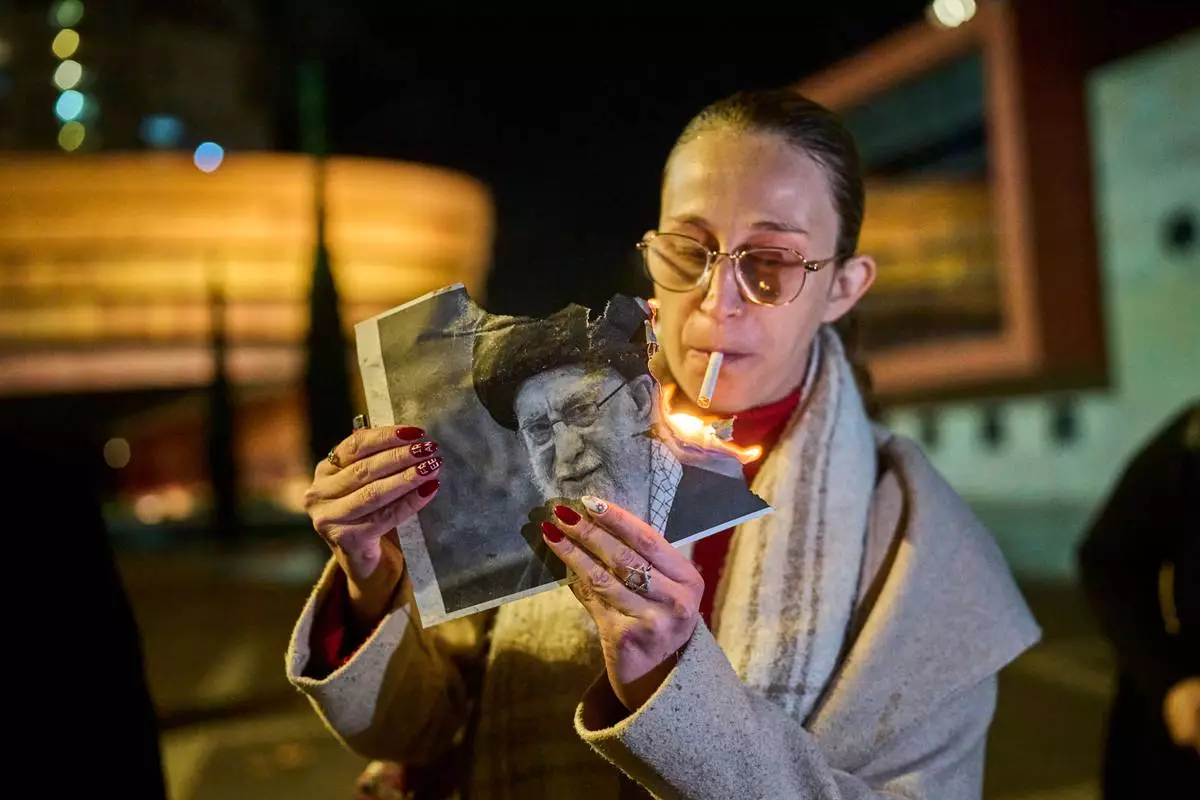
A demonstrator lights a cigarette with a burning poster depicting Supreme Leader Ayatollah Ali Khamenei during a rally in support of Iran's anti-government protests, in Holon, Israel, Wednesday, Jan. 14, 2026. (AP Photo/Ohad Zwigenberg)
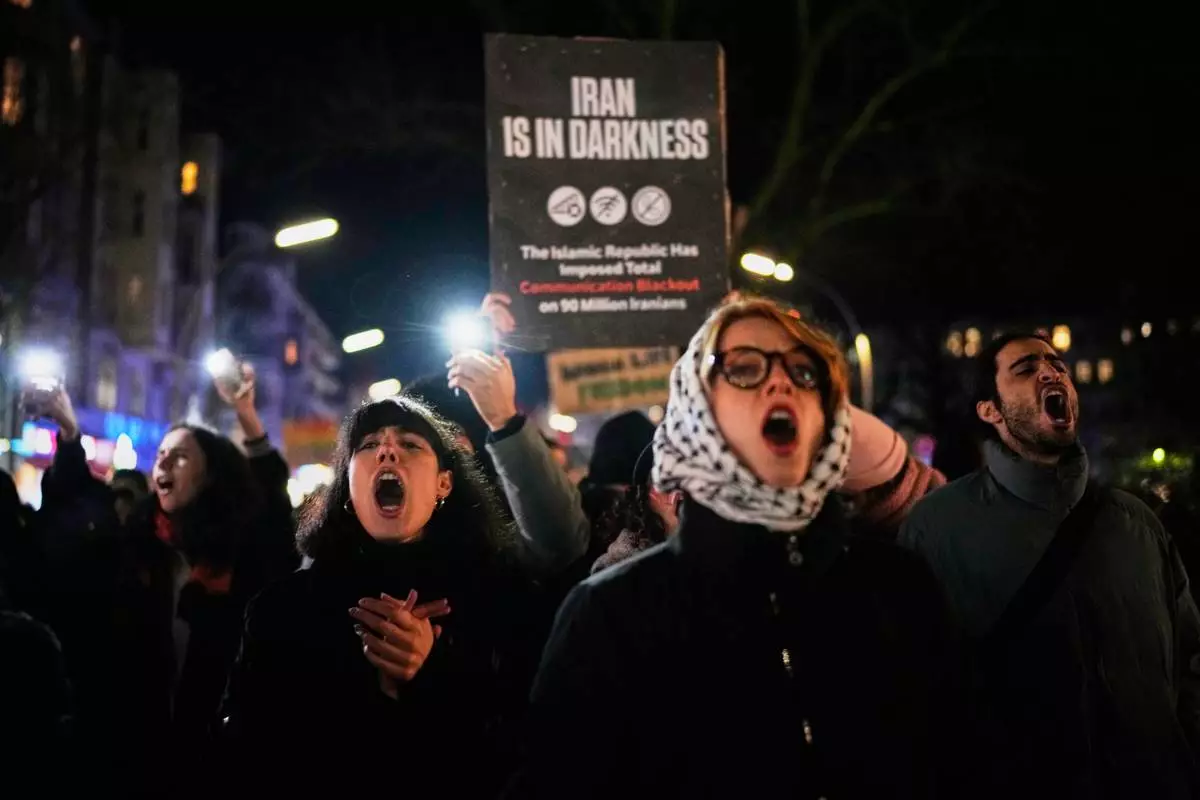
Protesters participate in a demonstration in support of the nationwide mass protests in Iran against the government, in Berlin, Germany, Wednesday, Jan. 14, 2026. (AP Photo/Ebrahim Noroozi)
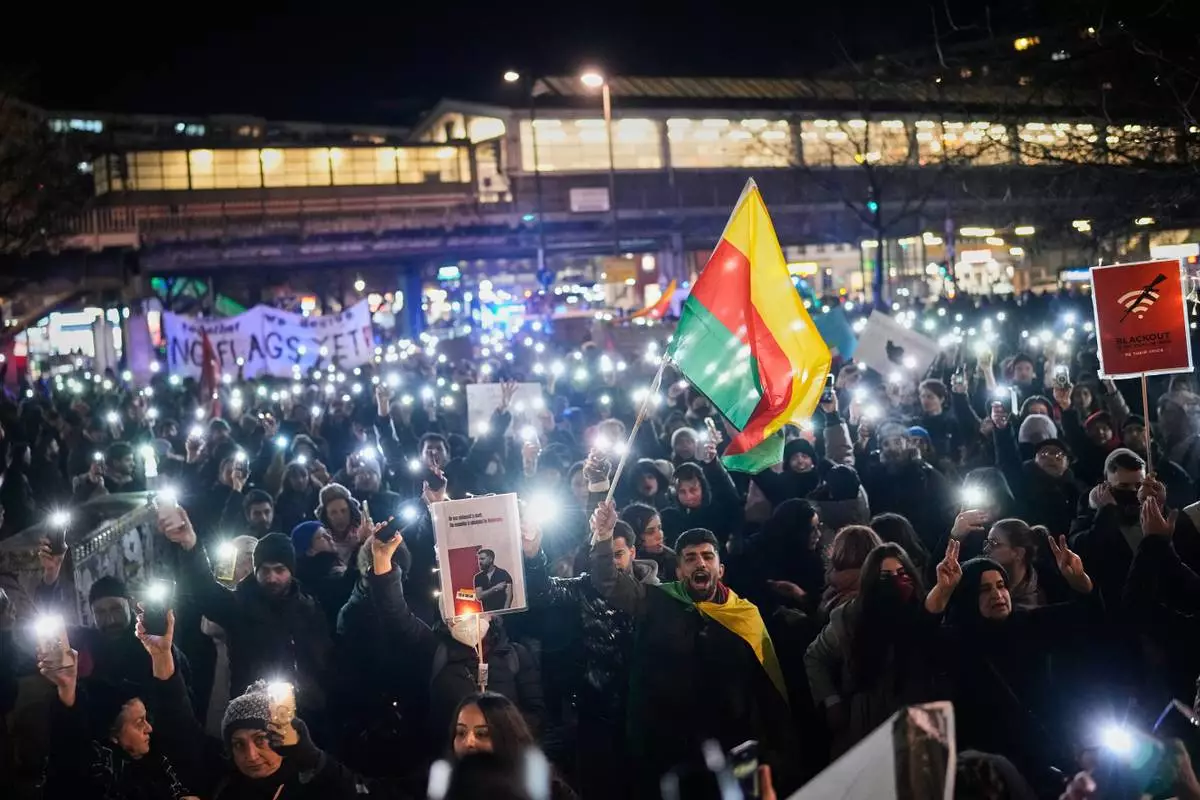
Protesters participate in a demonstration in support of the nationwide mass protests in Iran against the government, in Berlin, Germany, Wednesday, Jan. 14, 2026. (AP Photo/Ebrahim Noroozi)