China officially launched a nationwide subsidy program on Monday for the purchase of digital products, including smartphones, tablets, smartwatches or wristbands, sparking a surge in consumer enthusiasm and a spike in production orders across the industry.
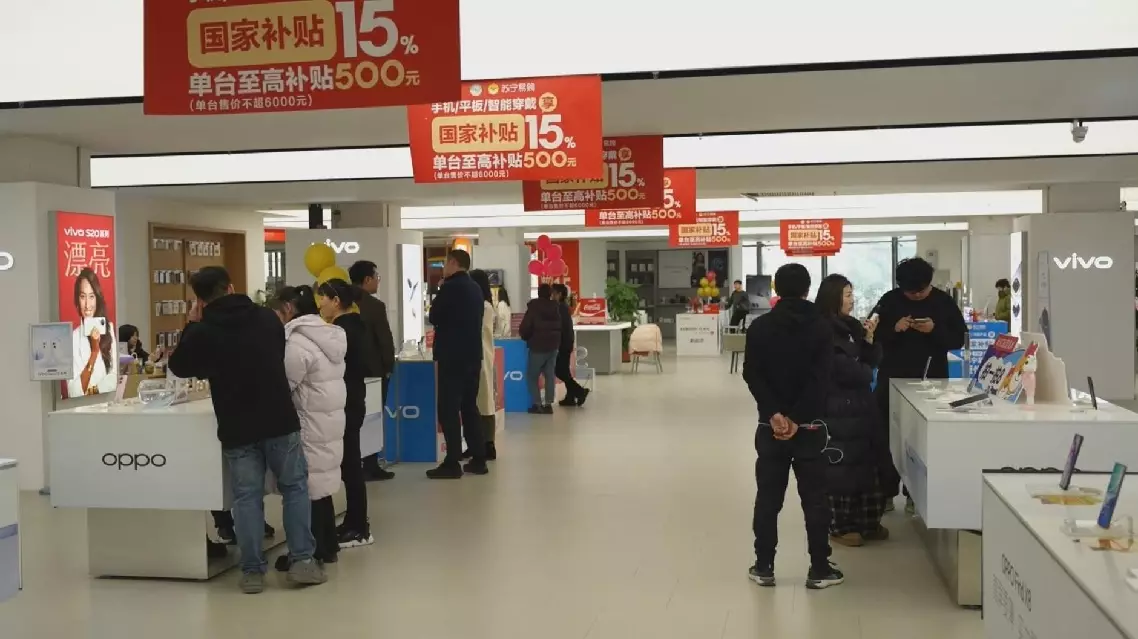
The new subsidy plan, announced by the Ministry of Commerce on Jan 15, gives a 15 percent discount on the sales price of eligible digital products priced below 6,000 yuan (around 835 U.S. dollars ) per item. Each consumer can receive a maximum subsidy of 500 yuan per product, with a limit of one subsidized item per category.
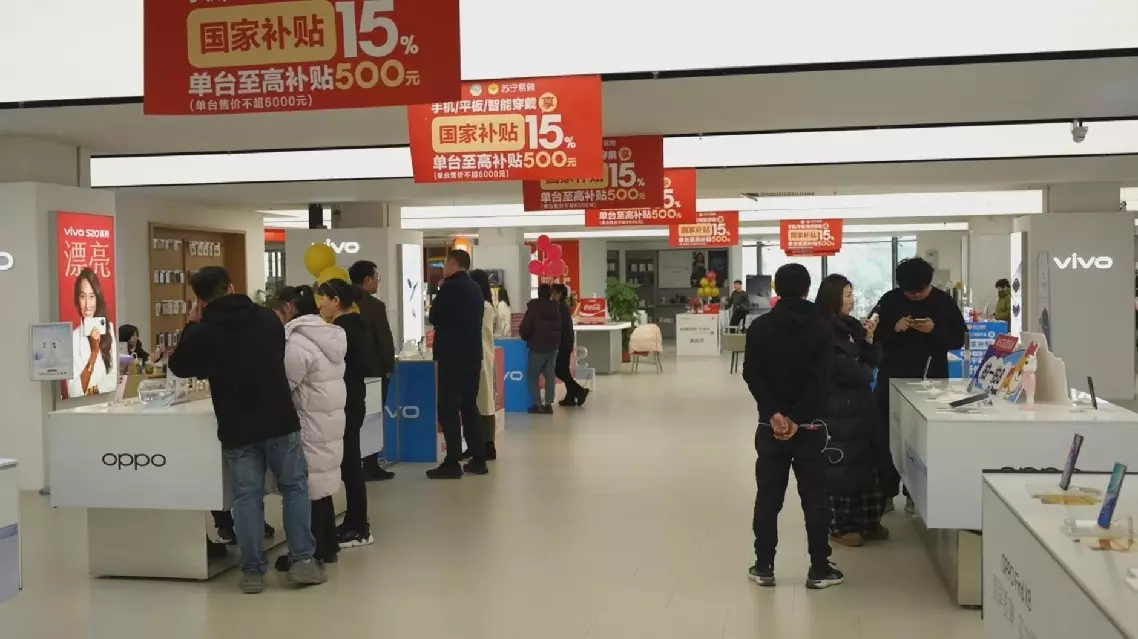
On the first day of the program's implementation, digital product retail stores across China experienced a surge in foot traffic. In a Beijing electronics store, customers flocked in, eager to take advantage of the new subsidies.
Many shoppers expressed their excitement, noting that the upcoming Spring Festival holiday is an ideal time for upgrades.
"It's almost the Spring Festival! I was planning to buy a new phone for my parents, and waiting for this subsidy. It saves me 500 yuan, so I went ahead and made the purchase. I'm really happy!" said a consumer.
Salespersons at major electronics retailers reported a significant uptick in demand across all brands, with 256GB smartphone models being the most sought-after.
"All brands are eligible for the subsidy, and we are collaborating with manufacturers to adjust prices of products exceeding 6,000 yuan to fall within that range, allowing consumers to choose from a wider range of preferred models. We anticipate a potential increase in store sales by five to 10 times, and we are currently stocking up at 10 times the usual level," said Wang Zhaotong, director of consumer electronics purchasing and sales at Chinese retail giant Suning.com.
The surge in consumer enthusiasm has also prompted retailers to offer additional promotions and discounts to attract shoppers. The online shopping experience has also been streamlined, with dedicated subsidy program entry points on e-commerce platforms like Suning and JD.com.
In a retail store in east China's Jiangsu Province, sales staff were seen guiding customers to place orders online through their smartphones.
The subsidy policy is expected to drive domestic smartphone sales to reach 300 million units this year, further boosting consumption and market recovery.
The retail boom has also had a ripple effect on the production side, as digital device manufacturers and their supply chain partners scramble to meet the surging orders. Many factories have increased production, with some even operating round the clock.
In Jiangsu, a front-end production company's factory has been running at full steam since last year's home appliance subsidy policy, while the recent expansion of the national subsidy policy has led to a supply shortage due to overwhelming demand.
"Our orders have increased by 37 percent month on month. Our 2025 order book is already full until April, and we're introducing more automated equipment and adjusting production capacity to ensure timely delivery of qualified products," said Chen Rui, production section chief at Qingbang Electronic Components Co., Ltd.
Automation and digitalization are playing key roles in meeting the increased production demands. Many manufacturers have implemented smart production systems, significantly enhancing efficiency and output rates.
In Xiaomi's production workshop in Beijing, all processes have been automated for intelligent manufacturing, resulting in a 60 percent efficiency improvement compared to the past, enabling better adaptation to current order demands. The company has achieved an impressive production rate of one new device every six seconds for most smartphone models participating in the national subsidy program, according to factory officials.
Production activity has boosted the supply chain, leading to a boost in capacity in logistics, warehousing, and packaging. A logistics company representative reported enhanced efficiency through digital supply chain management and smart warehousing, achieving full automation to reduce errors and improve responsiveness.
"We can see that under this policy impetus, front-end production has not only entered a phase of accelerated full-chain operations but also triggered a resonance upstream and downstream in the supply chain. This cycle of 'sales driving production, and production promoting technology' is leading to a comprehensive resonance throughout the entire industry chain, forming a more resilient supply system, and further enhancing the high-quality development and flexibility of the entire industry chain," said Song Shuang, a researcher at the China Center for Information Industry Development (CCID) at the Ministry of Industry and Information Technology.
China's new digital product subsidy plan ignites consumer spending, production surge
China's new digital product subsidy plan ignites consumer spending, production surge