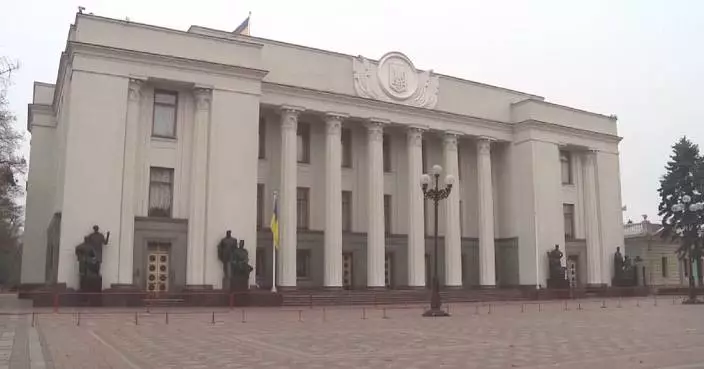
Chinese Foreign Ministry on Thursday reaffirmed its stance of opposing the U.S. deployment of mid-range-capability missiles in the Philippines.
Mao Ning, the spokeswoman of the ministry, made the statement when answering a media query about the case that the U.S. military recently has relocated its Typhon launchers, capable of firing multipurpose missiles with a range of up to thousands of kilometers, from Laoag Airfield in the Philippines to another location on the Luzon Island.
"On the U.S. deployment of Mid-Range Capability missile system in the Philippines, China has made clear its opposition more than once. I want to stress once again that introducing such strategic and offensive weapons into the region is a highly dangerous move. It will escalate regional tensions and divisions, provoke geopolitical confrontation, and fuel an arms race. This is an extremely irresponsible choice for the security of both the Philippines and the people of Southeast Asia. We once again urge the Philippines to heed the voices of countries in the region and their people, correct this mistake as soon as possible, fulfill the previous public commitment to promptly withdraw the Typhoon Mid-Range Capability missile system, and refrain from continuing further down the wrong path," said Mao.

China opposes U.S. deployment of mid-range-capability missiles in Philippines

China opposes U.S. deployment of mid-range-capability missiles in Philippines
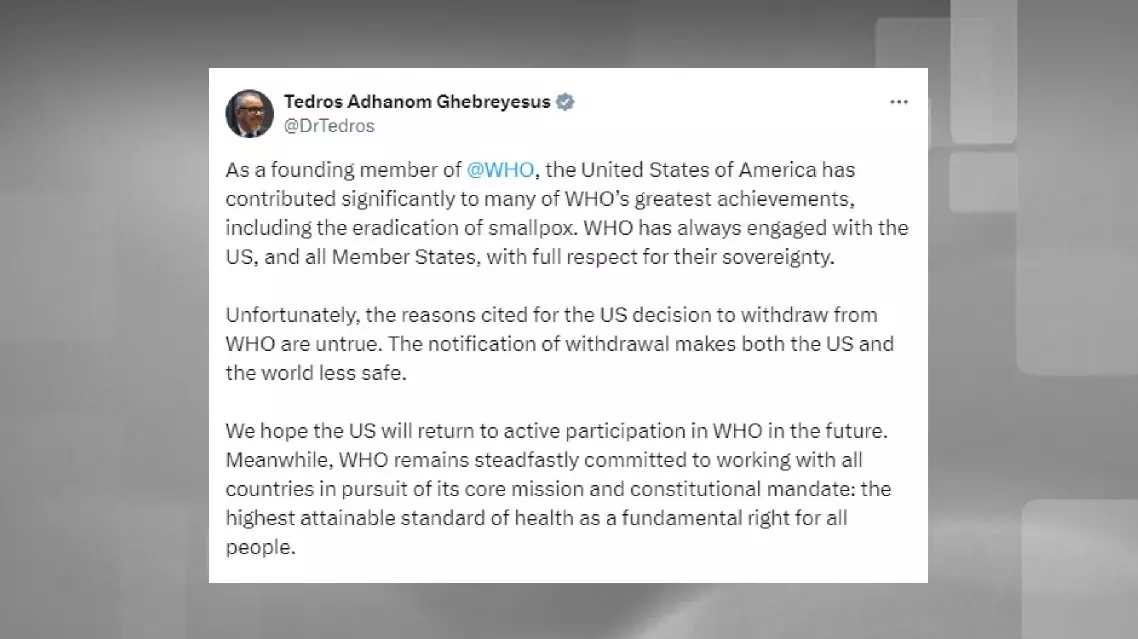
World Health Organization (WHO) Director-General Tedros Adhanom Ghebreyesus on Saturday depicted as "untrue" the reasons given by the United States for its withdrawal from the global health watchdog.
On the social platform X, the WHO chief noted that the move will make the United States itself and the world "less safe."
U.S. President Donald Trump signed an executive order on Jan. 20, 2025, the first day of his second term to formally initiate the U.S. exit from the UN specialized agency. The United Nations received the formal notice two days later.
Under the UN charter, the withdrawal takes effect one year after notice is given.
Commending the contribution made by the United States as a founding member to many of WHO's greatest achievements, Tedros wrote in the X post, "Unfortunately, the reasons cited for the U.S. decision to withdraw from WHO are untrue."
The U.S. move "makes both the U.S. and the world less safe," he said, expressing hope that the United States "will return to active participation in WHO in the future."
Also on Saturday, the WHO issued a statement, voicing regret over the U.S. withdrawal and rejecting accusations made by the Trump administration.
The U.S. withdrawal raises issues that will be considered by the WHO Executive Board at its regular meeting starting on Feb. 2 and by the World Health Assembly at its annual meeting in May 2026, it said.
In dealing with the consequences, the WHO Secretariat "will act on advice and guidance of our governing bodies accordingly," a WHO press official told Xinhua in an email Wednesday.
The United States has yet to pay its outstanding membership dues, according to the official. "As of today, the USA has not paid the invoiced amounts for its assessed contributions for the biennium 2024-2025," the official said.
The U.S.-based National Public Radio (NPR) reported that the outstanding amount is estimated to total some 278 million U.S. dollars.
WHO chief says U.S. reasons for withdrawal 'untrue'