Two coffee machine manufacturers in south China's Shenzhen have emerged as leaders among the city's small and medium-sized enterprise (SMEs) landscape, leveraging intelligent technology upgrades to drive a significant increase in overseas orders and establish themselves as major export-oriented players.
At a technology industrial park in Shenzhen's Bao'an District, several Georgian buyers were recently seen visiting coffee machine maker Cino Technology. After rounds of discussions, the company received a bulk order for 100,000 units.
"Orders are the lifeline of our business, but they also come with great pressure. It means we must make all-out efforts," said Liu Youliang, chairman of CINO Technology (Shenzhen) Limited.
Liu told China Central Television (CCTV) that the company registered over 22 million U.S. dollars in export revenue in 2024. New orders are already scheduled into the second half of the year, and they plan to export over 30,000 machines during the upcoming Chinese New Year holiday.
Their coffee machines are now sold in 87 countries and regions worldwide, but the company's journey to the top was marked by significant challenges. Liu recalled the difficult period when the company's traditional home coffee machines struggled to adapt to shifting market demands, resulting in a prolonged period of financial struggles.
"The whole company was on the brink of collapse. That's when I realized we must develop our own core technology," Liu said.
A turning point came during a government-organized trade fair abroad, where Liu saw a growing demand for high-end commercial coffee machines.
"We were starting from scratch. The technical requirements are much higher across the board, and there's no complete experience to draw from," technical director Zhang Yuanxian highlighted the challenges during the transition.
After three years of relentless efforts, the company's flagship product has transformed from low-cost machines priced at just dozens of dollars to high-end commercial capsule machines worth over 1,300 dollars. Today, with more than 270 domestic and EU patents across 40 different products, Cino Technology generates over 200 million yuan (about 27.6 million U.S. dollars) in annual revenue.
Just a short distance away, a younger and more futuristic coffee machine company is taking a different approach. RobotAnno (Shenzhen) Company, founded by 90s-born entrepreneur Huang Huang, specializes in robotic coffee machines.
"I'm meeting clients. With more overseas customers coming in, our sales team are too busy to handle it all, and I feel like my spoken English has improved during the process," said Huang.
Unlike Liu's traditional machines, Huang's products feature fully automated processes. With a simple click to select coffee type and latte art, a robotic arm springs into action. In just 90 seconds, a freshly brewed latte with intricate designs is ready. This cutting-edge technology impressed an Indian buyer, who quickly placed an order.
Over six years, Huang's research team, with an average age of just 25, have dedicated themselves to exploring new commercial application for robotic arms. Leveraging motion capture technology and self-developed control systems, they conducted tens of thousands of tests and improvements, ultimately achieving perfect replication of coffee latte art.
"These movements are based on capturing barista actions, which are then executed by the trained robots. We used nearly three tons of milk [during testing]," he said.
Huang said 2024 has been a remarkable year for the company, with their export value doubling compared to the previous year. In addition to the coffee robots, their products, including cocktail robots and ice cream robots, have been exported to over 60 countries and regions, including North America and Europe.
Recently, through government support, Huang met a tech company that uses big data and other technologies to analyze market trends and help SMEs expand their online overseas business.
"In 2024, we organized over 200 enterprises to attend nearly 30 overseas trade fairs. The government has strongly supported these small and medium-sized foreign trade companies, assisting them in securing and expanding orders and offering comprehensive, full-chain services," said Cai Qingdong, deputy director of Bao'an District Bureau of Commerce.
In 2024. Shenzhen's imports and exports exceeded four trillion yuan (about 552 billion U.S. dollars) for the first time in history, representing a 16.4 percent year-on-year increase. Private enterprises accounted for over 70 percent of the total, cementing their role as the primary driving force behind the city's robust foreign trade growth.
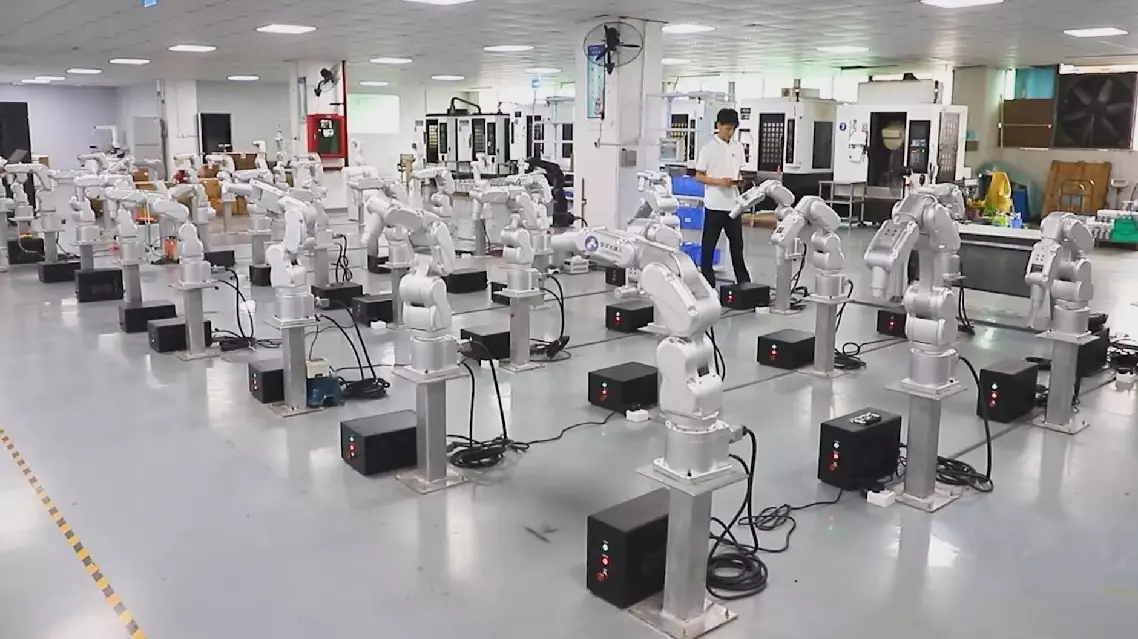
China's high-end and robotic coffee machine makers brew success with smart technology and global exports