A six-legged robot dog independently developed by China recently completed a series of tests in the ice sheet area near Zhongshan Station in Antarctica, a breakthrough which marks an innovative step in using advanced technology for polar scientific research.
The robot dog demonstrated its ability to walk steadily on ice and snow while carrying a box on its back, without slipping or falling. Its stability is credited to a pair of specially designed shoes. According to the research team, these shoes were crafted to endure extreme temperatures as low as minus 40 degrees Celsius while preventing slippage and minimizing damage to the ice surface.
"The material of these shoes can withstand temperatures as low as minus 40 degrees Celsius. Additionally, when they come into contact with the ice surface, the pressure becomes very low. This not only prevents slipping but also causes minimal damage to the ice surface, ensuring the robot dog can walk as if on flat ground," said Mao Shijie, head of the Antarctic six-legged robot team and director of Lenovo Research Institute's Shanghai branch.
Furthermore, the robot dog is equipped with a battery system that allows it to operate for up to two hours in temperatures ranging from minus 30 degrees Celsius to minus 40 degrees Celsius. In order to meet the demands of long-duration scientific expeditions, the team has developed a solution to extend its operating time.
"For scientific research needs, we require the robot dog to operate for more than four hours, such as performing ice surface detection. In such cases, we add two additional batteries to the robot dog, ensuring it can work for four to six hours," said Mao.
The robot dog is capable of carrying loads of about 70 to 100 kilograms and has already passed tests for walking on slippery ice while carrying weight. Its potential applications extend beyond transporting materials, as the research team plans to upgrade the robot to meet various expedition needs, including safety detection and research operations.
"One major concern for the expedition team is safety. When walking on the ice surface, ice crevasses are invisible, posing a significant challenge for people and vehicles exploring the polar interior. Another critical mission of the robot dog is to carry an ice crevasse detector and lead the team. This ensures that the areas it traverses are free of crevasses and safe," said Mao.
The data collected during these tests will help refine and improve the robot dog's design, enabling it to take on more advanced tasks.
"Patrolling is typically done through GPS positioning or visual navigation, but in Antarctica, neither is reliable. First, the geomagnetic environment in polar regions is very different, posing a great challenge. Additionally, the vast expanse of white snow makes visual navigation very difficult. To address this, we need to integrate new methods, such as combining gyroscopes and various sensors, to achieve autonomous positioning," said Mao.
The research team also plans to adapt the robot dog for even more complex tasks, such as underwater sampling at multiple points.By integrating the robot dog with underwater robots and drones, they aim to enable collaborative operations that will further enhance the capabilities of polar scientific expeditions.
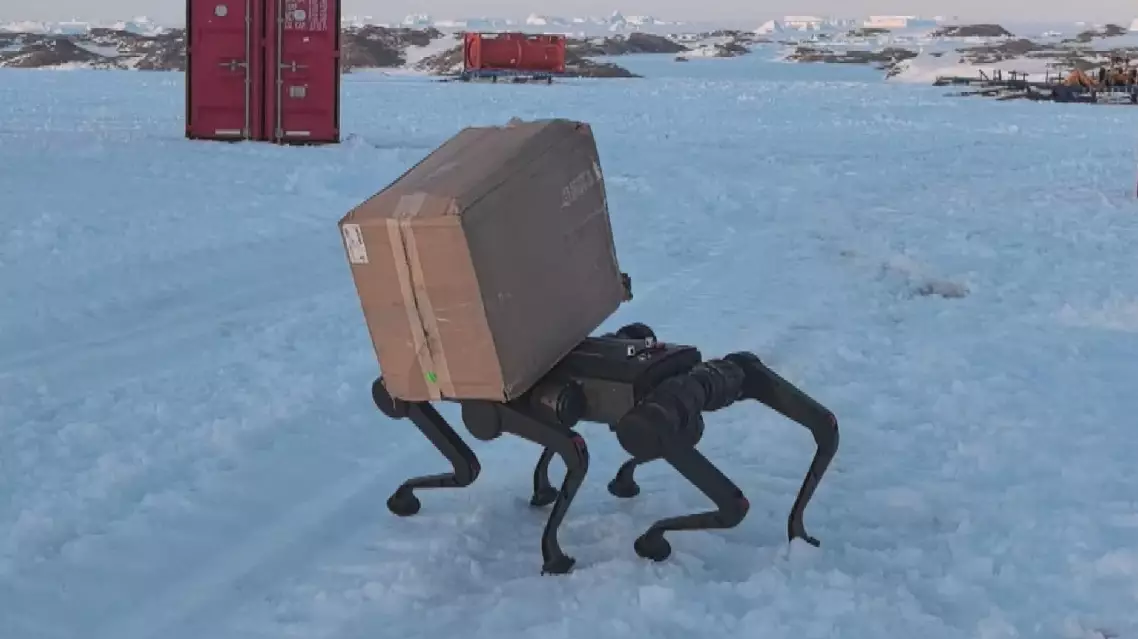
China's six-legged robot dog passes Antarctic tests to facilitate polar research
China's six-legged robot dog passes Antarctic tests to facilitate polar research