Skip to Content Facebook Feature Image

Girls choir from Sichuan to perform mountain melodies at Spring Festival Gala

China

China

China

Girls choir from Sichuan to perform mountain melodies at Spring Festival Gala

2025-01-28 17:26 Last Updated At:17:37

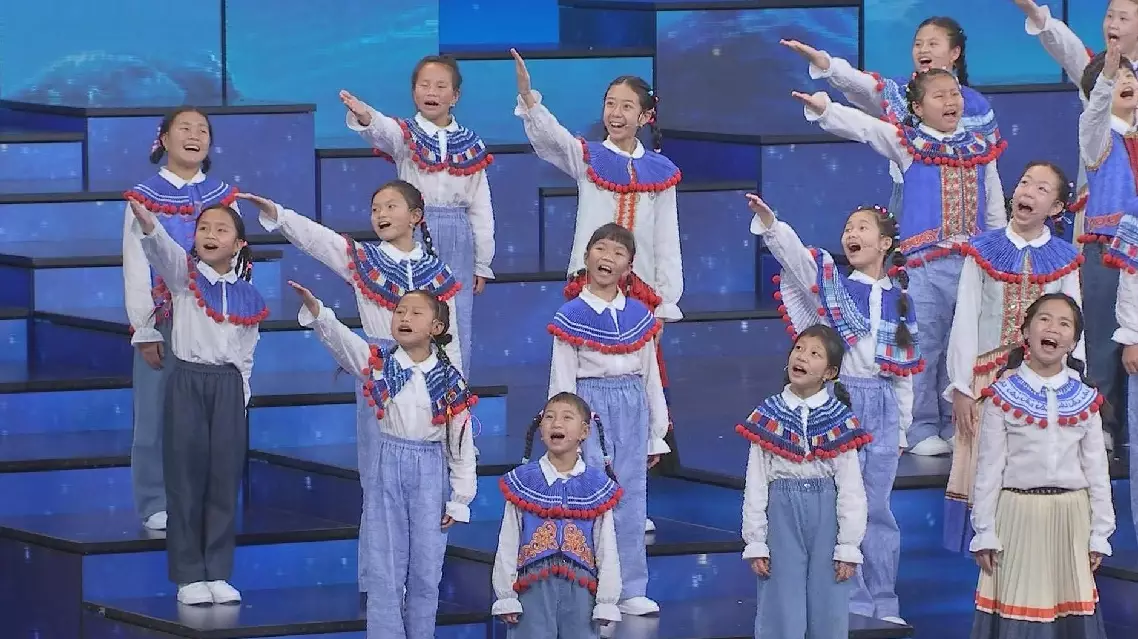
A choir of girls from Daliang Mountain in southwest China's Sichuan Province will perform a traditional folk song on the main stage of the 2025 Spring Festival Gala in Beijing on Tuesday night.

The choir titled "Niuniu", meaning little girl in Chinese, was established by Jibu Xiaolong, the music teacher of the young singers at the Central Primary School of Dacao Town, Puge County in Sichuan.

Their clear voices and pure smiles have recently captivated the practice hall during a rehearsal break of the gala.

"It's actually a bumpy journey from Daliang Mountain. We took a long bus ride to Xichang, and then switched to plane to come here. Many children kept vomiting during the trip. And then, we have received attention and care. Although the weather is cold in the north, our hearts feel warm. The children have also quickly recovered, so we are very happy," he said.

Jibu highlighted that the majority of the choir members are children of migrant workers, and have found a sense of empowerment and self-assurance through their participation in the choir, transforming from shy and introverted to confident individuals.

Li Shuhui, director of singing programs at the gala, can still recall the debut of the Niuniu Choir at the rehearsal over a month ago.

"They were wearing all kinds of clothes. There were sweaters, shirts and T-shirts. When we got to the stage, there was only very basic light. All the girls stood in a small group and then sang the song, without neat movements or well combed hair. But many directors wept and were deeply moved. They are so simple and sincere, which makes their performance very touching. From the beginning, we have been simplifying the design of their program, from the shape of the stage to their formation, as well as the children's movements. At first, they were supposed to wear makeup, but now, they basically wear no makeup. They will be on the stage just after simple face cleaning, after getting up. We have been guiding the children to perform like they are not on a stage but a mountain and are singing to the distant moon," Li said.

The gala, also known as "Chunwan" in Chinese, has been held since 1983 and aired live on the eve of the Chinese New Year, or the Spring Festival. It has become a fixture for many Chinese households as part of the country's largest annual holiday celebrations. The 2025 Spring Festival falls on Jan 29, which is the first day of the Year of the Snake.
Girls choir from Sichuan to perform mountain melodies at Spring Festival Gala

Girls choir from Sichuan to perform mountain melodies at Spring Festival Gala
A new round of trade-in subsidy program is energizing China's consumer market these days, with provinces across the country seeing a surge in demand for cars, home appliances and digital devices.

In north China's Shanxi Province, the new trade-in subsidy program, which started on January 9, has further helped boost sales in home appliances and digital devices which are covered by the new round of subsidies.

To enjoy the subsidies, six types of home appliances, including refrigerators and washing machines, must meet national Level 1 energy-efficiency or water-efficiency standards. Digital and smart products include four types, such as mobile phones and tablets, with a sales price cap of 6,000 yuan (about 800 U.S. dollars) per item.

In both categories, subsidies are set at 15 percent of the final transaction price. For home appliances, the maximum subsidy is 1,500 yuan per item. For digital products, the cap is 500 yuan per item. Each consumer can receive a subsidy for one unit in each category.

Neighboring Shanxi, Hebei Province kicked off the year of 2026 with the new round of trade-in subsidy program starting on January 1.

The subsidies cover automobiles, home appliances, and digital products. Individual consumers who purchase designated Level 1 energy-efficiency appliances or eligible digital products priced at no more than 6,000 yuan can receive subsidies equal to 15 percent of the transaction price. The maximum subsidy is 1,500 yuan per appliance and 500 yuan per digital or smart device, with each person limited to one subsidized item in each category.

Data showed that from Jan 1 to 9, Hebei's home appliance trade-in program alone disbursed more than 130 million yuan in subsidies, driving sales of over 920 million yuan.

In east China's Jiangsu Province, the new trade-in subsidy program, taking effect for two weeks, has brought the province a boom in trade-in.

At a local 4S store in Jiangsu's Suqian City, showroom traffic has spiked as salespeople walked customers through the new benefits from the trade-in subsidy program.

"Under the scrappage-and-replacement scheme, customers who buy a new energy vehicle (NEV) can receive a subsidy worth 12 percent of the vehicle price, capped at 20,000 yuan (about 2,860 U.S. dollars). For combustion-engine cars, the subsidy is 10 percent, with an upper limit of 15,000 yuan. For trade-ins, NEVs are able to receive a subsidy worth 8 percent of the vehicle price, up to 15,000 yuan, while combustion-engine cars will receive a 6-percent subsidy, with a cap of 13,000 yuan," said Sun Yue, a saleswoman at the store.

In the home appliance sector, Jiangsu's policy this year stipulates that only products that meet China's Level 1 energy-efficiency standard are eligible for subsidies. The scheme covers six major categories, including refrigerators and washing machines.

Consumers who purchase qualifying appliances can receive a subsidy equal to 15 percent of the final retail price, up to a maximum of 1,500 yuan per item. Each person is limited to one subsidized unit per product category.

Four types of digital and smart products, such as mobile phones and tablets, are eligible for a 15-percent subsidy capped at 500 yuan per unit, with a retail price no more than 6,000 yuan.

"With the national subsidy policy back in place this year, I went to the store to check what discounts I could get. It knocked 500 yuan off the price. [The discounted price is] very reasonable," said Wang Kang, a resident of Jiangsu's Xuzhou Province.

To enhance the shopping experience for consumers, many retailers are pairing subsidies with "one-stop" services that combine the delivery of new products with on-site collection of old ones.

"After consumers place an order for new home appliances, our staff will schedule a time to pick up the old units. Recycling the old appliance can also further offset the purchase price of the new one," said Yang Jie, a sales supervisor at a major home appliance company.

China's new trade-in program sparks consumption boom

China's new trade-in program sparks consumption boom

Recommended Articles