Imposing unilaterally adding tariffs and addressing internal issues including the fentanyl-related crisis through shifting blames onto other countries will not resolve the problems of the U.S., said a commentary published by China Media Group (CMG) on Monday.
An edited English-language version of the commentary is as follows:
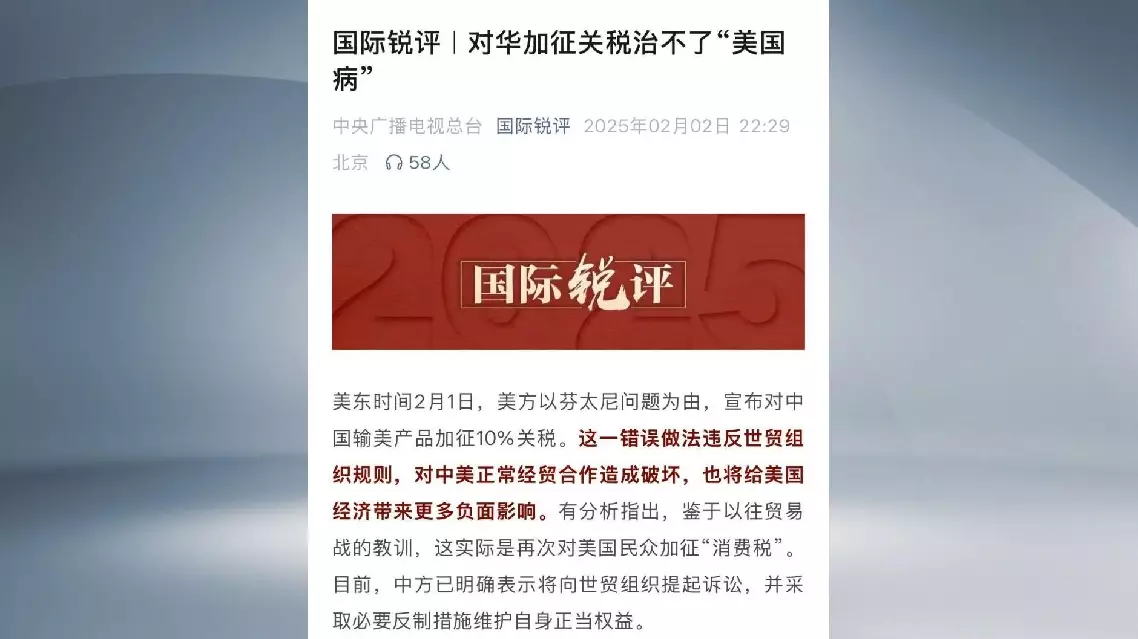
The U.S. announced on Saturday to impose a 10-percent tariff on Chinese imports into the country on top of existing tariffs on the ground of fentanyl issues.
The erroneous action violates WTO rules, undermines normal economic and trade cooperation between China and the U.S., and will bring further negative impacts on the U.S. economy.
Analysts have pointed out that, considering the lessons learned from previous trade wars, this effectively constitutes an additional "consumption tax" on the U.S. public.
Currently, China has clearly stated it will file a lawsuit with the WTO and take necessary countermeasures to safeguard its legitimate rights and interests
It is necessary to note that the U.S. justification of imposing more tariffs on China based on the so-called fentanyl issue is completely unfounded.
Fentanyl is a potent opioid, and its status as a drug problem in the U.S. is linked to significant abuse demand within American society and the related profit chain, as well as the government's inadequate regulation.
Today, more than half of U.S. states have enacted the "legalization of marijuana," and many areas are witnessing a "black market" for fentanyl-related drugs.
Fentanyl is U.S. own problem and a consequence of its domestic governance failures. The attempt of the U.S. side to link public health issues with tariff pressures not only fails to address the root causes of the problem but may also exacerbate political divisions, hindering effective governance regarding the fentanyl crisis.
China is one of the world's toughest countries on counternarcotics both in terms of policy and its implementation, and announced back in 2019 the decision to officially schedule fentanyl-related substances as a class, the first country in the world to do so.
According to reports from U.S. drug enforcement agencies such as the Customs and Border Protection, no fentanyl-related substances originating from China have been seized by the U.S. since September 2019.
In this context, the U.S. continuation of hyping up the so-called fentanyl issue is clearly driven by ulterior motives.
Analysts have pointed out that the incumbent U.S. administration invoked the International Emergency Economic Powers Act of 1977 just days after taking office, bypassing standard investigation procedures to link the fentanyl issue with tariff pressures.
The goal is to circumvent the WTO obligations such as the most-favored-nation (MFN) treatment and schedule of concessions within the WTO legal framework, and advance the trade protectionism that violates WTO rules. By "having other countries pay," this approach aims to alleviate domestic economic pressures while shifting attention away from internal conflicts.
The actions of the U.S. government are based on a flawed understanding and perception of tariffs. Import tariffs are borne by importers and are ultimately passed on to U.S. consumers, thereby distorting the global industrial chain.
This is the basic consensus among think tanks such as the Peterson Institute for International Economics in the U.S., and it has been validated by the results of the previous round of trade conflict initiated by the U.S. in 2018.
According to reports from U.S. media, products imported from China, including fish and shellfish, vegetable oils, vegetables (particularly corn), fruits and nuts, soaps, lubricants, tea, and spices, fall within the scope of the current tariff increases.
Furthermore, given China's significant advantages in the export of consumer electronics, footwear, and toys, imposing tariffs on these products will also impact the life of American people.
The National Retail Federation estimates that the additional tariffs could cost consumers an extra 6.4 billion to 10.9 billion U.S. dollars just on household appliances.
In addition to daily consumption, employment opportunities for Americans will also be impacted due to disruptions in the supply chain caused by tariffs.
In January 2021, the U.S.-China Business Council released a study indicating that the trade policies implemented during the first tenure of Donald Trump resulted in the loss of 245,000 jobs in the U.S.
In contrast, what impact will the new round of tariffs from the U.S. have on China?
Relevant research shows that the average tariff rate previously imposed on Chinese products by the U.S. reached 19.3 percent, and with the addition of the new tariffs, the total rate is around 30 percent.
In the short term, the cost advantages of some Chinese products may be somewhat weakened; yet, considering factors such as the cost-effectiveness of Chinese products, the strong foundation of China's manufacturing sector, a well-established supply chain system, and high production efficiency, Chinese products still maintain global competitiveness.
More importantly, China's reliance on exports to the U.S. has significantly decreased after several years of adjustment, and the resilience of its exports has been further strengthened.
Currently, exports to the U.S. account for only 3 percent of China's GDP and less than 15 percent of its total exports. At the same time, China's exports to the Belt and Road countries have increased by 9.6 percent year on year, and exports to ASEAN countries have grown by 13.4 percent.
This ongoing expansion of China's "circle of friends" and the diversification of markets are providing new growth points for Chinese exports.
From the global perspective, the unilateral imposition of additional tariffs by the U.S. has sparked strong dissatisfaction and even retaliation from other trading partners.
Canada, similarly affected by U.S. tariffs, on Saturday announced that it will respond to U.S. tariff hikes with 25 percent tariffs against 155 billion Canadian dollars (105.55 billion U.S. dollars) worth of American goods.
Mexico has also indicated that it will take countermeasures, imposing additional tariffs on products imported from the U.S.
The international community is generally concerned that if this cycle of retaliation and counter-retaliation continues, it could lead to a global trade war, disrupting the stability of global supply chains and hindering global economic growth.
The World Bank warned in mid-January that if the U.S. implements a comprehensive 10 percent tariff and trading partners respond with retaliatory measures, global economic growth could decline by 0.3 percentage points in 2025.
There are no winners in a trade war or tariff conflict, and attempting to address internal issues through shifting blames onto other countries will not resolve America's problems.
It's expected that the U.S. will approach and address its issues including the fentanyl problem objectively and rationally, and refrain from using them as an excuse to threaten other countries with tariff measures.
The U.S. should adhere to basic economic principles and common sense by canceling the erroneous practice of imposing unilateral additional tariffs, manage U.S.-China relations in a responsible manner and contribute positively to the people of both countries and the world.
The historical lesson that cooperation benefits both sides while conflict harms all will continue to be proven by facts.
Unilateral adding tariffs or shifting blames won't solve US problems : commentary