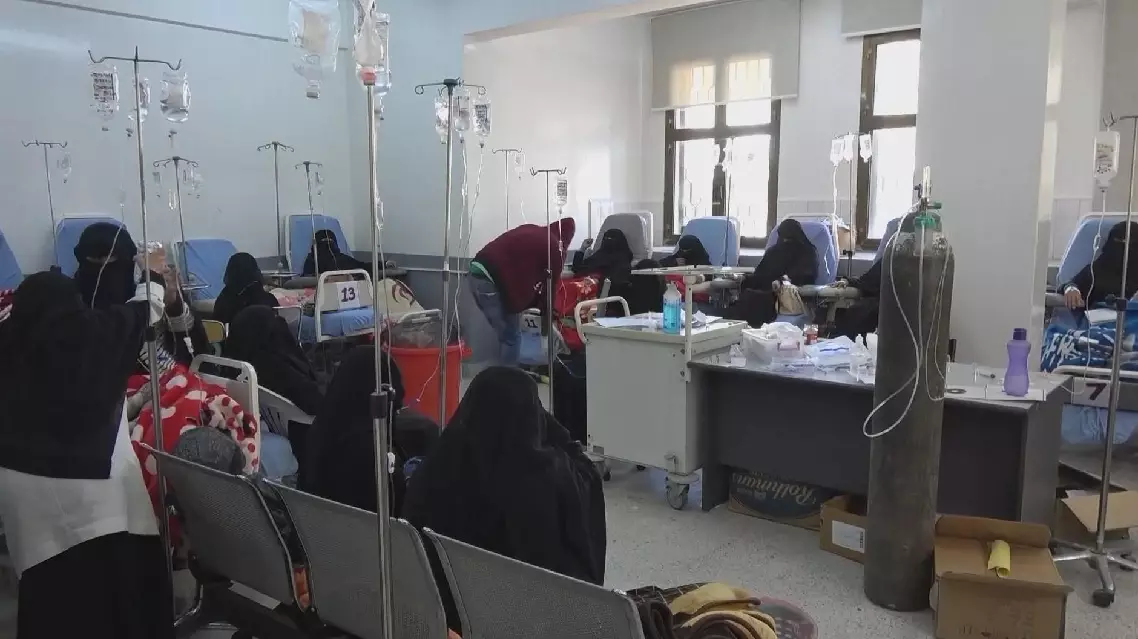
War has devastated the healthcare system in Yemen, a country now facing a protracted political, humanitarian and developmental crisis, leaving thousands of cancer patients without a proper diagnosis or care.
From the small village of Al-Mahwit to the Cancer Center in Sanaa, Ahmed Al-Hijari traveled to the Yemeni capital with hopes for his son Hussein, who is battling nerve cancer.
But Ahmed's struggle is not just against the disease. He also faces the challenges of war and sanctions, which have made finding medicine difficult.
"My son has been sick for about two months, and our situation is very difficult. I came from Al-Mahwit to seek treatment for my son. Because of the war, there's no medicine and we need to travel abroad for treatment, but our circumstances are tough," said Ahmed Al-Hijari.
While the world marks the World Cancer Day on Feb 4 by raising awareness and improving prevention and the search for a cure, around 80,000 people in Yemen are suffering from the disease.
Each year, 30,000 new cases are recorded, largely due to the consequences of the ongoing war since 2014 in which internationally banned weapons have been used.
As the world works to improve methods of treatment, Yemen's healthcare system faces major challenges. The situation has been made worse by current U.S. sanctions, following the reclassification of the Houthis, a Yemen-based militant group, as a "Foreign Terrorist Organization (FTO)" last month. This recent reclassification is expected to worsen conditions, leading to new obstacles to the delivery of medical supplies and threatening the lives of thousands of patients.
"Any restrictions on the operation of companies or on the arrival of safe medicine in Yemen will directly affect cancer patients and all other patients. Any measures that hinder patients from traveling for treatment will have an extremely severe impact on them," said Abdullah Thawabah, director of National Cancer Center in Sanaa.
Yemen's healthcare sector is on the brink of collapse, with a severe shortage of medicines and essential equipment for cancer treatment such as radioactive materials, including iodine. More than 320,000 patients are unable to travel for treatment due to the closure of the Sanaa airport. The United Nations has warned of an impending health disaster unless immediate aid is provided.
Yemen is still facing a protracted political, humanitarian, and developmental crisis, more than 10 years after the full outbreak of civil conflict marked by the Houthi forces' capture of Sanaa, Yemen's capital, on Sept. 21, 2014.
The latest round of the Gaza conflict and its spillover effect have once again dimmed the prospects for peace in Yemen following the historical reconciliation between Saudi Arabia and Iran in March 2023. As the civil conflict drags on, the Yemeni people are still finding themselves yearning for peace.
Yemen faces health crisis as war cripples medical system

China's first 500-kV cross-border alternating-current power interconnection project entered service Monday, creating the highest voltage grid tie between the two countries and advancing Belt and Road energy cooperation.
The project raises two-way power transfer capacity between the two countries from 50,000 kW to 1.5 million kW, enabling the annual transmission of about 3 billion kWh of clean electricity, roughly 30 times the capacity of previous lines, according to China Southern Power Grid.
As the largest cross-border grid project and the highest-voltage power link between China and Laos, it connects southwest China's Yunnan Province with Oudomxay and Luang Namtha provinces in northern Laos.
Cross-border electricity trading began as the project entered operation. About 4.81 million kWh of power from clean energy bases in northern Laos was transmitted to Yunnan through the new line, marking a more regular and institutionalized phase of power connectivity between the two countries.
It is also the first time an overseas new energy project has participated in China's electricity market, the company said. The power involved in the transaction came from a large mountain photovoltaic project in Laos, one of the core supporting power sources for the interconnection line.
"This project is the cross-border power grid project with the highest voltage level between China and Laos. Leveraging the China-Laos power grid interconnection and the power markets in southern China, surplus hydropower from Laos can be transmitted to China during the rainy season, while China can supply supplemental power to northern Laos during the dry season. This project represents yet another landmark achievement between China and Laos in deepening power cooperation and jointly advancing the high-quality development of the Belt and Road Initiative," said Li Jingru, general manager of Electricite du Laos Transmission Company Limited (EDL-T), a joint venture of China Southern Power Grid and Lao state-run Electricite du Laos.
The solar project has an average annual power generation capacity of about 1.65 billion kWh. In 2026, it is expected to transmit about 1.1 billion kWh of solar power across the border, supporting energy complementarity between the two countries.
"In the future, efforts will be made to further promote normalized cross-border electricity trading, meet the trading needs such as electricity transmission from Laos to China's Yunnan, from China's Yunnan to Laos, and from Laos to China's Guangdong, and facilitate the optimal allocation of energy resources in the Lancang-Mekong region," said Li Minhong, marketing director of China Southern Power Grid.
Construction of the interconnection project began in late February last year. Spanning a total length of 177.5 km, the transmission line includes a 145-km Chinese section and a 32.5-km Lao section.
New China-Laos power link expands transfer capacity 30-fold, boosts electricity trading