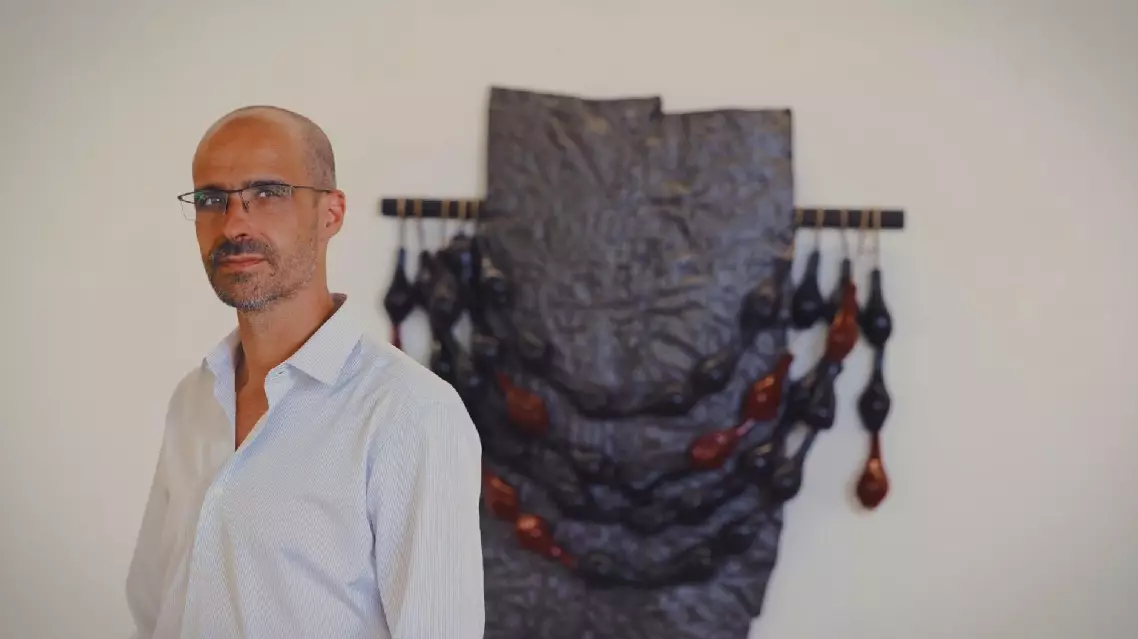
A French lacquer artist, who is deeply inspired by China's ancient lacquer tradition, has spent more than a decade studying and working with raw Chinese natural plant lacquer.
Vincent Cazeneuve, the artist, has lived in China for over 17 years, and he is currently living in Chengkou County, northern part of Chongqing Municipality in southwest China.
Cazeneuve's fascination with Chinese natural plant lacquer began during his university studies in decorative arts, where he was drawn to the material's warmth compared to the coldness of metals. After becoming an antique restorer, Cazeneuve had the chance to work with raw Chinese natural plant lacquer -- a painting material harvested from lacquer trees.
However, he faced a challenge: France does not produce natural plant lacquer.
His journey into China's lacquer culture began in 2007, when he first encountered authentic Chinese natural plant lacquer.
"The first time I encountered authentic Chinese natural plant lacquer was in 2007, at the Chengdu studio of my master, Ms. Zou. Raw lacquer is the material I've always dreamed of working with. I've completely fallen in love with the charm of Chinese lacquer, with its rich color, and every single characteristic it has," Cazeneuve recalled.
In the country with a lacquer tradition dating back to the Neolithic period, he studied under masters of the craft in southwest China's Sichuan Province and neighboring Chongqing, eventually moving to Chengkou County's lacquer forests, where he learned how to harvest and prepare natural plant lacquer.
The "Chengkou lacquer" is prized for its excellent toughness and resistance to fading, making it one of the finest types of natural plant lacquer available.
Chengkou County, located an eight-hour drive from downtown Chongqing, offers Cazeneuve a sense of peace in his remote studio, nestled in the mountains.
Here, he learned the traditional processes of tapping and preparing lacquer from local villagers, who typically tap the lacquer trees in the early morning hours before the flow rate slows after sunrise.
For Cazeneuve, China's raw materials and traditional techniques are invaluable. Not only does he harvest and prepare lacquer himself, but he has also learned crafts like weaving, bamboo weaving, and embossing.
In the village, Cazeneuve was drawn to traditional craftsmanship and quickly integrated his experiences into his own artistic philosophy.
He believes that everyday items like rice bags, bamboo baskets, and eggshells can serve as mediums for his artwork. He also draws inspiration from printmaking, sculpture and collage, blending these forms with traditional techniques like shuttle weaving and embroidery.
The combination of Eastern and Western influences in his work has earned him recognition in the art world, with solo exhibitions held both in China and abroad.
"This piece of lacquerware features carving techniques. To achieve this effect, I applied 80 layers of lacquer, then carved into it. We spent nearly an entire year working on this project," Cazeneuve explained, speaking about a large scoop he was working on.
Looking ahead to the new year, Cazeneuve has set a new goal: to expand his understanding of Chinese culture further by learning more Chinese characters and incorporating them into his artwork.
"I love the Chinese culture. Thus, I think everybody in the world is really fascinated by Chinese culture and history. We are fascinated by Chinese culture and the Silk Road, and all the porcelain, the silk, the lacquer. After I came to China, I felt like, almost my life. I felt almost I'm part of it. The more I live in China, the more I come like a Chinese person," Cazeneuve concluded.
French lacquer artist finds inspiration in China's rich lacquer heritage