Chinese animated film "Ne Zha 2" became the first Asian film to enter the Top 35 of the global box office chart, according to data from an online platform.
According to Chinese ticketing platform Beacon, "Ne Zha 2," a sequel to the 2019 hit featuring a mythical boy with magical powers and exceptional martial arts skills, grossed over 8.085 billion yuan (over 1.11 billion U.S. dollars) as of 21:00 Beijing Time on Sunday, surpassing the box office earnings of "The Dark Knight Rises".
Data from the platform also shows that the total number of viewers (including pre-sales) for "Ne Zha 2" exceeded 160 million, surpassing that of "Wolf Warrior 2" and topping the list of moviegoers in Chinese film history.
"Ne Zha 2" premiered in Chinese cinemas on Jan 29, alongside other films such as "Detective Chinatown 1900" and "Creation of the Gods II: Demon Force." Together, these films helped the Chinese New Year holiday box office revenue reach a historic milestone of 10 billion yuan (about 1.4 billion U.S. dollars).

China's blockbuster 'Ne Zha 2' enters Top 35 on global box office chart

China's blockbuster 'Ne Zha 2' enters Top 35 on global box office chart
China's latest medical science and technology is drawing attention for its role in reshaping patient care from diagnosis to surgery and to rehabilitation at the ongoing third phase of the 139th China Import and Export Fair, or Canton Fair, in Guangzhou, capital of south China's Guangdong Province.
The five-day segment of the world's largest trade fair opened on Friday, showcasing frontier achievements in fields such as smart healthcare, functional textiles, and green materials, with an exhibition area of 515,000 square meters and 25,000 booths. Walking through the exhibition, visitors see that medical innovation is no longer confined to technical parameters. It is being designed to accompany patients through every stage of treatment.
In the exhibition hall, surgical robots allow doctors to operate with clear 3D vision and flexible wrist-like instruments, while requiring only minimal network support.
According to exhibitors, in some cases, a simple mobile connection is enough to keep the system running. This lowers deployment thresholds and makes advanced surgery more accessible.
Earlier this year, one such robot enabled a doctor in Chengdu, capital of the southwestern province of Sichuan, to complete a gastric surgery for a patient in Brazil, spanning half the globe.
High-tech rehabilitation devices are emerging among the most engaging exhibits.
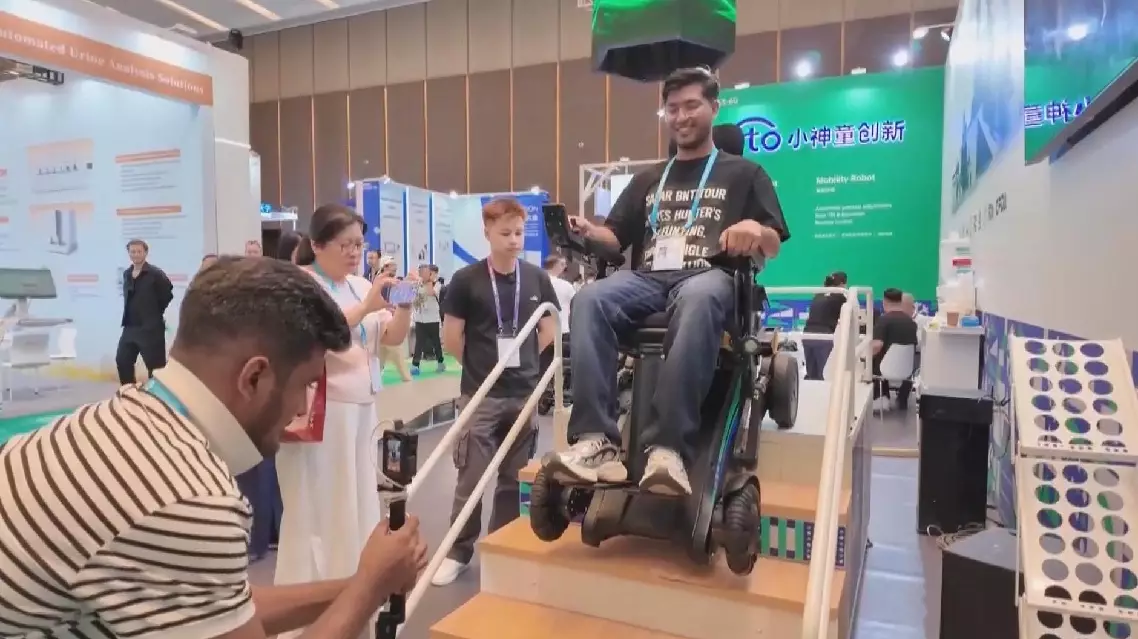
Mobile robots capable of navigating stairs and slopes, along with brain-machine interface exoskeletons that help stroke patients regain mobility, show how innovation is being applied to everyday needs.
These practical devices have attracted strong interest from international buyers, especially those from the United States, Europe and Mexico.
Artificial intelligence is extending its role in medical imaging.
In the exhibition, large-scale models on display can analyze X-rays and CT scans to detect conditions ranging from kidney stones to cardiovascular blockages.
Exhibitors say the technology can help transfer the expertise of senior doctors from top-tier hospitals to community clinics, helping improve access to quality healthcare nationwide.
Since June last year, the system has already been used in multiple hospitals, which can help find problems in 32 human organs and produce 92 auxiliary models to support doctors in screening and diagnosis, according to exhibitors.
Established in 1957, the Canton Fair is held twice a year in Guangzhou. It is the longest-running of several comprehensive international trade events in China, and has been hailed as the barometer of the country's foreign trade.
The first phase of the 139th edition of the Canton Fair ran from April 15 to 19, followed by the second phase from April 23 to 27.
Smart healthcare highlights innovation at Canton Fair