People from all walks of life paid their last respects to Huang Xuhua, chief designer of China's first-generation nuclear submarines, in Wuhan City of central China's Hubei Province.
Huang, also an academician of the Chinese Academy of Engineering, as well as recipient of the Medal of the Republic, passed away at the age of 99 on Thursday.
Born in Guangdong Province in 1926, Huang joined a research institute of the former China Shipbuilding Industry Corporation, and had been engaged in the research and development of nuclear submarines for about 30 years.
After learning the sad news, many people came to bid their farewell to this outstanding engineer at the 719 Research Institute of China State Shipbuilding Corporation where he used to work.
In the early morning on Sunday, groups of mourners have arrived. Bunches of flowers have been neatly placed by the fence, with cards filled with words of deep respect and endless sorrow for Huang.
"I came here from Xiangyang today. We should learn from Huang, especially his dedication to scientific research, his love to the country and his devotion to the nation," said Zhang Cheng'ao, a senior high school student from Hubei's Xiangyang City.
Among many flowers, there was a delicate nuclear submarine model which was assembled by Ma Qijing, a local teacher.
After learning about Huang's decease, he bought the model right away and pieced it together overnight. He wanted to give it to Huang as a farewell gift to show his respect and remembrance.
"I come here to pay my tribute to Huang. For three decades, he had worked incognito and dedicated himself to the cause of building China's nuclear submarine, a weapon of vital importance to our country," Ma said.
Some of the mourners even come from other provinces of China. Xu Wei is a tourist from central China's Henan Province. She changed her family's traveling schedule just to see Huang off.
"We come to Wuhan for a trip. After hearing the grievous news, we feel very sad. So we changed our schedule for this morning in the last minute and decided to take our child to pay tribute to Huang," Xu said.
At the 719 Research Institute, mourners left condolence hall with tears in their eyes. Many stood in silent tribute and were reluctant to leave.
"We have to say goodbye to our hero. We really appreciate him. Nuclear submarines are extremely crucial to our country's safety. It was Huang who led many people to make such important contribution without any resource materials for reference," said Xu Jiwen, a local resident.
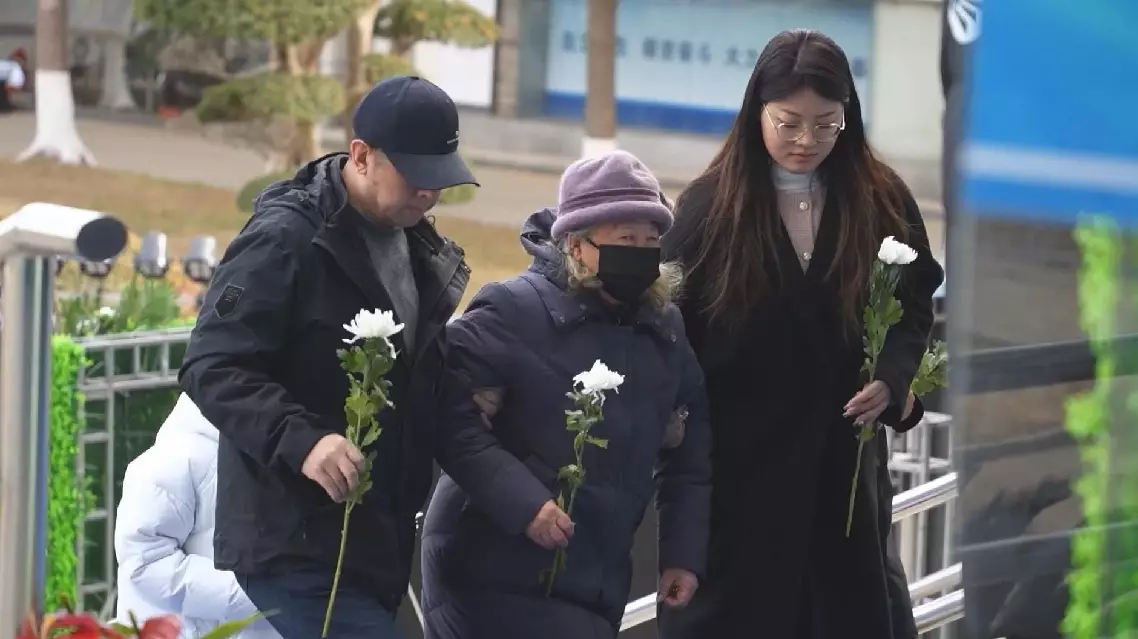
People from all walks of life bid farewell to chief designer of China's first-generation nuclear submarines