Skip to Content Facebook Feature Image

Production teams across China proud to witness Ne Zha 2 making history

China

China

China

Production teams across China proud to witness Ne Zha 2 making history

2025-02-11 17:18 Last Updated At:22:27

Chinese animated blockbuster "Ne Zha 2" ascending to the pinnacle of the country's box office is not just a testament to the film's dazzling visuals and compelling storytelling, but also to the collaborative efforts of over 100 animation companies and 4,000 professionals across China.

According to Chinese ticketing platform Beacon, "Ne Zha 2", the sequel to the 2019 hit featuring a mythical boy with magical powers and extraordinary martial arts skills, grossed over 1.152 billion U.S. dollars (including pre-sales) as of Monday, surpassing the box office earnings of "Aquaman".

The movie has made history as the first Asian film and the only non-Hollywood film to enter the top 30 on the global box office chart, according to data from an online platform.

The record-breaking run makes "Ne Zha 2" not just a box office titan but a cultural phenomenon, further underscoring China's ability to produce homegrown blockbusters that strike a chord with domestic audience while showcasing the potential for global appeal.

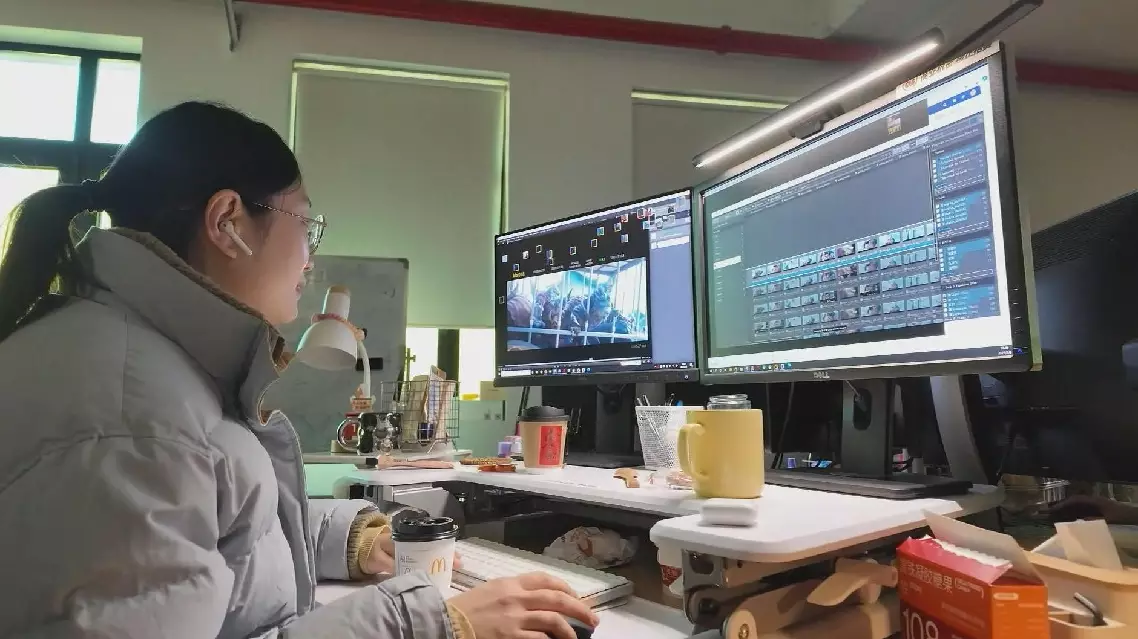
The production of "Ne Zha 2" involved an immense effort from 138 animation companies, including 13 based in east China's Jiangsu Province. Altogether, the film features 2,427 visually stunning scenes, with breathtaking light effects and intricate designs that have captivated audience.

The film's climax, the Chentang Pass battle scene, is a standout moment that showcases the collaborative effort behind "Ne Zha 2". Wang Xingming, an animator born in the 1990s, and his team based in Jiangsu's Nantong City were responsible for crafting the sequence's special effects, including the movements of shrimp and crab soldiers, and the realistic depiction of fireworks and smoke.

"We encountered many problems during the production process, but we tried to beat them all. It's a great honor to take part in this project," Wang said.

Suzhou Red Whale Film and Television Culture Communication Company, the largest co-production company, was responsible for a quarter of the film's production including character design, scene layout, and lighting effects. The company dedicated 160 animators over 26 months to craft their part of the film.

"(Suzhou) is relatively complete in terms of the entire supply and distribution chain. You can find the corresponding team and partners to participate in each module," said Ge Yi, CEO of the company.

The success of "Ne Zha 2" also highlights the power of integrating traditional Chinese culture with modern storytelling. The film, which is inspired by the mythological figure Ne Zha from the Ming Dynasty novel Fengshen Yanyi (The Investiture of the Gods), reimagines the tale through a contemporary lens.

Much of the film's emotional depth is carried by its music, including a hauntingly beautiful Dong Grand Song performed by 10 Dong ethnic girls from Rongjiang County of southwest China's Guizhou Province. The "Wu Yue Chan Ge" ensemble, led by founder Yang Xiangni, introduced this intangible cultural heritage to a wider audience through the film.

"Apart from the Khoomei, all other vocals are by us. Our lyrics and singing style were used in the opening theme, the background music for the appearance of the Dragon King and the Lotus in full blossom," said Yang.

Nanning Four-leaf Clover Cultural Communication Co., Ltd, an animation company based in Nanning, capital of south China's Guangxi Zhuang Autonomous Region, is another participant which contributed to creating 3D digital assets and animated characters.

Its founder expressed pride in the team's role in the project.

"Now that the box office has reached the top, we, as one of the production teams, are excited and proud, and we have a huge sense of accomplishment and satisfaction. This is our mood at this moment," said Zhou Weiwei, founder of Four-leaf Clover, also known as Clover Culture.

Among the team was model artist Wei Chenjing, who worked tirelessly on the film while taking care of her seven-year-old child.

"He was almost the loudest kid in the cinema (due to excitement). Seeing a project I worked on for so long come to life is truly emotional, and I'm so happy to play a part in the project," Wei said.

According to a recent audience satisfaction survey, "Ne Zha 2" scored 87.3 out of 100, the highest rating for a Spring Festival release in the past two years.
Production teams across China proud to witness Ne Zha 2 making history

Production teams across China proud to witness Ne Zha 2 making history
A new round of trade-in subsidy program is energizing China's consumer market these days, with provinces across the country seeing a surge in demand for cars, home appliances and digital devices.

In north China's Shanxi Province, the new trade-in subsidy program, which started on January 9, has further helped boost sales in home appliances and digital devices which are covered by the new round of subsidies.

To enjoy the subsidies, six types of home appliances, including refrigerators and washing machines, must meet national Level 1 energy-efficiency or water-efficiency standards. Digital and smart products include four types, such as mobile phones and tablets, with a sales price cap of 6,000 yuan (about 800 U.S. dollars) per item.

In both categories, subsidies are set at 15 percent of the final transaction price. For home appliances, the maximum subsidy is 1,500 yuan per item. For digital products, the cap is 500 yuan per item. Each consumer can receive a subsidy for one unit in each category.

Neighboring Shanxi, Hebei Province kicked off the year of 2026 with the new round of trade-in subsidy program starting on January 1.

The subsidies cover automobiles, home appliances, and digital products. Individual consumers who purchase designated Level 1 energy-efficiency appliances or eligible digital products priced at no more than 6,000 yuan can receive subsidies equal to 15 percent of the transaction price. The maximum subsidy is 1,500 yuan per appliance and 500 yuan per digital or smart device, with each person limited to one subsidized item in each category.

Data showed that from Jan 1 to 9, Hebei's home appliance trade-in program alone disbursed more than 130 million yuan in subsidies, driving sales of over 920 million yuan.

In east China's Jiangsu Province, the new trade-in subsidy program, taking effect for two weeks, has brought the province a boom in trade-in.

At a local 4S store in Jiangsu's Suqian City, showroom traffic has spiked as salespeople walked customers through the new benefits from the trade-in subsidy program.

"Under the scrappage-and-replacement scheme, customers who buy a new energy vehicle (NEV) can receive a subsidy worth 12 percent of the vehicle price, capped at 20,000 yuan (about 2,860 U.S. dollars). For combustion-engine cars, the subsidy is 10 percent, with an upper limit of 15,000 yuan. For trade-ins, NEVs are able to receive a subsidy worth 8 percent of the vehicle price, up to 15,000 yuan, while combustion-engine cars will receive a 6-percent subsidy, with a cap of 13,000 yuan," said Sun Yue, a saleswoman at the store.

In the home appliance sector, Jiangsu's policy this year stipulates that only products that meet China's Level 1 energy-efficiency standard are eligible for subsidies. The scheme covers six major categories, including refrigerators and washing machines.

Consumers who purchase qualifying appliances can receive a subsidy equal to 15 percent of the final retail price, up to a maximum of 1,500 yuan per item. Each person is limited to one subsidized unit per product category.

Four types of digital and smart products, such as mobile phones and tablets, are eligible for a 15-percent subsidy capped at 500 yuan per unit, with a retail price no more than 6,000 yuan.

"With the national subsidy policy back in place this year, I went to the store to check what discounts I could get. It knocked 500 yuan off the price. [The discounted price is] very reasonable," said Wang Kang, a resident of Jiangsu's Xuzhou Province.

To enhance the shopping experience for consumers, many retailers are pairing subsidies with "one-stop" services that combine the delivery of new products with on-site collection of old ones.

"After consumers place an order for new home appliances, our staff will schedule a time to pick up the old units. Recycling the old appliance can also further offset the purchase price of the new one," said Yang Jie, a sales supervisor at a major home appliance company.

China's new trade-in program sparks consumption boom

China's new trade-in program sparks consumption boom

Recommended Articles