China announced a series of policies to expand senior-friendly tourism services and senior-accessible trains at a press conference on Tuesday in Beijing.
China's population of senior citizens topped 300 million in 2024 bringing new demands for better elderly care services and improvements in the quality and enjoyment of seniors' daily lives.
In response, the Ministry of Commerce, China Railway Group and other departments, released a joint action plan to boost senior-friendly tourism with accessible trains as the centerpiece of the new approach.
Officials say the number of tourist train trips has increased significantly in recent years and, with the expanding elderly population and a growing demand for tourism, the potential for developing elderly-friendly tourist trains is considered huge.
"By 2027, over 100 high-quality routes for senior tourists are expected to be designed, with more than 2,500 elderly-friendly tourist trains in operation," said Zhu Wenzhong, deputy director at the Passenger Transportation Department of the China Railway Group.
According to the action plan, a comprehensive network of senior-friendly tourist trains will be established by 2027, featuring diverse routes, specialized themes and enhanced services for elderly travelers.
Officials emphasized infrastructure upgrades and renovations, making trains and scenic spots more accessible and comfortable with designs specifically catering to the needs of the elderly.
Establishing common standards for senior-friendly travel will be key to improving facilities for senior citizens.
"We need to optimize the services for elderly passengers, deploy professional medical and elderly care personnel on board, and ensure that medical expenses incurred during the journey can be covered through national medical insurance," said Kong Dejun, director of the Department of Trade in Services and Commercial Services at the Ministry of Commerce.

China promotes accessible trains to meet growing demands of elderly population
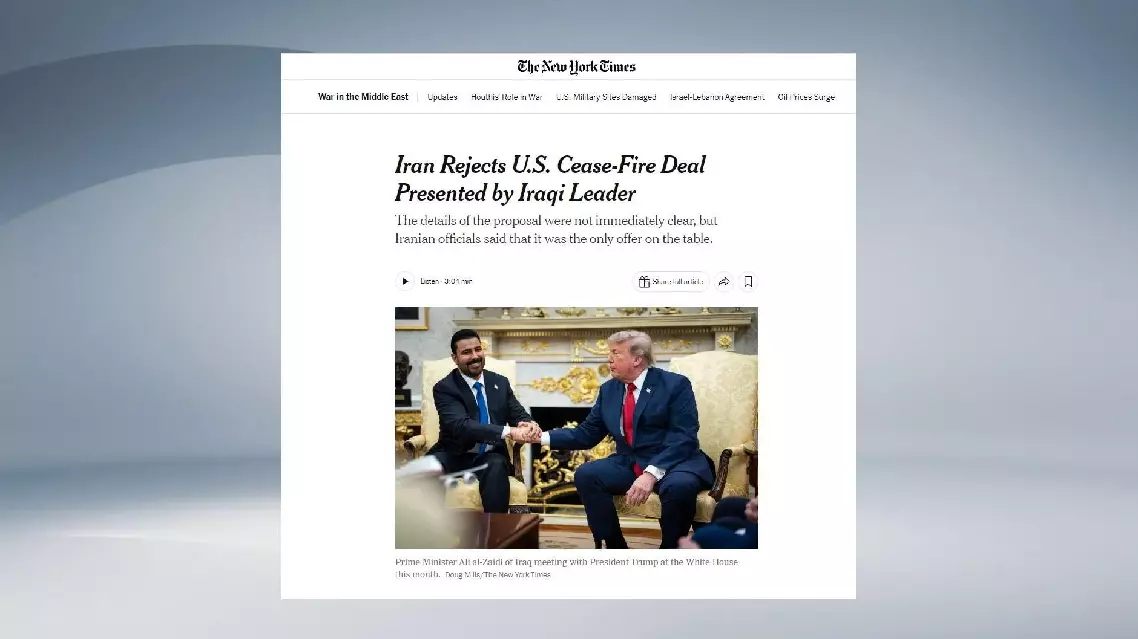
The United States and Iran Friday denied a report from the New York Times claiming Iran rejected a ceasefire proposal from U.S. President Donald Trump that was conveyed to Tehran by Iraqi Prime Minister Ali al-Zaidi.
The New York Times story quoted unnamed Iranian and Iraqi officials as saying the failed mediation effort came as Trump was threatening to escalate the war and target Iran's critical infrastructure.
According to the report, the details of the ceasefire proposal were not immediately clear. But Iranian officials said that their government was not interested in a temporary deal that left the question of control over the Strait of Hormuz unresolved.
Shortly after the report surfaced, Iran's official state news agency, IRNA, dismissed the claim, calling it "diverting and misleading."
Iraq on Friday also dismissed the media report as "entirely unfounded," saying it "bears no relation to reality," according to a statement by al-Zaidi's media office.
Meanwhile, a U.S. official also rejected the report, saying that the story was "inaccurate."
In a separate development on the same day, Iranian Foreign Minister Seyed Abbas Araghchi said the core problem between the United States and Iran stems from U.S. policies and practices rather than a lack of communication channels or mediators.
Araghchi stressed that Iran would not yield to U.S. pressure and would not accept threats, coercion, or force. He reiterated Tehran's commitment to safeguarding the interests of the Iranian people and its rights concerning the Strait of Hormuz.
Iran will continue its actions until the legitimate goals and demands of the Iranian people are realized, he said.
The United States and Iran signed a memorandum of understanding in mid-June, under which the two sides were expected to hold negotiations within 60 days toward a final agreement.
However, tensions have flared again recently as both sides traded rounds of attacks across the Middle East. The United States has carried out attacks on Iranian targets, while Iran has responded by targeting U.S. bases and facilities across the region.
US, Iran deny media report on ceasefire proposal mediated by Iraq