Maralbexi County, located in northwest China's Xinjiang region, has recently launched this year's desertification control efforts, aiming to restore 73,670 hectares of sand-affected land.
Situated on the western edge of the Taklimakan Desert -- China's largest and the world's second-largest shifting desert -- this initiative will help reinforce a 3,046-kilometer green belt encircling the desert. The belt was completed last November after more than 40 years of dedicated efforts.
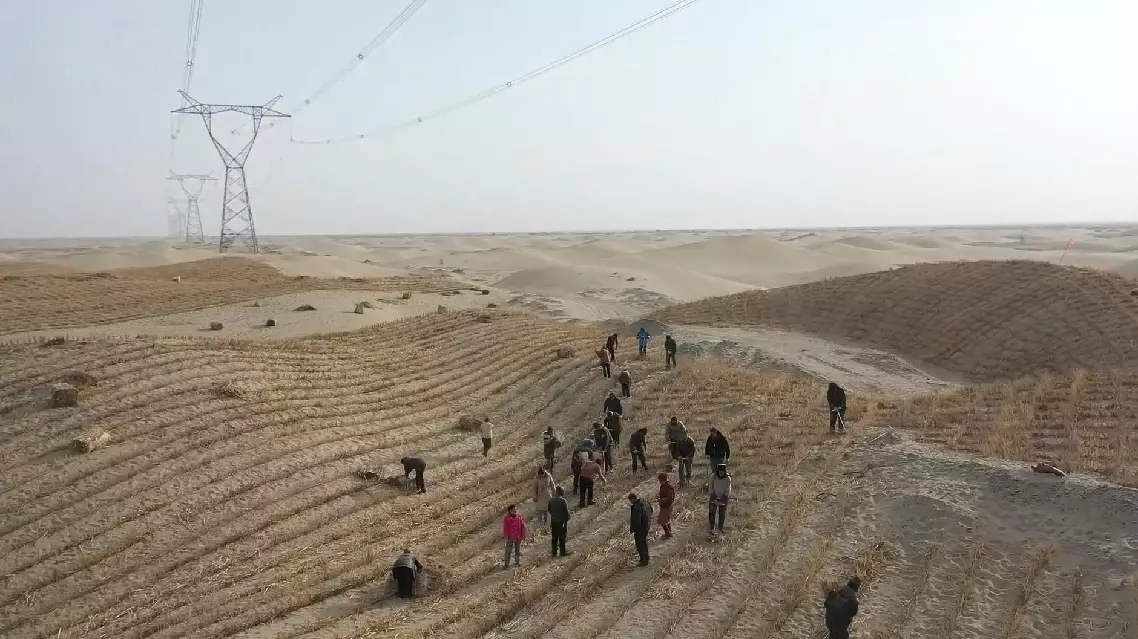
In the past few days, at the sand control site in Yingwusitang Township, Bachu County, more than 500 villagers have been laying pre-prepared checkerboard-patterned barriers made of reed segments on the desert floor. This effort aims to prevent dust storms in the upcoming windy season and minimize their impact on nearby cities and villages.
Production of the reed segments began last November at multiple factories in local towns to ensure a sufficient supply for the spring season.
"Considering that reeds are fragile and break easily, we have introduced weaving machines to turn them into reed mats. Using a sand barrier laying machine, we then plant the reed mats vertically to form strip-shaped sand barriers," Nureli, a local official, said.
The annual target is expected to be met by November this year, according to local authorities.
The Taklimakan Desert spans 337,600 square kilometers, with a circumference of 3,046 kilometers, making it one of the world's largest shifting deserts.
To combat its expansion and the threat of desertification, China launched the Taklimakan Desert control project as part of the Three-North Shelterbelt Forest Program (TSFP), the world's largest afforestation initiative. Started in 1978, the program is scheduled for completion by 2050.
Since 1978, China has expanded its afforestation area by 32 million hectares under the TSFP. By 2050, the program's afforestation efforts are expected to cover over 4 million square kilometers across 13 provincial-level regions, accounting for 42.4 percent of the country's total land area.
Over the past 46 years, the forest coverage rate in areas under the TSFP has increased from 5.05 percent to 13.84 percent. Significant progress has been made in controlling desertification and soil erosion, while approximately 30 million hectares of farmland have been protected.
Xinjiang county launches 2025 desertification control project