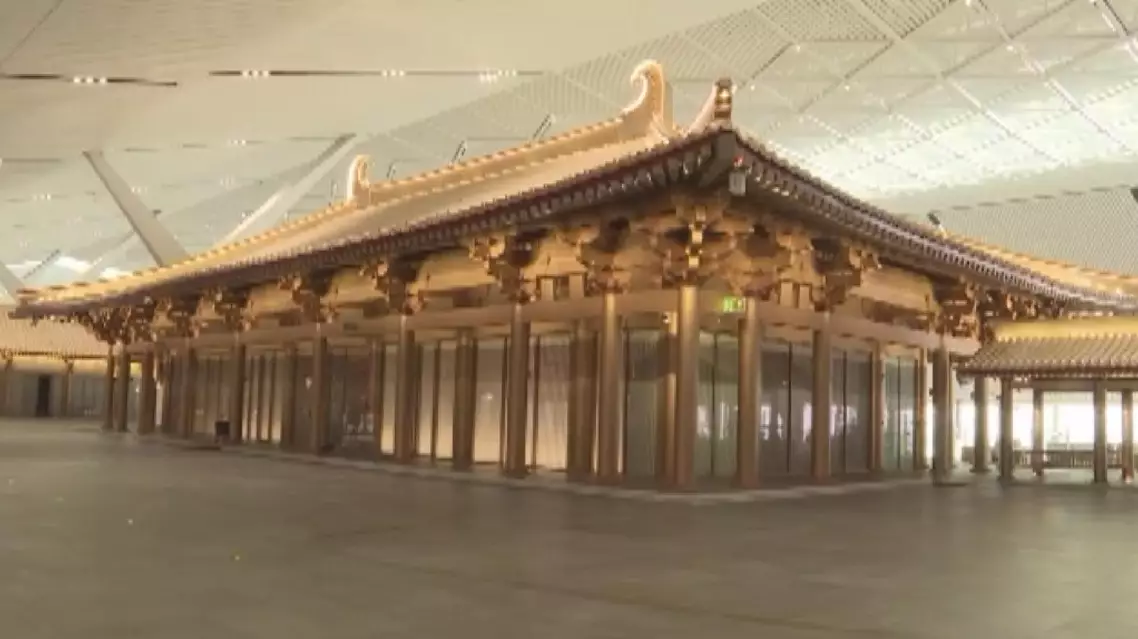
The highly-anticipated Terminal 5 at Xi'an Xianyang International Airport, which opened on Thursday, boasts the world's first on-site museum within an airport, showcasing the historical features of the Silk Road and Xi'an, also known as Chang'an in ancient times.
Located within the Terminal 5, the museum covers an area of 6,400 square meters and features an architectural style of the Tang Dynasty (618-907).
The main exhibition hall of the basic exhibition is called the Square Pavilion, covering an area of 400 square meters. It will primarily showcase artifacts discovered during the airport's construction, supplemented by archaeological finds from the Hongduyuan area.
"The Square Pavilion is the name of a diplomatic office during the Sui and Tang dynasties (581-907). Adopting the name not only continues our connection to the ancient history, but also represents our theme of welcoming guests from near and far," said Chen Yao, head of the preparatory team of the museum at the Terminal 5.
In addition, the Hall of Treasures, an 88-square-meter exhibition hall, will display significant cultural relics from Shaanxi.
The Hall of Treasures adopts a rotating exhibition approach by selecting a representative Shaanxi's cultural relic for a special exhibition each period. The inaugural exhibition features the first-class national relic Qin Gong Bo, which has been transported to the Terminal 5 on Wednesday.
Qin Gong Bo is a type of bronze percussion instrument dating back to China's Spring and Autumn Period (770BC-476BC). "We rotate the exhibit roughly every six months. We will select some of the better and more outstanding cultural relics from within Shaanxi Province. Qin Gong Bo is both a ceremonial vessel and a musical instrument," Chen said.
The museum is expected to open to the public on Feb 26, allowing visitors to enter for tours by making online reservations.
New terminal in Xi'an airport houses museum, showcasing local culture
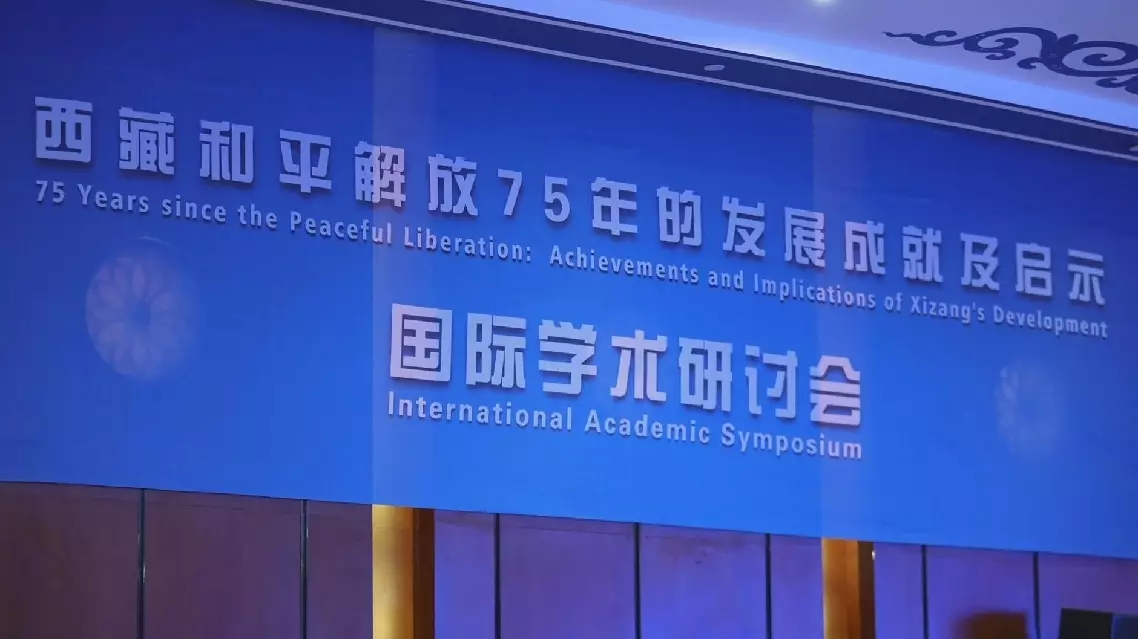
An international academic symposium was held on Saturday at the Xizang Museum in Lhasa, capital of southwest China's Xizang Autonomous Region, to mark the 75th anniversary of the peaceful liberation of the region.
Perched on the Roof of the World, the Xizang Museum is the first modern museum on the plateau.
On the 75th anniversary of Xizang's peaceful liberation, it welcomed a group of international scholars to reflect on the region's transformation and future.
Greening efforts on the highest region on Earth have seen major strides.
Forest coverage has risen from less than 1 percent in 1951 to 12.5 percent today.
"Even here you see around the mountains of Lhasa here, the massive large-scale plantation. There is a big lesson to learn now to other parts of the world and other countries also to come. This is the conservation. We should move this way," said Krishna Prasad Oli, former Nepali ambassador to China. Nestled in the Himalayas is not just Xizang's natural beauty, but its unique culture.
Over the past few decades, the central government has invested billions of yuan in the region's heritage protection.
"In general there are so many rumors that are just not true. For example, there are rumors in our media that China suppresses the Tibetan language. A very simple thing is on the street that you see signs and two languages everywhere (in Mandarin and in Tibetan). Even in Austria and the minority areas, there are big discussions if we should write something in minority languages. But in China it is not a problem. So China's handling this is far better than Austria," said Georg, Vavra, an Austrian historian.
The most ambitious and costly undertaking on the plateau since its liberation has been building modern infrastructure.
Today, Xizang boasts a network of roads and railways that continues to expand.
"It just so happens that yesterday I traveled by train from Nyingchi to Lhasa. The UK is a country of 60 million people and has been struggling and failing for 17 years to build 150 kilometers of high speed rail. Now if you consider Xizang with a population of 4 or 5 million, they could never undertake a project of that scale, and that is what China is trying to do. China is the only country in the world that has a genuine interest in the prosperity and the development of Xizang," said David Ferguson, a Scottish commentator.
Beyond traditional industries, emerging sectors are also taking root in China's western frontier.
"In the 75 years since its peaceful liberation, Xizang has built its scientific and technological capabilities from the ground up. It has become a driving force behind the region's economic and social progress," said Nyima Tashi, a professor with the School of Information Science and Technology under Xizang University.
Int'l scholars gather in Xizang to review regional development over past 75 years