Skip to Content Facebook Feature Image

Zhejiang unveils plan to boost low-altitude economy in agriculture, rural areas

China

China

China

Zhejiang unveils plan to boost low-altitude economy in agriculture, rural areas

2025-02-21 17:22 Last Updated At:02-22 00:37

China's Zhejiang Province has issued an action plan for the development of the low-altitude economy in agricultural and rural areas, aiming to further integrate the low-altitude economy to enhance agriculture.

The space-air-ground integrated information sensing and fusion platform is one of the best examples of integrating the low-altitude economy with agriculture. Researchers at the Rural Development Academy of Zhejiang University can mobilize drones in Nanxun Village, Huzhou City, located 90 kilometers from the academy, with just a click of the mouse. By inputting a route, the drones can perform various tasks such as aerial defense and monitoring.

"We can judge the growth condition of a crop by its plant height. The differences in plant height help us identify which areas are growing well and which are not," said Nie Pengcheng, a researcher of the academy.

According to the plan, by 2027, the number of agricultural drones in Zhejiang will be more than 10,000, and 100 intelligent monitoring points for agricultural production will be built.

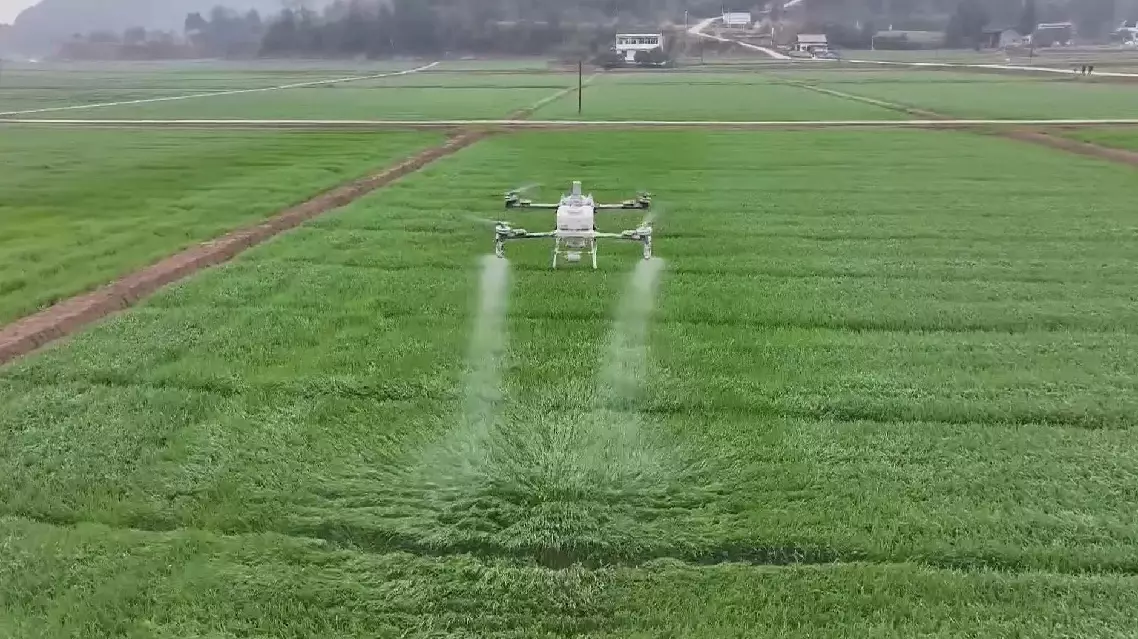
In Xieqiao Township, Haining City, Zhejiang Province, drones are used to spread fertilizer. A local farmer said using drones not only saves labor, but also boosts yield.

"When we applied fertilizer manually, it would be amazing to cover 40 to 50 mu (about 2.6 to 3.3 hectares) a day. Now, drones can easily spread fertilizer over 400 to 500 mu a day (about 26 to 33 hectares), saving labor. The uniformity is better, and the yield has also improved after adopting drones," said Chen Zhongyuan, a farmer.

In addition to agricultural production operations, the people's government of Zhejiang Province has proposed six key scenarios for the low-altitude agricultural economy, including monitoring, services, transportation, governance, and agricultural tourism consumption. Among these, two major sectors -- agricultural transportation and cultural tourism consumption -- have gained significant momentum in recent years. This includes express food delivery and aircraft sightseeing, which have enhanced rural life and offered innovative ideas for the integration and development of agricultural cultural tourism.

"While meeting the needs of production, we use low-altitude aircraft to carry tourists, allowing them to have different perspective and experience the unique geographical features and natural scenery of each place," said Nie.
Zhejiang unveils plan to boost low-altitude economy in agriculture, rural areas
Zhejiang unveils plan to boost low-altitude economy in agriculture, rural areas


Zhejiang unveils plan to boost low-altitude economy in agriculture, rural areas
Zhejiang unveils plan to boost low-altitude economy in agriculture, rural areas

Continued surges in global oil prices, a result of the ongoing U.S.-Israeli military strikes against Iran, will put severe pressure on Japan's heavily energy-import-dependent economy, a Japanese scholar warned.

The warning came as the Japanese government started a historic oil reserve release on Monday to ease the impact of volatile international oil prices. The release totaled around 80 million barrels, equal to roughly 45 days of Japan's domestic oil consumption, marking the largest-ever drawdown of the country's oil reserves.

Tomohiko Nakamura, a professor of the Faculty of Economics at Kobe International University, said that while the reserve release will have a limited effect in curbing oil price hikes, protracted geopolitical tensions in the Middle East will undermine the policy's impact given Japan's finite oil stockpiles.

"I believe the release of oil reserves will have a certain effect in curbing oil price hikes. However, if the tensions in the Middle East become protracted, that will pose a problem as Japan's oil reserves are not unlimited. We are facing a double whammy: on one hand, crude oil prices are rising, and on the other, the yen's depreciation is driving up import costs. The impact of soaring crude prices is being felt not just in Japan, but across the world. For example, the power sector, where a large share of electricity generation still relies on oil, will see higher generation costs, and as a result, nearly all industries will be affected. These unforeseen impacts may gradually become apparent over the next month," he said.

Beyond the immediate macroeconomic pressures, Nakamura expressed particular concern for Japan's small and medium-sized enterprises (SMEs), which form the backbone of the country's economic activity.

"The biggest impact is the sharp rise in raw material and fuel costs. While large corporations can reduce costs through bulk purchasing, SMEs find it difficult to achieve the same. As a result, the operating pressures on SMEs will grow increasingly severe, leading to a probable rise in the number of businesses exiting the market. The trend of declining SME numbers could accelerate further," he said.

Soaring oil prices put severe pressure on Japan's economy: Japanese scholar

Soaring oil prices put severe pressure on Japan's economy: Japanese scholar

Recommended Articles