As China seeks to strengthen its private sector, cities like Guangzhou in the southern province of Guangdong are leading the charge by integrating technology and creativity to modernize traditional industries and compete globally.
With a 28-billion-dollar market cluster at its core, Guangzhou's textile industry is responding to national calls for modernization and technological progress, adapting to a rapidly changing landscape.
Once a maze of crowded stalls, the Guangzhou China Fabrics and Accessories Center has been transformed into a sleek seven-story complex housing vendors, offices, and showrooms.
The market, located within one of China's largest textile hubs, is central to the nation's textile and accessory trade, with nearly a third of China's textile business conducted within a five-kilometer radius of the city.
Peng Liangmin, general manager of Guangzhou Light Knitting, reflected on how his company has evolved alongside this transformation.
"We started as a trading agent with about 40 people. Today, we have 900 employees. The market has provided a solid platform to connect with customers. Over the last 20 years, our industry has shifted from a sellers' market to a buyers' market. Intense competition has pushed us to innovate. For instance, we developed fabrics with high-elastic fiber that are antibacterial and UV-resistant," said Peng.
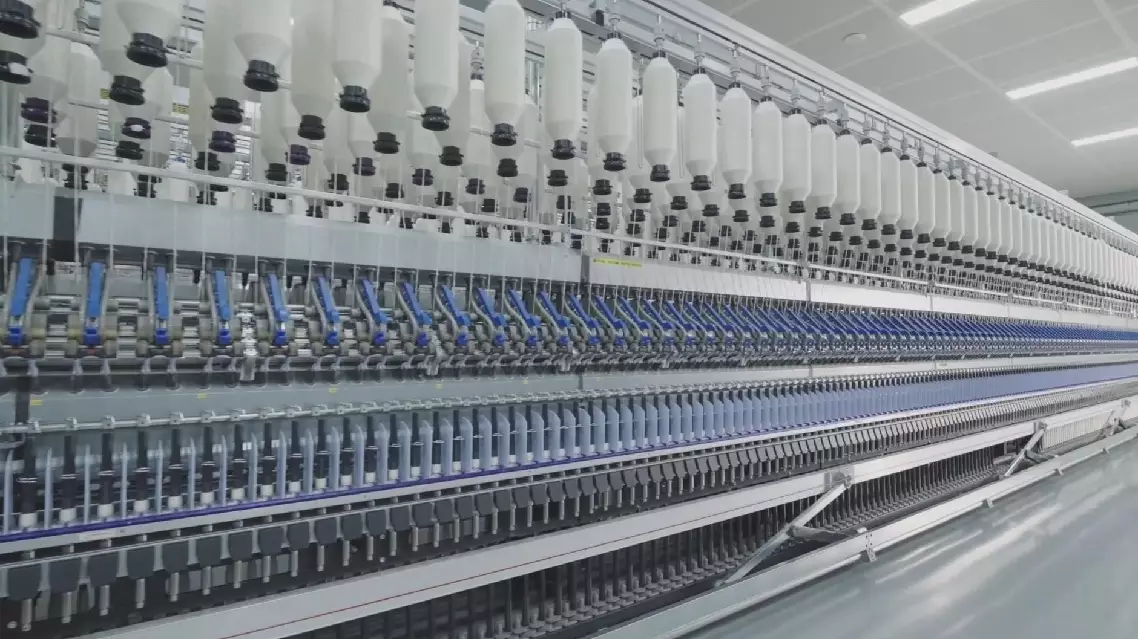
His company now uses intelligent production systems, with products sold globally, including to leading U.S. brands. Despite challenges such as weak consumer demand and rising tariffs, Peng believes technology is the key to staying competitive.
"In fact, the government has provided significant support, including incentives for talent relocation. Without such policies, attracting young professionals to traditional industries would be difficult. The market will face ups and downs; we need to stay confident and manage risks. I hope the government will continue to create a strong business environment, giving private enterprises like ours more opportunities to grow," Peng added.
Guangzhou's textile transformation aligns with China's broader efforts to support private sector growth and technological innovation.
This week, China's leadership reaffirmed its commitment to safeguarding fair market competition and promoting innovation. In Guangdong Province, where textiles remain a key economic pillar, provincial authorities have outlined plans to further modernize the industry.
Wu Hong, deputy director of the Guangdong Provincial Department of Industry and Information Technology, emphasized the need for change at a recent press briefing on high-quality development.
"Traditional industries account for over 70 percent of the value-added in large-scale manufacturing, contribute 65 percent of profits and taxes, and employ 75 percent of the workforce. We must enhance their production quality and efficiency. This year, we aim to support 10,000 industrial enterprises in digital transformation and help 1,000 companies expand investment and production capacity," said Wu.
The revitalization of Guangzhou's textile market is already fostering new opportunities. The newly renovated space now hosts fashion shows, international buyers' meetings, and even a museum dedicated to the market's history.
Designer Lin Zihan, whose latest creations feature fabrics sourced from the market, reflects this blend of tradition and modernity.
"I'm proud that my work is being showcased here, but also deeply aware of the responsibility to merge traditional creativity with modern design. The renovation of the textile market has created a one-stop hub for designers, offering high-quality fabrics and accessories. It also fosters a space for collaboration and learning. Through fashion releases, runway shows and international exposure, we can significantly boost the influence of the fashion industry in the region," Lin said.
Today's textile market vastly differs from its heyday in the 1980s, when it was a maze of crowded stalls. Now, the space channels its foot traffic into creativity, attracting young designers, retail brands, and digital entrepreneurs. The market's modernization is a crucial part of Guangzhou's strategy to stay competitive in the rapidly evolving global textile industry.
As Guangzhou's textile industry continues to evolve, its transformation highlights the growing importance of innovation in maintaining global competitiveness, with a future that merges heritage with cutting-edge design and technology.
Guangzhou transforms textile hub with innovation, design, technology