China's robotic dogs have evolved from mere lab curiosities into a thriving multi-billion-dollar industry, showcasing the country's innovative prowess and pushing the boundaries of industry-applied robotics.
With advancements in artificial intelligence and the country's strengthened industry supply chains, Chinese companies like DEEP Robotics been creating sophisticated four-legged machines capable of an increasing number of real-world applications.
"We used the technology of 'reinforcement learning' to develop a controller based on a neural network, so now robot dogs can perform the highly bionic and natural gait we see now. It's a self-learned action based entirely on the state of the environment," said Xiong Junjie, director of overseas business of DEEP Robotics.
The robotic dogs can even perform difficult maneuvers like backflips, something even a real dog would struggle to achieve.
"Normal dogs can't jump very high, but robot-dogs can jump about 80 centimeters off the ground. Only by continuously improving their hardware capabilities can we lay a solid foundation when developing applications later," said Xiong.
The potential applications for these robotic dogs are vast and fascinating. Equipped with 12 motors that mimic a real dog's muscles, these machines exhibit remarkable agility while also functioning as vital assets in industrial settings. Unlike their canine counterparts that seek treats, these robotic dogs are engineered for survival -- capable of detecting gas leaks, mapping collapsed tunnels, and identifying power grid faults.
In Singapore's six-kilometer-long electric cable tunnels, China's robot dogs have been deployed to patrol and inspect the infrastructure.
One of the key advantages of these machines is their cost-effectiveness. More than 95 percent of the technology and components used in the robots produced by DEEP Robotics are domestically sourced, including the chips. Meanwhile, other companies in the country expect to be providing similar value for global markets soon.
"I feel China's robots are superior to some of the competitive products from abroad in terms of product iteration speed, maturity and cost. I believe their advantages will become more and more obvious over time," said Zhong Jianguo, CEO of Roborack.
Due to their industrial applications, robotic dogs are already being applied more broadly than humanoid robots. Research indicates that the global market for robotic dogs reached 1.2 billion U.S. dollars in 2023, with projections suggesting that this figure could quadruple by 2031. By then, more than 560,000 flexible and intelligent "metal hounds" are expected to enter the market, further solidifying their role as a key player in the technological landscape.
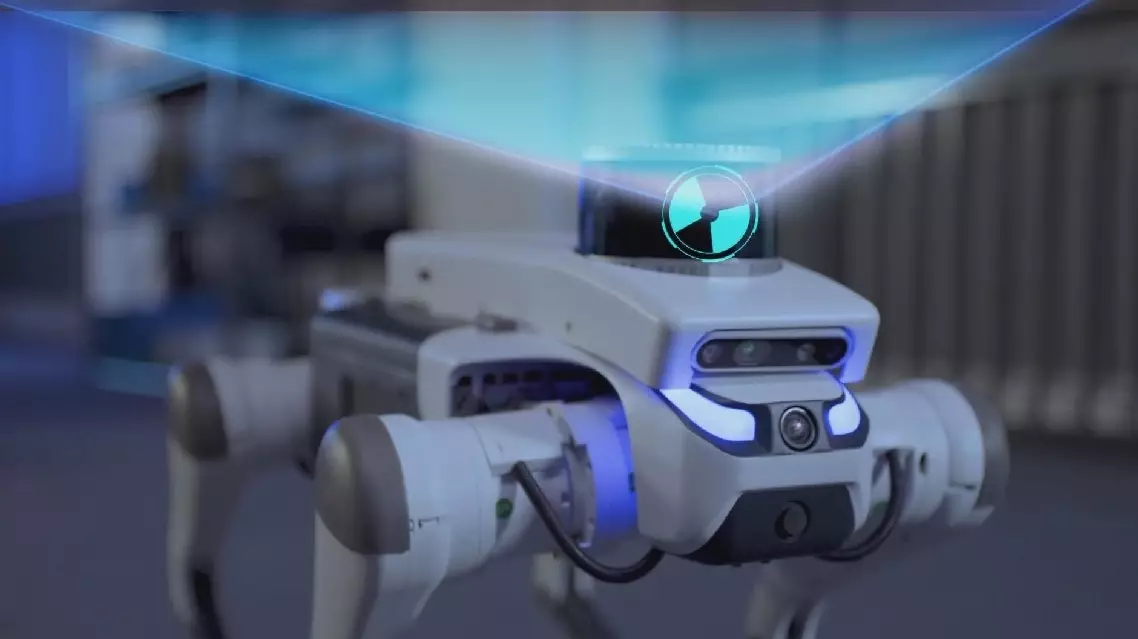
China's robotic dogs unleash multi-billion-dollar industry
China's robotic dogs unleash multi-billion-dollar industry
China's robotic dogs unleash multi-billion-dollar industry