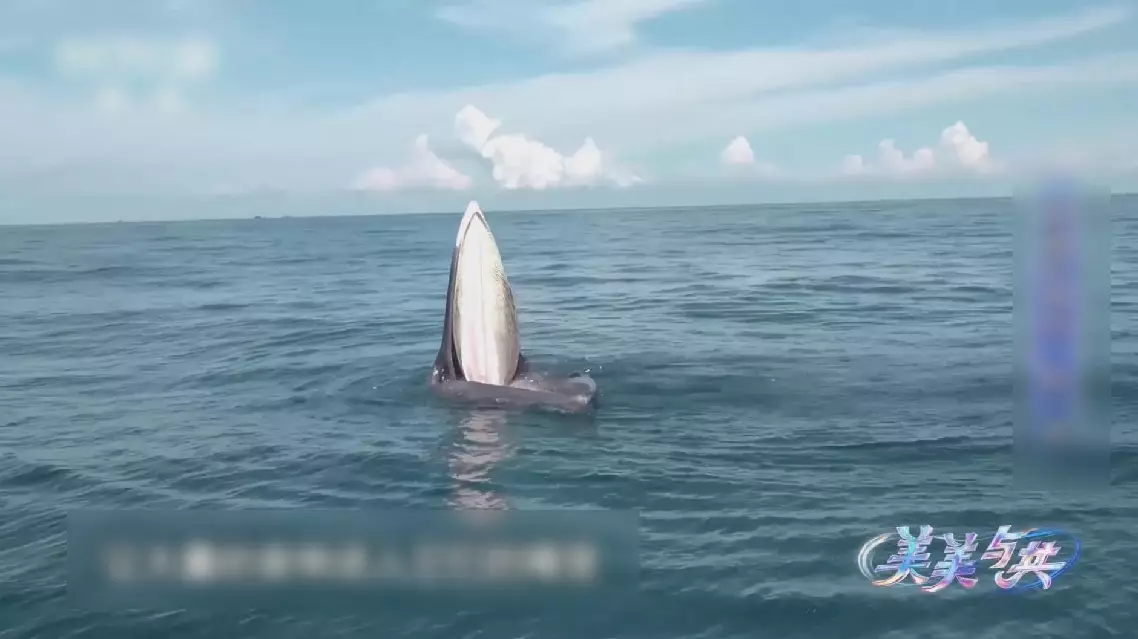
Biologists have observed Bryde's whales preying on fish with unique foraging patterns in waters near south China's Weizhou Island, using creative teamwork to trap their harvest near the ocean surface.
The foraging techniques were discovered by Chinese and Thailand biologists, who have been working closely to protect Bryde's whales, one of the national first-class protected aquatic animals in China.
Weizhou Island, located in the Beibu Gulf, is China's youngest volcanic island. Bryde's whales, a species mainly living in tropical and subtropical waters, are frequently spotted preying on fish in the waters near Weizhou Island.
Patcharaporn Yaowasooth, a marine biologist at the Department of Marine and Coastal Resources of Thailand, said that during her joint research with the Chinese partners, she discovered a great number of similarities in the ways that Bryde's whales in Thailand and China hunt. This includes corkscrew-style swimming and bubble-net feeding -- a learned method of cooperative hunting in which a group of whales traps fish within a net of bubbles formed by exhaling through their blow holes.
"Almost all of them in Thailand have this feeding. And (the similarities extend) up to the species and fish that they eat, also," she said.
Yet, the scientists also saw unique behaviors that are not seen in Thai waters, as a Chinese professor from the School of Life Sciences of Nanjing Normal University explained.
"The Bryde's whale living in the waters near Weizhou Island have two unique foraging behaviors. In one case, they were discovered emerge from the water, tilt to the right, and then whirl around in a full or half circle, just like one creates swirling motion while scooping. We named the new hunting technique as 'self-rotating foraging' or 'swirling foraging'. In another case, they conduct teamwork, making up a circle with their bodies and then spiraling up to the water surface to trap the fish inside before eating up the harvest. This is a quite unique foraging technique," said Bingyao Chen, a professor at the university's School of Life Sciences.
Bryde's whales, like other species, are capable of learning non-instinctual behaviors from each other, allowing unique behaviors to develop in different parts of the oceans.
Chinese, Thai biologists discover unique foraging pattern of Bryde's whale

The U.S. military strike against Venezuela and capture of its president, Nicolas Maduro, has shocked the international community, triggering a steady stream of condemnation and serious concerns worldwide.
Brazil, Chile, Colombia, Mexico, Uruguay and Spain issued a joint statement on Sunday, expressing serious concern about and firm opposition to the U.S. unilateral military operations in Venezuela.
The U.S. actions contravene fundamental principles of international law, particularly the prohibition on the use or threat of force, and respect for the sovereignty and territorial integrity of States, as enshrined in the UN Charter, constituting an extremely dangerous precedent against peace and regional security, according to the statement.
In expressing profound concern and firm rejection, the six countries stressed in the statement that the situation in Venezuela must be resolved exclusively by peaceful means, and through dialogue, negotiation and respect for the will of the Venezuelan people in all its expressions, without external interference and in accordance with international law.
Only an inclusive political process, led by Venezuelans, can lead to a democratic, sustainable solution that respects human dignity, according to the statement.
Spanish Prime Minister Pedro Sanchez condemned the U.S. raid in Venezuela as a violation of international law, adding that the Spanish government always advocates and defends international law and peaceful resolution of conflicts.
Addressing a meeting of the Community of Latin American and Caribbean States (CELAC), Cuban Foreign Minister Bruno Rodriguez demanded the unconditional and immediate release of Maduro and his wife.
Noting that Latin America and the Caribbean are a zone of peace, he expressed his firm opposition to the use of force, which is an unshakable principle.
Any aggression against Venezuela shall be regarded as an attack against all CELAC member states, and nations must collectively oppose it, he stressed.
The South African government denounced the U.S. attack on Venezuela as a violation of international law, according to a statement released on Sunday.
History has repeatedly demonstrated that military invasions against sovereign states yield only instability and deepening crisis, the statement said.
South Africa calls on the UN Security Council to urgently convene a session to address this situation, according to the statement.
Serbian President Aleksandar Vucic said what happened in Venezuela demonstrates that international law and the UN Charter are losing their practical effectiveness.
U.S. military action against Venezuela marks a dangerous precedent, as similar actions could be taken against any other nations, he said.
In addition, the foreign ministries of Namibia, Singapore, Oman and Pakistan also issued statements on the same day, expressing grave concern over U.S. interference in Venezuela's internal affairs.
They emphasized the need to uphold international law and the principles of the UN Charter while respecting Venezuela's sovereignty.
They also called on all parties to exercise restraint and resolve the crisis through peaceful dialogue.
U.S. move against Venezuela sparks condemnation, concerns worldwide