LONDON (AP) — “Conclave” author Robert Harris isn’t planning to stay up and watch the Oscars.
The British writer will be in a different time zone. Plus, Harris would rather wait to see how the movie, which is up for eight Academy Awards including best picture, does Sunday night.
“These things are a bit of a strain anyway, and I don’t want to sit up all night and hear them say and the winner is... ‘Anora’ at four in the morning,” he said, laughing. “I hope that ‘Conclave’ wins and it’s certainly in with a chance. It’s not the favorite, but it’s probably started to creep up to become a second favorite. So who knows.”
Sitting in his study — a converted church office at his home in southeast England — Harris writes in the morning and tinkers in the afternoon, surrounded by books. He's in the early stages of a new novel.
These days it’s his 2016 papal thriller that everyone wants to talk about.
“I’ve always written about politics and power. It greatly interests me what it does to people, the kind of people who seek it and so on,” explains Harris. “This is in many ways the ultimate election, for God’s representative on Earth, the spiritual leader of one and a third billion people. It doesn’t get much bigger than that, quite frankly.”
Inspired by the conclave of 2005, which elected Pope Benedict XVI, the novel was adapted into a screenplay by Peter Straughan, and brought to life by director Edward Berger, starring Ralph Fiennes, Stanley Tucci and Isabella Rossellini.
Harris talked The Associated Press about Fiennes' portrayal of inner turmoil on screen, visiting a fake Sistine Chapel set and that twist.
Remarks have been edited for clarity and brevity.
HARRIS: Obviously I’m absolutely delighted. I think that they did a brilliant job, in every department. The direction, the production, the acting, the whole thing and music. The screenplay is very, very fine. Very closely follows the book, which of course makes me pleased. But I think that’s a sign of Peter Straughan’s talent. It makes a bit of a change of the quiet life of the novelist.
HARRIS: Yes, it has sold quite a lot actually since October and got a particular boost after the BAFTAs last week. It has done well in America as well where it got into the top 20 on Amazon, which is surprising for a book that old.
HARRIS: Yes, I think that that is the way to approach it. But I’m quite happy if lots of people are doing it the other way around. I’ve always had a particular fondness for this novel and I’d like people to read it.
There’s a lot more about the cardinal’s crisis of faith, for instance, and the details of other members of the College of Cardinals and the story of past conclaves. So I think if you enjoyed the film, then this is like further reading and will fill in, maybe, some questions people have.
HARRIS: That’s why he’s so brilliant. The great difference between a novel and the film is what we would call, technically, interior monologue, that you have the character’s thoughts. A lot of films actually fail, from books, because they can’t convey that. But when you’ve got an actor of Ralph’s quality, then his face does register every twist and turn. You can feel his pain and his anguish and his humor and his humility and intelligence. It all flits across his face. He’s on screen pretty well, nonstop for two hours. It’s an extraordinary feat.
HARRIS: I went to once to Rome to see them when they were in the studios there, Cinecitta. They’d got a set of the Sistine Chapel. And it was staggering, actually, to walk in and then suddenly see this and with all the rows of cardinals, it was just like you’d stepped into the real thing. It was astonishing.
HARRIS: I was certainly very much involved early on. I met (Straughan). Ralph Fiennes and Edward Berger came down here to lunch to tell me they wanted to change the nationality of the central character, which I thought, well, if that’s the price of having Ralph Fiennes play him, then I’m willing to pay it, quite frankly. I kept in touch in particular with the screenwriter. We got on very well and we had a couple of very nice long lunches.
HARRIS: Not invited (laughs.) But I don’t mind that, I can’t say that I would have particularly wanted to go.
HARRIS: It’s always divided opinion. I didn’t just sort of tag it on at the end, the whole book leads up to it and it’s embedded in the themes of the story. I knew when I came up with it that it was a risk. I wanted to really do something startling and ask a big question of the church.
I should think the reaction to the twist in the film is roughly the same as the reaction to the twist in the book. Some people say, I really love this book until I got to the final 20 pages and I threw it across the room. But a lot of other people really like it. I mean, they gasp, they’re startled. It makes them talk. It challenges. And that’s what I want to do.
I write with some sympathy for the Catholic Church, but I want to question some of its assumptions.
HARRIS: I tried to be accurate. I’m a sort of slave to facts really. All the processes of a conclave are laid out like canon law. What happens every day and what the rules are, how many votes have to be achieved and how they’re counted and then burned and so on. I read a lot of accounts of past conclaves. It’s all supposed to be secret. But of course, people gossip and things leak out. So one knows roughly how the politics of it work, and I hope it is a fairly accurate portrayal.
HARRIS: Yes, I have. I feel very sorry to hear it. I’ve been refusing all requests to talk about it and a future conclave because I think that’s in extreme bad taste. I don’t want to get any publicity or to be seen to be trying to get anything out of it. The death of anyone is a tragedy and I really hope he’s got some more years yet.

Peter Straughan poses with the adapted screenplay award for 'Conclave' at the 78th British Academy Film Awards, BAFTA's, in London, Sunday, Feb. 16, 2025. (Photo by Joel C Ryan/Invision/AP)
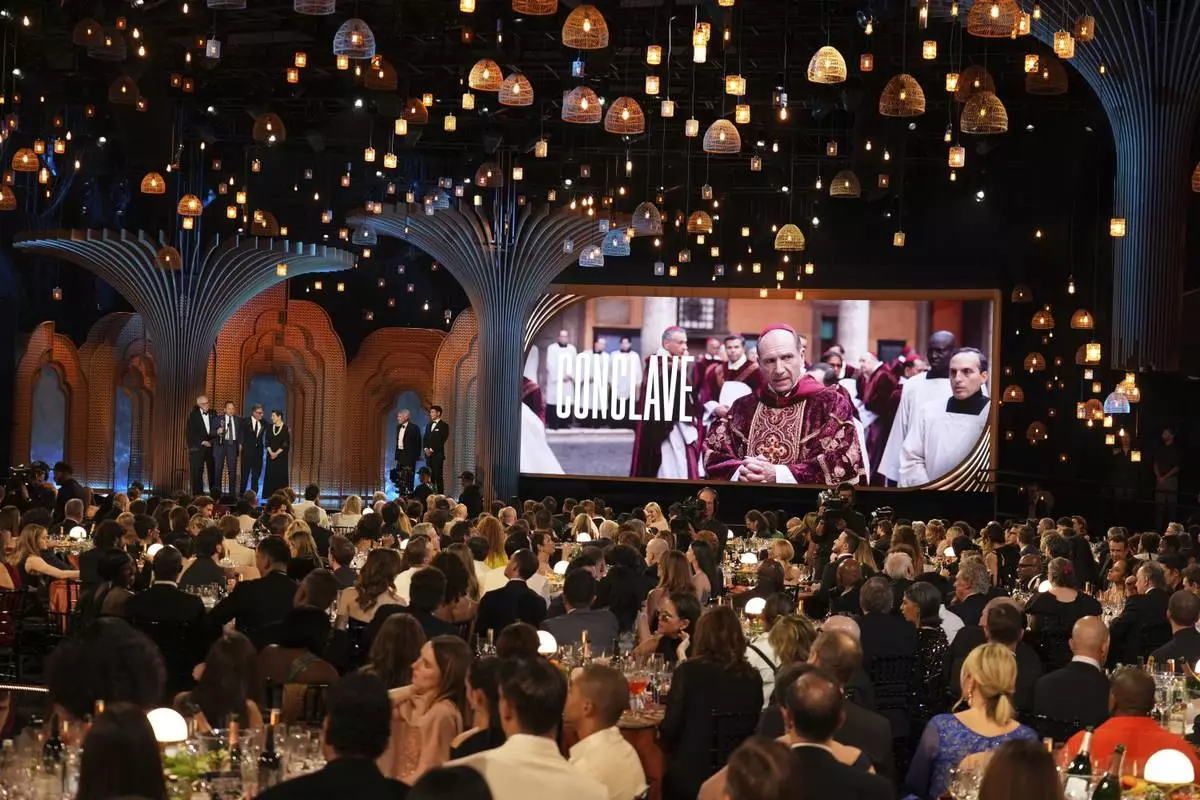
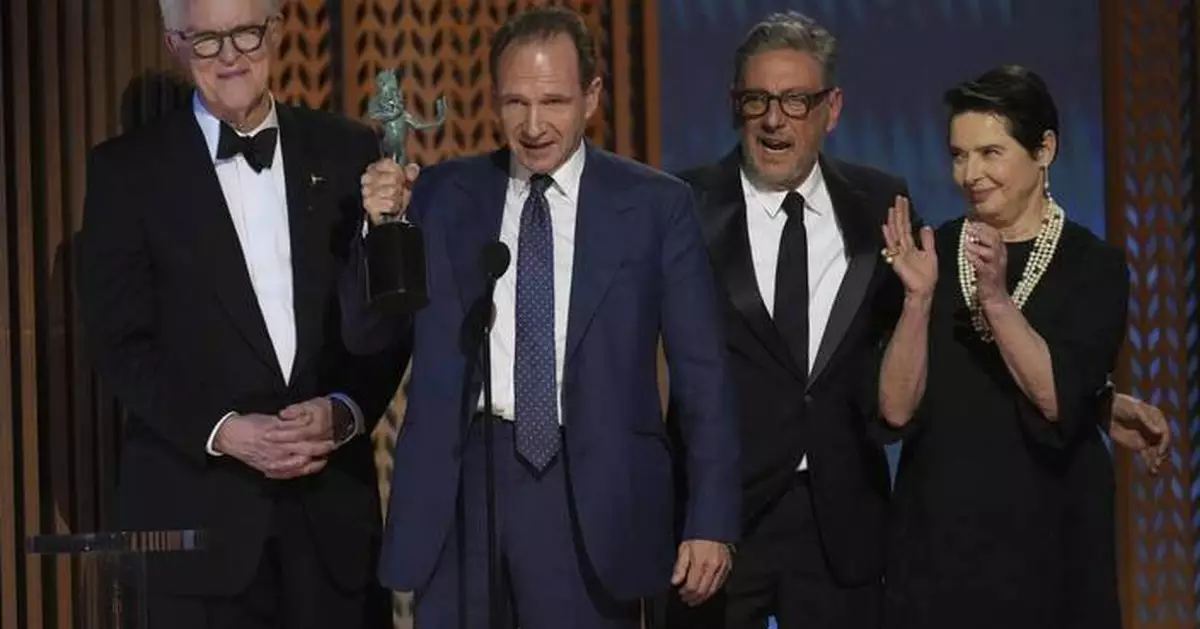
John Lithgow, from left, Ralph Fiennes, Sergio Castellitto, and Isabella Rossellini accepts the award for outstanding performance by a cast in a motion picture for "Conclave" during the 31st annual Screen Actors Guild Awards on Sunday, Feb. 23, 2025, at the Shrine Auditorium in Los Angeles. (AP Photo/Chris Pizzello)
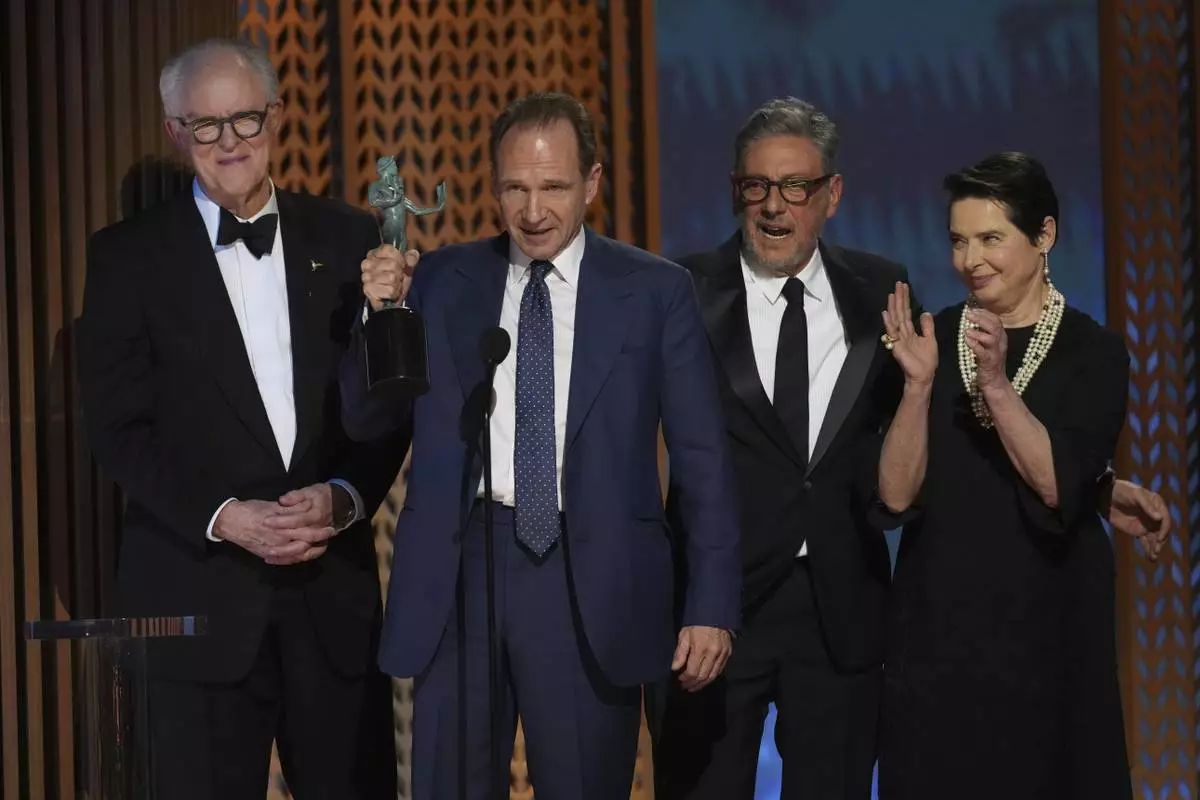
John Lithgow, from left, Ralph Fiennes, Sergio Castellitto, and Isabella Rossellini accepts the award for outstanding performance by a cast in a motion picture for "Conclave" during the 31st annual Screen Actors Guild Awards on Sunday, Feb. 23, 2025, at the Shrine Auditorium in Los Angeles. (AP Photo/Chris Pizzello)