Extensive sand control projects have been recently launched in north China's Inner Mongolia Autonomous Region, and in Xinjiang Uygur Autonomous Region, northwestern China, to curb desert expansion.
The sand control efforts in Inner Mongolia were unrolled Friday in the Alxa Right Banner to effectively combat the encroachment of the Badain Jaran Desert, the Tengger Desert, and the Ulan Buh Desert. The project aims at finishing building the last section of a sand prevention belt within six months.
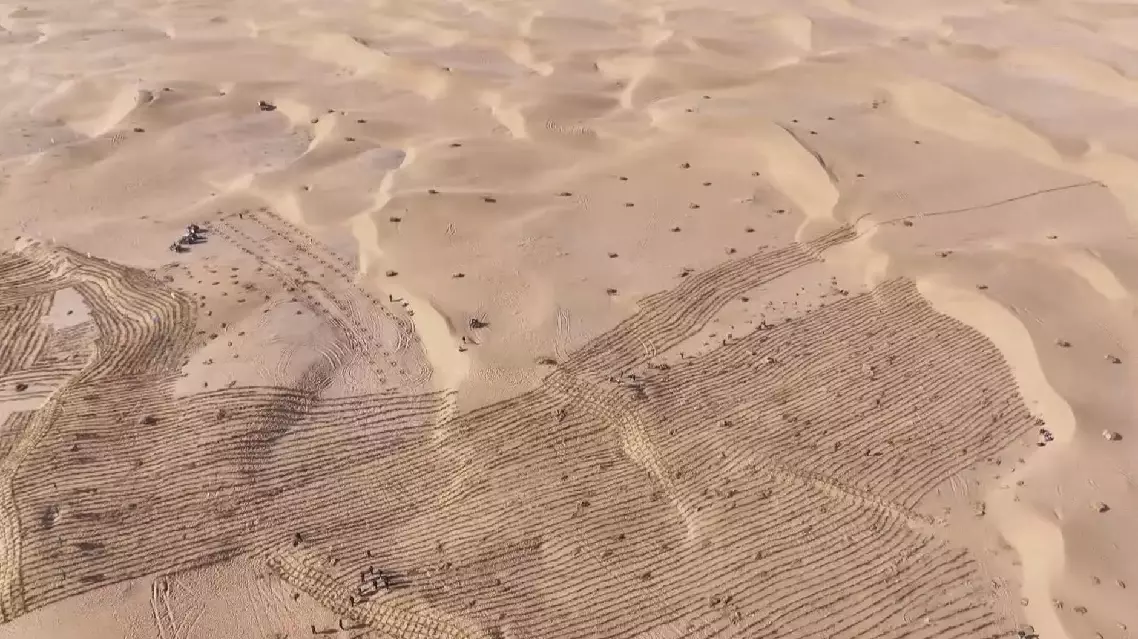
At the desertification control site, workers were seen busy laying straws on the desert.
"We are using straws to build grids that measure one meter in length and one meter in width [on the desert], and then we will plant seedlings within the grids," said Zhang Youyong, chief engineer at the Alxa Right Banner Forestry, Grassland and Desertification Control Bureau.
With a total sandy area of 196,900 square kilometers, Alxa League has one of the highest levels of desertification in China.
Pan Jingjun, deputy director of the league's forestry and grassland administration, said the region is now finishing building the last section of its sand control belt so that the areas lying downstream along the Yellow River can have a safe ecological environment.
"We have finished building 1,425 kilometers of sand control belt, but still have 430 kilometers more to do. We will work to complete the final section by solar photovoltaic sand control, tree planting, vegetation restoration, and engineering sand fixation to safeguard the ecological security of the Hexi Corridor, Ningxia Plain, and Hetao Plain that lie downstream along the Yellow River," said Pan.
As the weather become warmer, sand control efforts were also continued in Xinjiang's Yutian County, with locals planting roses to halt the encroachment of the Taklimakan Desert.
"Roses have a robust root system and the lateral roots sprout and branch out very quickly. They can grow into a flower wall about two to three meters wide within two to three years, which serves as a thick vegetation barrier that keeps the wind out, thus significantly reducing the harm of sandstorms." said Cai Xianfu, Party Secretary of Arele Village in Alxa Right Banner.
Local authorities said the county will plant about three million rose plants in this Spring.
"This year, the desertification control project in Yutian County will cover over 307 square kilometers of land. Among them, solar photovoltaic sand control method will be used for 22 square kilometers of desert, engineering sand control will be applied to 20 square kilometers, and biological sand control will be used for 267 square kilometers," said Jiang Donghui, deputy director of Yutian County Forestry and Grassland Administration.
Inner Mongolia, Xinjiang continue to advance initiatives against desertification

Inner Mogolia, Xinjiang continue to advance initiatives against desertification