Tensions between the United States and Iran are escalating as both sides have issued strong statements regarding the opening of the strategic Strait of Hormuz.
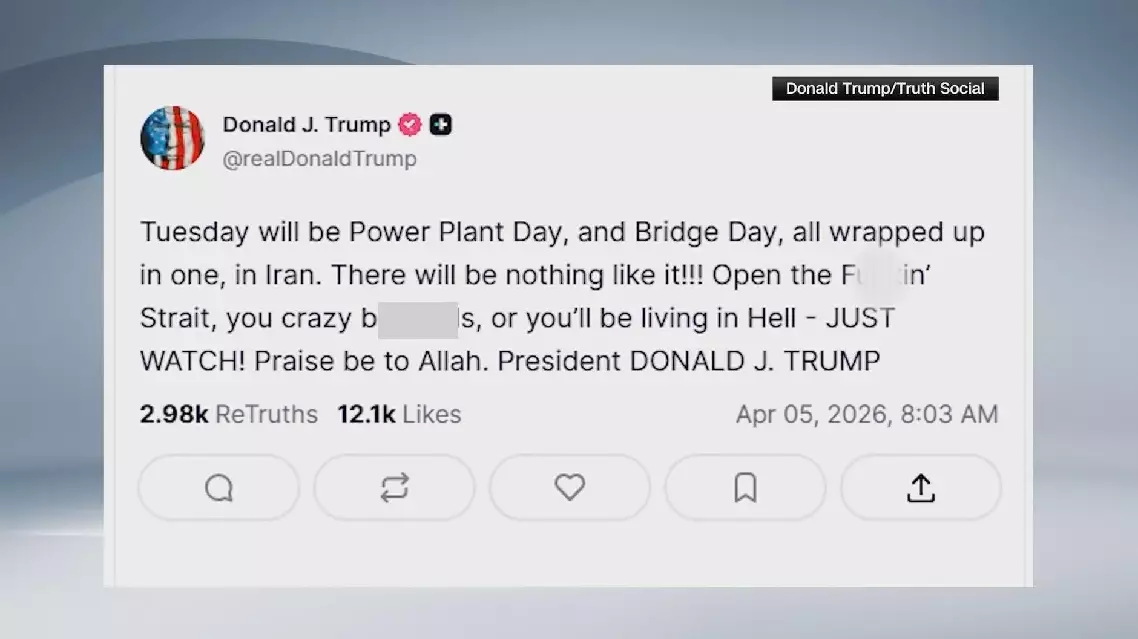
U.S. President Donald Trump on Sunday renewed his demand for Iran to open the Strait of Hormuz and issued a fresh threat on social media, Warning that if Iran failed to comply, "Tuesday will be power plant day and bridge day," hinting at severe bombardment of Iranian power stations and bridges.
Trump posted "Tuesday, 8:00 p.m. Eastern Time!" later on Sunday, a message that appeared to signal a possible extension of the deadline for Iran to reopen the strait.
On March 21, Trump threatened to "hit and obliterate" Iranian power plants if the country fails to fully open the strait within 48 hours. Two days later, he postponed strikes on power plants for five days, claiming to have held "productive conversations" with Tehran.
On March 26, Trump again pushed the deadline back, saying that he will pause planned strikes on Iranian energy facilities for 10 days, to April 6, the upcoming Monday at 8 p.m. Eastern Time. On Saturday, Trump reaffirmed that Iran has 48 hours to strike a deal on opening up the strait or face "Hell."
In response to Trump's threats, Iran has said that "the Strait of Hormuz will never return to its former state."
Iran's Supreme Leader Mojtaba Khamenei posted on Sunday on social media that the Iranian people's will is to continue effective national defense operations, and the blocking of the Strait of Hormuz, a strategic leverage, must continue to be utilized.
The Islamic Revolutionary Guard Corps (IRGC) Navy Command announced on the same day that its forces are completing operational preparations to establish a "new order" in the Persian Gulf, asserting that "the Strait of Hormuz will never return to its former state, especially for America and Israel."
Iran's Foreign Ministry spokesman Esmaeil Baghaei on Sunday condemned Trump's threats to attack Iran's critical infrastructure, including energy facilities, as "incitement for war crimes and crimes against humanity."
He affirmed that Iran will respond decisively to any attacks on its infrastructure, including striking U.S. or related facilities.
Iranian Parliament Speaker Mohammad Bagher Ghalibaf said on the same day that Trump's actions are dragging the United States into hell, causing suffering to every American family, and that the entire Middle East would be engulfed in war due to Trump's insistence on following Israeli Prime Minister Benjamin Netanyahu's policies.
Ghalibaf warned that Trump would gain nothing from war, and that the only viable solution is to respect the rights of the Iranian people and end this dangerous game.
Also on Sunday, the Iranian Permanent Mission to the United Nations issued a statement, accusing the United States of intending to drag the Middle East into an endless war.
The statement highlighted that Trump's earlier threats to bomb Iranian power plants and bridges aimed at destroying Iran's civilian infrastructure, which is a direct provocation against civilians and clear evidence of an attempt to commit war crimes.
It called on the international community to take immediate actions to prevent such egregious war crimes from occurring.
US, Iran exchange harsh rhetoric regarding opening of Strait of Hormuz
US, Iran exchange harsh rhetoric regarding opening of Strait of Hormuz
US, Iran exchange harsh rhetoric regarding opening of Strait of Hormuz