Skip to Content Facebook Feature Image

Chinese scientists make new breakthrough in quantum computing

China

China

China

Chinese scientists make new breakthrough in quantum computing

2025-03-04 17:32 Last Updated At:18:57

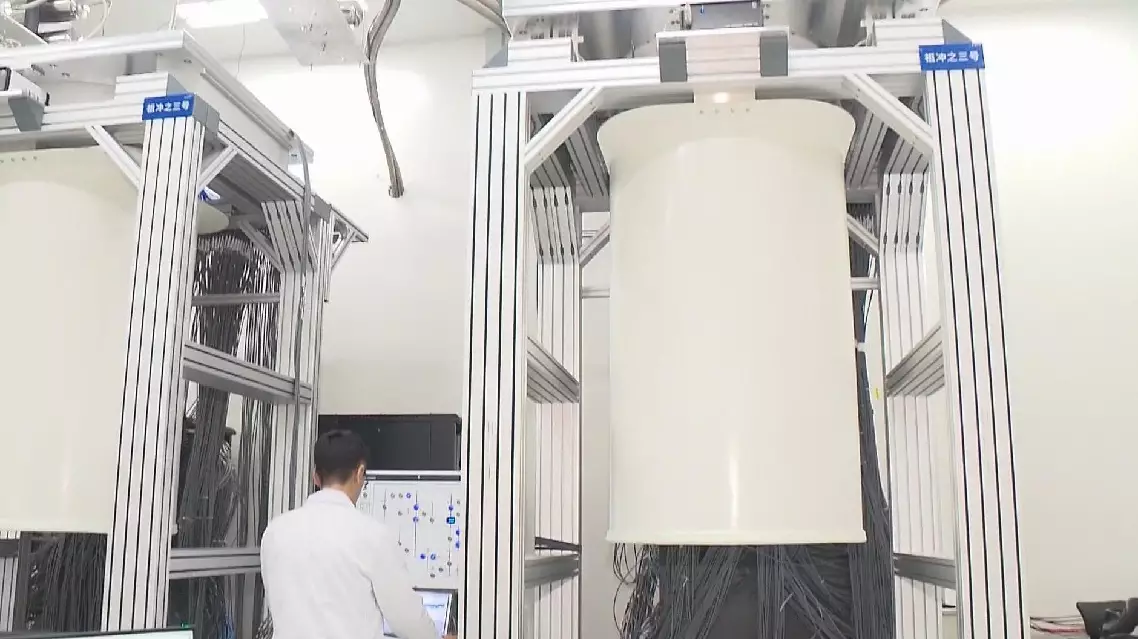
Chinese scientists unveiled a superconducting quantum computer prototype named Zuchongzhi 3.0 with 105 qubits on Monday, marking a breakthrough in China's quantum computing advancements.

The achievement also sets a new record in quantum computational advantage within superconducting systems.

Developed by a team from the University of Science and Technology of China (USTC) in collaboration with several domestic research institutions, Zuchongzhi 3.0 features 105 readable qubits and 182 couplers. It processes quantum random circuit sampling tasks at a speed quadrillion times faster than the world's most powerful supercomputer and 1 million times faster than Google's latest results published in Nature in October 2024.

Quantum computational advantage, also known as "quantum supremacy," refers to the point where quantum computers outperform the most advanced classical supercomputers in specific tasks. This milestone not only validates the feasibility of quantum computing but also serves as a direct indicator of a nation's research strength in this field.

Currently, China and the United States are the two global frontrunners in quantum computing research, with each country alternately achieving groundbreaking advancements.

In 2019 and 2020, the United States and China, respectively, launched their quantum computing prototypes, Sycamore and Jiuzhang, achieving quantum supremacy. In 2021, China successfully developed a 66-qubit programmable superconducting quantum computing system named Zuchongzhi 2.1, making it the first country to achieve a quantum computational advantage in two mainstream technical routes.

According to the research team, Zuchongzhi 3.0 significantly enhances key performance metrics compared with its predecessor, Zuchongzhi 2.1, achieving a globally leading level of quantum computational power.

"This machine has reached new heights in terms of readout precision and control precision of quantum computing," said Zhu Xiaobo, a professor of USTC, highlighting the prototype's advanced capabilities.

The study was published online in the journal Physical Review Letters. Peer reviewers praised the work, calling it "benchmarking a new superconducting quantum computer, which shows state-of-the-art performance" and "a significant upgrade from the previous 66-qubit device."

The global scientific community has outlined a three-step roadmap for experimental quantum computing development. The first step is achieving quantum supremacy; the second step involves developing quantum simulators with hundreds of controllable qubits to tackle real-world problems beyond the capabilities of supercomputers; and the third step focuses on substantially improving qubit control precision, integration scale and error correction to develop programmable, general-purpose quantum computers. Eventually such a machine could revolutionize artificial intelligence, biotechnology, pharmaceuticals, and national security.

"With gradual decrease of error rates, we can eventually achieve an extremely low error rate, paving the way for a fault-tolerant general quantum computer, which could fundamentally transform the entire landscape of information processing. It will also have a fundamental impact on national security, including artificial intelligence, biology, and pharmaceutical production," Zhu said. According to Zhu, the team is currently conducting surface code error correction research with a code distance of 7. After making progress, they will extend it to 9 and 11, paving the way for large-scale qubit integration and control.

The superconducting quantum computer is named after Zu Chongzhi (429-500),the renowned 5thcentury Chinese mathematician and astronomer.
Chinese scientists make new breakthrough in quantum computing
Chinese scientists make new breakthrough in quantum computing
A video featuring a former member of Unit 731, a notorious Japanese germ-warfare unit during World War II (WWII), was released on Thursday in northeast China's Harbin, revealing details of how the unit used meteorological data to conduct horrific bacterial experiments on human beings.

The video was released by the Exhibition Hall of Evidence of Crimes Committed by Unit 731 of the Japanese Imperial Army, in which former Unit 731 member Tsuruo Nishijima detailed how the unit used meteorological data to carry out a bacterial dispersal experiment.

The video was recorded in 1997 by Japanese scholar Fuyuko Nishisato and donated to the exhibition hall in 2019, according to the hall, which was built on the former site of the headquarters of Unit 731 in Harbin, the capital city of Heilongjiang Province.

Jin Shicheng, director of the Department of Publicity, Education and Exhibition of the exhibition hall, said that Nishijima joined Unit 731 in October 1938 and served in the unit's meteorological squad. The squad was not a simple observation section but rather an auxiliary force supporting the unit's field human experiments by measuring wind direction, wind speed, and other conditions to ensure optimal experimental results, according to Jin.

Nishijima confirmed in the footage that "the meteorological squad had to be present at every field experiment." He testified to the "rainfall experiments" conducted by Unit 731, which involved aircraft releasing bacterial agents at extremely low altitudes.

At a field-testing site in Anda City, Heilongjiang, Unit 731 aircraft descended to about 50 meters above the ground. They sprayed bacterial culture liquids onto "maruta" -- human test subjects -- who were tied to wooden stakes. Each experiment involved about 30 people, spaced roughly 5 meters apart. After the experiments, the victims were loaded into sealed trucks and transported back to the unit, where their symptoms and disease progression were recorded over a period of several days.

"Unit 731's bacterial weapons were dropped by aircraft from a height of 50 meters in the open air. Therefore, the meteorological squad needed to observe wind direction and speed, which directly affected the precision and accuracy of the bacterial weapons deployment," said Jin.

Nishijima recounted the harrowing experience of the human test subjects.

"They were fully aware that inhaling the substances would certainly lead to death, so they closed their eyes and held their breath to avoid breathing them in. Their resistance prevented the experiment from proceeding. To compel them to comply, they were forced at gunpoint to open their mouths and lift their heads," said Nishijima.

These experiments, disguised as "scientific research," were in fact systematic tests of biological warfare weapons conducted by the Japanese military. The data generated from these inhumane activities became "research findings" shared among the Japanese army medical school, the medical community, and the military at large.

"At that time, the entire Japanese medical community tacitly approved, encouraged, and even participated in the criminal acts of Unit 731. The unit comprised members from Japan's medical and academic sectors who served the Japanese war of aggression against China. Thus, Unit 731 was not just a military unit but represented an organized and systematic criminal enterprise operating from the top down," said Jin.

Unit 731 was a top-secret biological and chemical warfare research base established in Harbin as the nerve center for Japanese biological warfare in China and Southeast Asia during WWII.

At least 3,000 people were used for human experiments by Unit 731, and Japan's biological weapons killed more than 300,000 people in China.

Video offers details of Japan's germ-warfare crimes in northeast China

Video offers details of Japan's germ-warfare crimes in northeast China

Recommended Articles