Deputies to the 14th National People's Congress (NPC) have proposed suggestions to advance the strategy of invigorating China through science and education, as well as to promote development through innovation, during meetings at the NPC's third session.
Their suggestions echoed the government work report delivered by Chinese Premier Li Qiang at the opening meeting of the annual NPC session on Wednesday, emphasizing efforts to implement the strategy, uphold innovation-driven development, and unlock the potential of the digital economy.
Huang He, a deputy to the NPC from southwest China's Sichuan Province, said the report highlights China's breakthroughs and achievements in scientific research, which have significantly boosted confidence among the Chinese people.
He called for greater efforts to establish Sichuan as a key hub for innovation in western China.
"Chengdu serves as an innovation hub in western China, gathering a large number of original research and development achievements. I suggest accelerating the development of the Chengdu metropolitan area while positioning Sichuan as a key support area for the national strategic hinterland and a core hub for strategic backup. Additionally, I propose categorized support, with large cities focusing on original innovation and medium-sized and small cities providing synergistic support for the application and industrialization of innovation achievements. This will help Meishan develop into a pilot transformation base for western China," said Huang, who is also the secretary of the Communist Party of China (CPC) Committee in Meishan City, Sichuan Province.
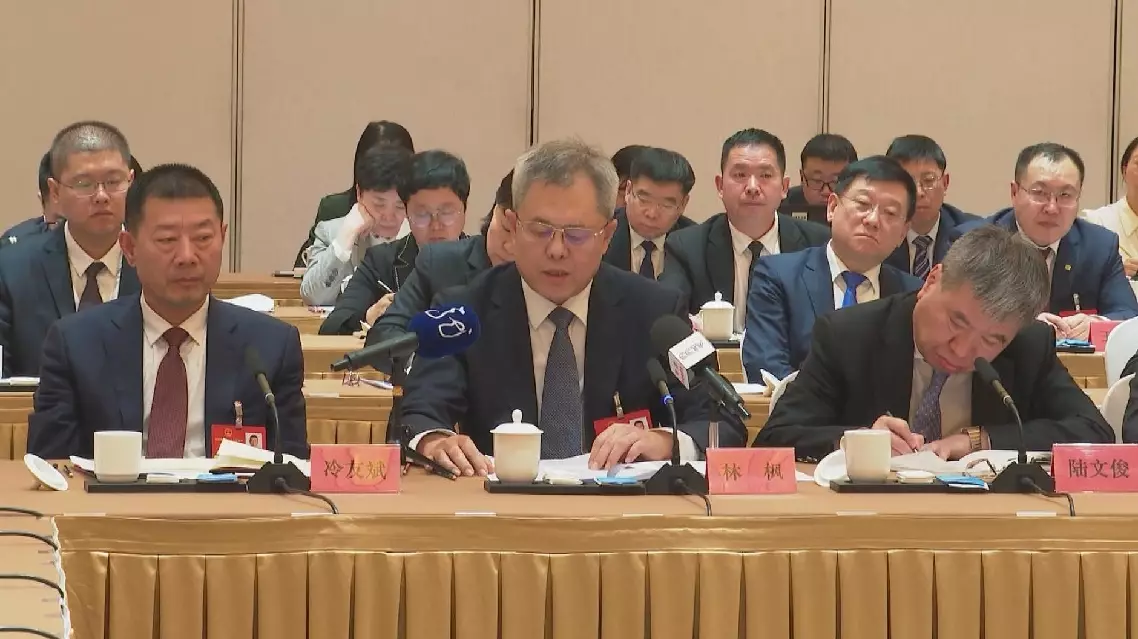
Lin Feng, a deputy to the NPC from northeast China's Heilongjiang Province, said the report outlines the development of new quality productive forces based on local conditions and the overall enhancement of the national innovation mechanism.
"We empower the development of equipment products throughout their life cycle with digital and intelligent technologies. We have built a ship power and high-end energy equipment industry system driven by efficient digital coordination, covering the full industrial chain of research and development, production, equipment supply, and full-life integrated support services. This serves as a core driving force for the high-quality development of the science and technology industry. The advantages of school-enterprise cooperation have been fully leveraged, effectively promoting the deep integration of scientific, technological, and industrial innovation," said Lin, also Party committee secretary and director of the No. 703 Research Institute under China State Shipbuilding Corporation Limited.
Artificial intelligence and robotics are emerging as key drivers of scientific and technological competition, future industries, and economic growth. Li Zheng, an NPC deputy and research and development manager at Guangdong Ucan Robot Technology Co., Ltd., emphasizes the need to strengthen talent development, enhance research on core technologies, introduce targeted policies for industrial autonomy, and improve the ecosystem to expand market applications.
"At present, artificial intelligence and robotics, as representatives of new quality productive forces, are increasingly becoming key frontiers of scientific and technological competition, new tracks for future industries, and new engines for economic development As a researcher in the robotics industry, I have a few suggestions: strengthen talent cultivation and recruitment while advancing research on core technologies; introduce targeted support policies to enhance the autonomy and controllability of the industrial chain; improve the industrial ecosystem and expand market application scenarios," Li said.
Jin Li, an NPC deputy from Shanghai, called for fully leveraging China's advantages in education to cultivate more innovative talent.
"Facing the tide of innovation and global changes, we urgently need to cultivate a large number of young talents who enjoy thinking from the root to solve problems and quickly transform the advantages of a major education powerhouse into those of an innovation-driven nation. Therefore, schools need to establish pilot zones for basic research and top innovative talent training, enhance innovation capability training, and build a strong ecosystem for innovation. Meanwhile, we need to cultivate individuals with a broad vision and foster high-potential, multi-talented "stem cell-like" talents to best prepare for a rapidly changing world. Our reform should empower students to independently build and shape their knowledge structures to meet the country's needs for top-tier innovative talent," said Jin, also an academician of the Chinese Academy of Sciences and the president of Fudan University.
NPC deputies propose suggestions to boost education, innovation

NPC deputies make suggestions on education, innovation in echo with gov't work report